
Most HVAC articles will tell you to buy the highest-efficiency system you can afford, pick a well-known brand, and let the SEER rating make the decision for you.
That advice is incomplete, and in Houston, incomplete advice can cost you thousands of dollars and years of discomfort.
The best HVAC system for a Houston home is the one that handles humidity correctly, fits your household’s lifestyle, and makes financial sense over the full time you plan to own that home.
That’s a different question than “which system has the best efficiency rating”, and it deserves a more honest answer.
Before we talk about specific system types, it helps to understand why standard HVAC advice often falls short here.
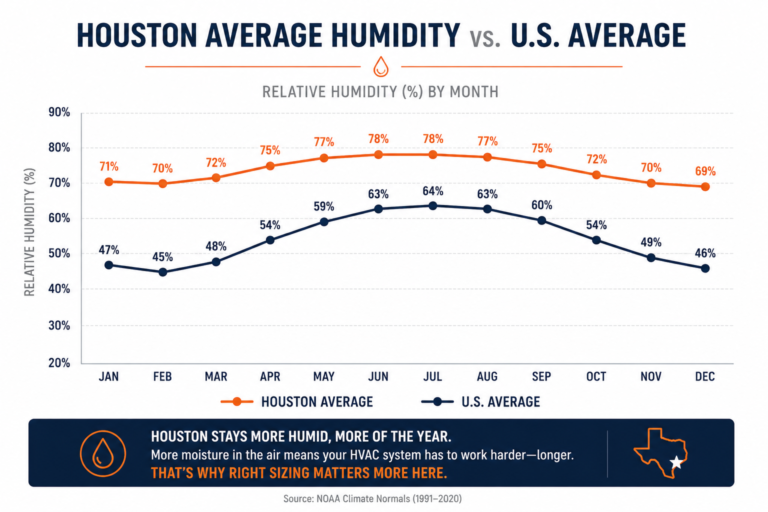
Houston’s challenge isn’t just heat—it’s humidity. The region averages nearly 50 inches of rainfall per year, and relative humidity stays in the mid-70s for most of the year.
Here’s something worth understanding: your AC system actually has two jobs. The first is cooling the air down to the temperature on the thermostat. The second, and this is where Houston gets complicated, is pulling moisture out of the air so the home feels comfortable, not just cool.
In most of the country, the temperature piece is the bigger challenge. In Houston, both are constant demands, running simultaneously for months at a time. That changes everything about how a system should be sized and selected.
A house can sit at 72 degrees and still feel miserable if the humidity is high. If you’ve ever walked into a home in August that felt perfectly cooled but somehow still uncomfortable, that’s exactly what was happening.
The other factor unique to this region: our cooling season is relentless. From roughly April through October, systems in Cypress and Katy run harder and longer than in any other metro in the country. That changes the wear-and-repair math significantly.
If you’ve been wondering why your home feels sticky even when the AC is running, we go deeper on this in Why Your House Feels Humid (and Why It Gets Worse During Allergy Season).
When Houston homeowners think about replacing their HVAC system, the instinct is often to size up. More capacity, more power, more assurance the system can handle August.
That instinct is understandable. It’s also one of the most common and costly mistakes in residential HVAC.
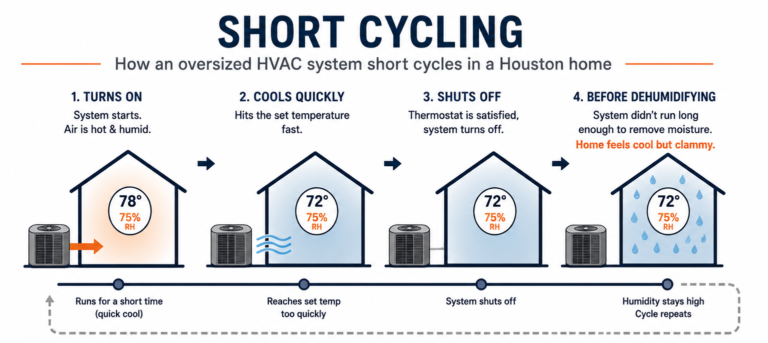
Here’s why: an oversized system cools a home too quickly. It hits the thermostat’s target temperature and shuts off before it’s had enough time to pull moisture out of the air. This is called short cycling—the system runs in brief, frequent bursts rather than sustained cycles.
Short cycling causes three real problems:
Many humidity problems in Houston homes are actually oversized AC problems.
The Air Conditioning Contractors of America (ACCA) publishes a protocol called Manual J that governs proper system sizing for a specific home. Manual J accounts for square footage, ceiling height, insulation, window placement, local climate data, and other variables specific to your structure. A system sized by Manual J will almost always be smaller than what a homeowner assumes they need, and it almost always performs better because of it.
We wrote a full guide on the signs that your current system may be the wrong size: 7 Signs Your HVAC System Is the Wrong Size. Worth reading before you replace anything.
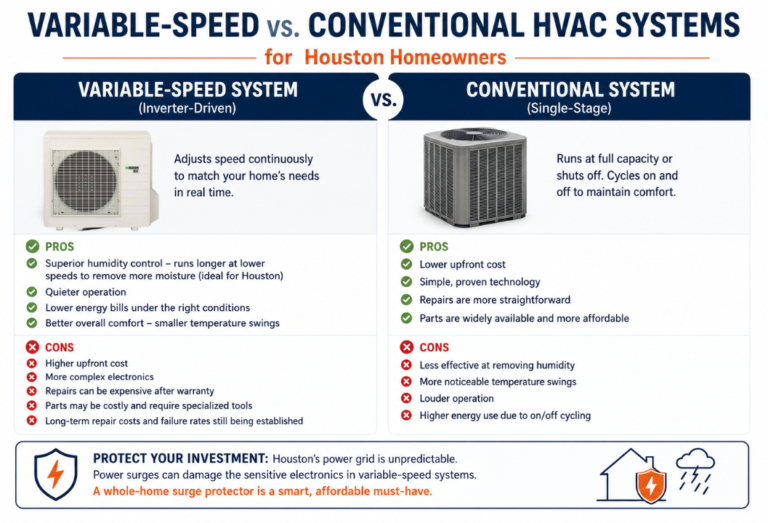
Variable-speed systems, sometimes called inverter-driven systems, are legitimately impressive. Instead of running at full blast or not at all, they constantly adjust how hard they’re working based on what the home needs in real time.
The compressor slows down on mild days and ramps up when demand increases, rather than cycling fully on and off.
The benefits are real:
These are not marketing claims. For homeowners who value premium comfort and plan to stay in their home for the long term, a well-installed variable-speed system can be an excellent investment.
But here’s what the efficiency conversation often leaves out: repair costs after the warranty period.
Variable-speed systems contain significantly more sophisticated electronics than conventional units: Smart controls, circuit boards, and components that enable the system to adjust its output continuously. When something goes wrong, the repair usually requires manufacturer-specific tools and parts that aren’t sitting on any service truck:
The efficiency savings are predictable. The repair costs are not.
That’s not an argument against variable-speed systems. It’s an argument for going in with clear eyes about the full economics. Not just the monthly utility savings, but what happens when something needs to be fixed five or seven years after the warranty expires.
One step that makes particular sense for variable-speed system owners in Texas: whole-home surge protection. If you’ve lived in the Houston area for any length of time, you already know the Texas power grid has a reliability problem.
Power surges when electricity flickers back on, spikes from nearby lightning strikes during storm season, and general grid instability are regular realities here, not rare events. The electronics inside a variable-speed system are far more sensitive to those spikes than a conventional unit.
A surge that a traditional AC would shrug off can knock out the smart controls in a newer variable-speed system and leave you with a repair bill in the thousands. A whole-home surge protector, installed at the electrical panel, protects that investment for a fraction of what a single electronics repair costs. It’s worth asking for it as part of any installation.
For a deeper look at the full cost of replacing a system in this area, including what different tiers actually run: How Much Does It Cost to Replace an HVAC System in Cypress & Katy?
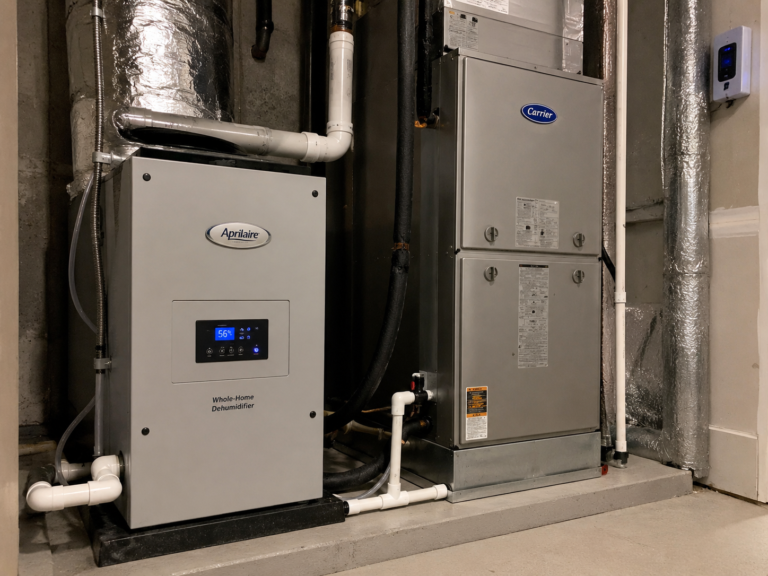
If the primary goal is humidity control with more financial predictability, there’s another path worth understanding.
This matters in Houston because humidity doesn’t take a season off. On a mild October day when the temperature is comfortable and the AC isn’t running, the humidity inside a Houston home can climb fast. A standalone dehumidifier addresses that regardless of whether cooling is called for.
This isn’t the right solution for every homeowner. But for those who want to manage indoor air quality without tying their entire comfort system to one complex machine, it deserves serious consideration.
For more on what actually affects the air quality in your home beyond just temperature: What Affects Indoor Air Quality? 5 Factors Impacting the Air in Your Home
Before comparing systems, it helps to know what you’re actually dealing with. Our complimentary Home Air Quality Snapshot gives you a written assessment of your home’s indoor air quality: humidity levels, what’s affecting them, and what a realistic solution looks like. No equipment purchase required.
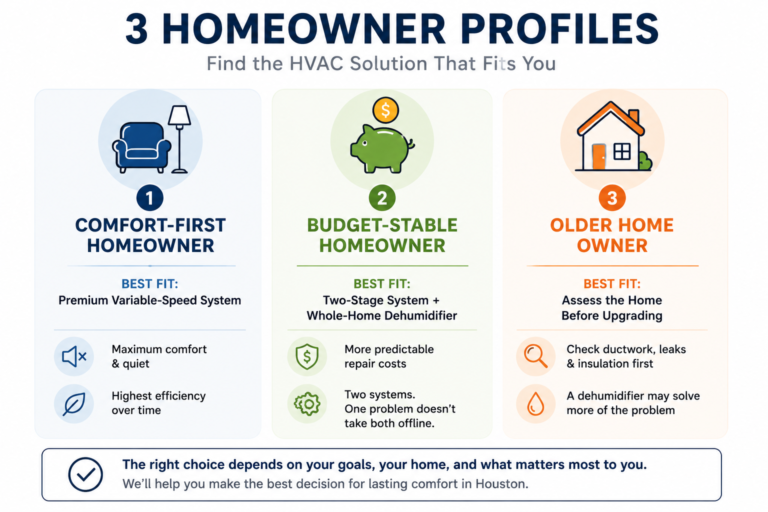
Rather than prescribing one answer, here’s an honest framework. Think about which of these sounds most like your situation.
You plan to stay in this house for ten-plus years. You want the quietest, most efficient, most comfortable system available. Repair surprises are manageable, you have the financial flexibility to handle them when they come. The efficiency savings compound over a long timeline and justify the higher up-front cost and repair complexity.
You want to know roughly what your maintenance and repair costs will look like each year. An unexpected $2,000–$3,000 electronics repair call would be a significant disruption. You’re willing to trade some efficiency upside for substantially more cost transparency over the life of the equipment.
Sometimes the humidity problem isn’t primarily an HVAC problem, it’s a home structure problem. Outside air leaking in through gaps, inadequate insulation, and leaky ductwork can undermine even the best system. Before replacing equipment in an older home, it’s worth having ductwork evaluated. You may find that a whole-home dehumidifier addresses more of the discomfort than a full system upgrade would.
Here’s something most HVAC conversations skip entirely: most major air conditioning brands come from the same upstream manufacturers.
At the top of the supply chain, roughly four or five companies produce the equipment that gets sold under dozens of different brand names. Those same companies source most of their key components from just one or two parts manufacturers. The brand name you recognize from an ad or a neighbor’s recommendation is largely a packaging decision, not a fundamental quality difference.
This doesn’t mean all equipment is identical. It means that choosing between well-regarded brands is a far less meaningful decision than the sales conversation often makes it feel.
What actually matters more than which brand is on the unit is your contractor’s relationship with their distributor.
Every HVAC company buys its equipment through a regional distributor. That relationship determines whether the parts to fix your system arrive within days or are on backorder for weeks. It determines whether your manufacturer warranty gets registered correctly and whether someone handles that paperwork on your behalf, or leaves you to track it down yourself.
For you as the homeowner, that plays out as faster repairs when something breaks, no waiting on parts, and warranty coverage that actually kicks in the way it’s supposed to. The brand name on the unit doesn’t control any of that. Your contractor’s relationship with their supply chain does.
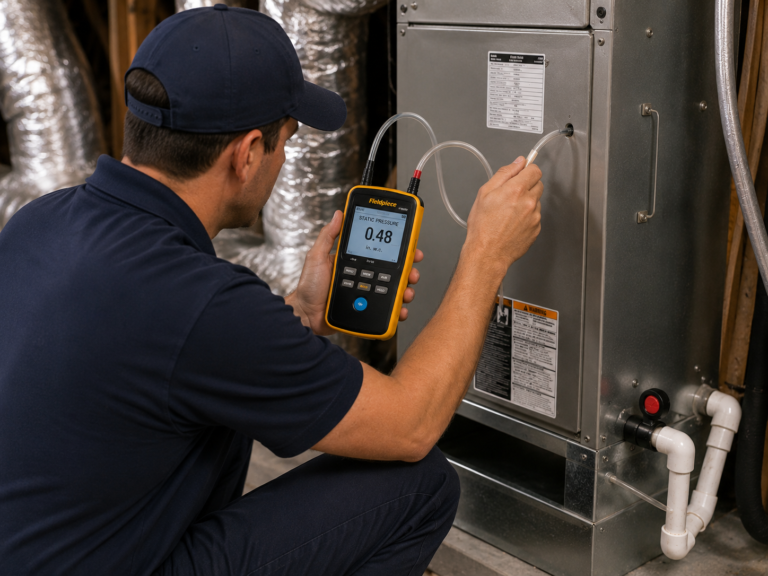
The single factor that most determines how your HVAC system performs — regardless of the brand on the unit — is the quality of the installation.
A correctly installed mid-tier system will outperform a poorly installed premium one almost every time. This is one of the least-discussed facts in HVAC, and it rarely comes up in conversations centered on brand comparisons and SEER ratings.
What correct installation actually requires:
Knowing how to evaluate who’s actually doing the work is as important as knowing what equipment to buy: How to Choose the Right HVAC Company in Cypress & Katy
Here’s the frame that ties this together.
You’re not choosing between a good system and a bad one. You’re making a tradeoff decision. The relevant variables are:
The best HVAC system for a Houston home is the one that balances humidity control, comfort, repair tolerance, and long-term financial reality, not simply the one with the highest efficiency rating on the spec sheet.
If you’re trying to decide between repairing what you have and replacing it entirely, this will help you think through it: HVAC Repair vs. Replace: Why Lifecycle Matters More Than Cost
Not automatically. In Houston, humidity management often matters more than raw efficiency numbers.
A higher SEER rating means a system is more efficient under ideal test conditions. But a system with an outstanding SEER rating and poor dehumidification performance can leave your home feeling clammy even when the temperature is right. Efficiency is one factor but it should be weighed alongside humidity control, proper sizing, and installation quality.
A few signs point in that direction: your home cools quickly but still feels humid, you notice frequent short on-off cycles, or your home feels cool in temperature but sticky in texture.
If any of those sound familiar, it’s worth having the system evaluated. Not replaced necessarily, but assessed with actual measurements rather than assumptions. We cover the specific warning signs in detail in 7 Signs Your HVAC System Is the Wrong Size.
A well-sized variable-speed system running long, slow cycles can handle humidity effectively on its own. A conventional single-stage or two-stage system, or any system that tends to short cycle, may not remove enough moisture, especially during Houston’s shoulder seasons when the AC runs less. If humidity is a persistent problem even with a newer system, a whole-home dehumidifier is worth considering as a separate solution.
Each step up adds comfort and efficiency and adds complexity to the repair equation.
A single-stage system runs at one speed, fully on or fully off. A two-stage system can operate at a lower capacity for mild days and ramp up when needed, improving both comfort and efficiency. A variable-speed (inverter-driven) system adjusts continuously across a wide range of outputs, running slow and steady most of the time. For a full breakdown of system types and costs in this area, see How Much Does It Cost to Replace an HVAC System in Cypress & Katy?
Most systems last 10–15 years here; shorter than the national average, and the reason isn’t equipment quality. It’s workload.
Houston’s cooling season runs from roughly April through October, putting significantly more hours on a system each year than most of the country. Systems that run harder due to oversizing, poor installation, or deferred maintenance often fall short of even that range. Regular maintenance is the single biggest factor in getting full life out of the equipment. If you’re approaching the 10-year mark and experiencing recurring issues, HVAC Repair vs. Replace: Why Lifecycle Matters More Than Cost walks through how to think about that decision.
You came into this article thinking the answer was probably straightforward: find the best brand, buy the highest efficiency rating you can afford, done.
What you actually know now is more specific than that.
The decision depends on how Houston’s humidity changes the math, whether your current system is even the right size, what you’re willing to accept in terms of repair risk, and how long you plan to be in this home.
Those aren’t small variables. They’re the whole question.
The right system is the one that fits your home, your family, and your honest financial picture. In Cypress and Katy, that means taking humidity control seriously from the start, sizing correctly, and understanding what you’re committing to when something eventually needs to be fixed.
If you’re weighing a replacement or trying to understand why your current system isn’t delivering the comfort you expect, the most useful next step isn’t picking a brand. It’s knowing what your home actually needs.
We offer a complimentary System Replacement Consultation, a measurement-based evaluation of your current system and a clear look at what replacement would actually involve for your specific home, including honest options and financing if you need it.
Schedule at thegeneralhvac.com or call (832) 558-8539.