Jump to section
If you're a Houston-area homeowner staring down another HVAC repair and wondering whether it's time to replace the system, you've probably already noticed something:
Most of the advice out there sounds the same and doesn't actually make the decision any easier.
Someone gives you a repair number. Someone else gives you a replacement number. You read a few articles that say, "If the repair is more than 50% of replacement, just replace it."
And somehow, you walk away less confident than when you started.
I've been there.
Before my husband Adé and I started this company, I was the homeowner trying to make sense of those same conversations. And what became clear, both from my perspective as a physician trained to look at patterns, and from his background as a U.S. Air Force veteran who spent ten years maintaining the kind of equipment your home AC is a small cousin of, is this:
Most HVAC systems don't suddenly fail, they become less reliable over time.
And because of that…
"Repair vs replace" isn't really the decision you're making.
The better question is:
Where is your system in its life cycle and what is the pattern telling you?
What You’ll Learn in This Guide
- How HVAC systems actually age (especially in Houston)
- The three stages every system goes through
- Why one repair doesn't mean much, but patterns do
- How to tell what stage your system is likely in
- What happens when homeowners wait too long to decide
- What your next step should look like
Why "Repair vs Replace" Is the Wrong Frame
One repair is an event. A pattern of repairs is information.
Here's what most homeowners experience:
- The system works fine for years
- Then one small repair
- Then another a year or two later
- Then cooling starts to feel… less consistent
- Then you're suddenly being asked: repair or replace?
The problem is that moment gets framed as a single decision about a single repair.
But your system didn't get there because of one part.
It got there because of:
- Time
- Usage
- Houston climate
- Maintenance history
- Installation quality
If you only ask "Is this repair worth it?" you're solving for today.
If you ask "What is this pattern telling me?" you're solving for the next several years.
The 3 Stages of an HVAC System's Life
Every HVAC system follows the same general life cycle. What changes is how quickly it moves through it.
1. The Reliable Years (0–5 years)
This is when your system just works.
- Consistent comfort
- Minimal repairs
- Little to think about
In a Houston home, this looks like a system that handles August afternoons without drama. You set it and forget it. The only call you should be making during these years is for seasonal maintenance.
2. The Watch Years (5–12 years)
This is where patterns begin but they're easy to miss.
- Occasional repairs
- Slightly longer run times
- Subtle comfort changes
In a Cypress home, this might look like a master bedroom that takes a little longer to cool down than it used to, or a system that's running into the evening when it didn't a few summers ago. Nothing alarming. Just… different.
This stage isn't about reacting, it's about paying attention.
This is also where proper maintenance has the biggest impact on how long your system lasts. Catching small drift early is what keeps watch years from collapsing into wear-out years too soon.
3. The Wear-Out Years (12+ years, often sooner in Houston)
This is where reliability becomes the real issue.
- Repairs happen more often
- Performance drops more noticeably
- Comfort becomes inconsistent
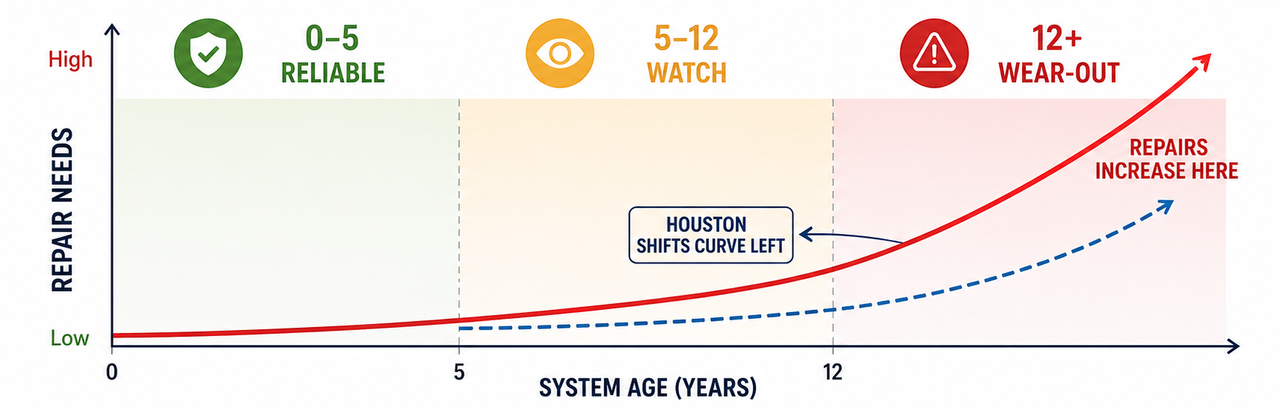
In a Houston home, this often looks like a system that struggles to keep up on the hottest afternoons, humidity that lingers even when the temperature is technically right, and repairs that start clustering closer together.
Two repairs in 18 months.
Then one more six months after that.
The decision point isn't one repair, it's when problems start repeating.
Why HVAC Systems in Houston Age Faster
In Houston, systems don't just age, they're worked harder.
While national averages suggest 15–20 years, most systems here fall closer to 10–15 years. That difference isn't about manufacturer quality. It's about workload.
2–3x more runtime per year
A system in a milder climate runs about 1,000 to 1,400 hours a year. A Houston system runs closer to 2,800 to 3,200.
Cooling season here often starts in March and doesn't fully let up until November.
If two cars are otherwise identical and one drives twice as many miles per year, no one is surprised when it wears out first. HVAC works the same way.
Houston humidity gives your system a second job
This is the part most homeowners feel but never get explained.
Cooling is only half of what your system is doing on a Houston summer day. The other half is dehumidification, physically pulling moisture out of the air and draining it away. With humidity routinely between 75% and 85% during our warm months, that second job is constant and significant.
It's why a system that's technically "cooling" can still leave a home feeling sticky. It's why air that hits 72°F in Houston can feel heavier than 72°F in Denver. And it's why systems here wear in places systems in dry climates don't, coils, drainage, and the components doing the moisture work are under load every time the system runs.
A Houston system isn't running harder because something's wrong. It's running harder because the air itself is harder to condition.
Little nighttime or seasonal recovery
Summer nights stay warm here. Temperatures often hold in the high 70s or low 80s well past midnight, which means your system rarely gets the long off-cycle that systems in cooler climates depend on for recovery.
Spring and fall don't behave gently either. A single week can pull the system between cooling and heating, sometimes within the same day. That kind of switching adds wear that calmer climates simply don't produce.
Frequent cycling in extreme conditions
During our hottest stretches, the system is starting and stopping constantly, and that on-and-off motion adds wear faster than steady running does. The hotter the day, the more the system cycles. The longer the heat wave, the more those cycles stack up.
In Houston, systems often reach later life stages sooner because they've been working harder.
The 3 Types of "Age" That Actually Matter
When people ask, "How old is my system?" they're usually only looking at one number.
But there are three:
1. Calendar Age
How long it's been installed.
It's the number on the data plate, the install paperwork, or the home inspection report. Useful as a starting point but on its own, it doesn't tell you much about the condition.
2. Usage Age
How hard it's been working.
A system in a smaller, well-insulated home that runs at a steady temperature is mechanically nothing like a system in a larger home with leaky ducts that's been running constantly to keep up.
Same year on the label. Very different actual age.
3. Care Age
How well it's been maintained.
- Maintenance can extend life by 2–4 years
- Reactive-only repairs can shorten life by 3–5 years
Two systems with the same install date can be in completely different stages of life.
What Really Determines How Long Your System Lasts
Two factors matter more than anything else: installation and maintenance.
Installation Quality
- Proper sizing (not too big, not too small)
- Correct airflow
- Precise setup
A poorly installed system starts wearing out early, even if it's brand new.
Installation quality usually shows up around year eight, when a system that should still be running well starts wearing out early. By then, the install crew is long gone, and what looked like a good deal up front turns into a system that's quietly costing you years of useful life.
Maintenance History
- Catching issues early prevents bigger failures
- Keeps airflow, drainage, and components working properly
In Houston, maintenance isn't optional if you want your system to last.
A system that runs three times as much accumulates wear three times as fast, and the only way to stay ahead of that is to look at it more often. Twice a year, before each major season, is the standard for our climate.
How to Tell What Stage Your System Is In
You probably already have a sense, you just haven't put it into a framework yet.
Ask yourself:
- Is this the first repair in years, or one of several recently?
- Does your home feel as comfortable as it used to?
- Is humidity harder to control?
- Are energy bills creeping up?
- Has the system been consistently maintained?
Quick Pattern Guide
- Mostly stable, occasional issue → Reliable / Watch phase
- Repeat issues, small shifts → Late Watch phase
- Frequent repairs, noticeable decline → Wear-Out phase
The earlier you recognize the pattern, the more options you have.
What Happens When Homeowners Wait Too Long
Most homeowners don't decide too early. They decide too late.
Here's what that looks like in practice.
A system in its wear-out years gets one more repair in April. Then another in June. By August, the hottest stretch of the year, when the system is working its hardest, it gives up. The homeowner is now making a major decision in 100°F heat, with the house already uncomfortable, with whichever contractor can get out the fastest, and with no time to compare options.
Decisions made under pressure aren't the same as decisions made with time.
When you wait until full failure, three things change at once:
- Your timeline shrinks. What could have been a thoughtful decision over a few weeks becomes a same-week scramble.
- Your options shrink. Equipment availability and installer schedules tighten in peak season. The system you actually want may not be the one that can be installed Thursday.
- Your leverage shrinks. When you're choosing between a hot house and the first quote you can get, you're not really choosing.
The homeowners who feel best about their replacement decisions are almost always the ones who made the call when the system was still running. Not because something dramatic happened but because the pattern was clear, and they'd rather decide on their terms than on the weather's.
Planning ahead keeps the decision yours.
What the Right Next Step Looks Like
The next step is getting a clear picture of what the system is actually doing.
A real evaluation is a set of measurements that answer the questions you actually care about:
- Is the system still moving air the way it should? When airflow drops off, rooms stop cooling evenly and the system has to work longer to do the same job.
- Is it working too hard to do its job? A system that's straining against itself wears out faster, even when nothing has technically "broken" yet. This is one of the most common silent issues in Houston homes, and one most homeowners have never had explained.
- Is it cooling and dehumidifying the way it was designed to? This is what tells you whether the system is keeping up, falling behind, or quietly stressing the most expensive parts inside it.
- Are the components still strong, or starting to drift? Most parts give warning signs before they fail, but only if someone is actually checking.
- Is the system performing the way it should for your specific home? Size, layout, ductwork, and insulation all change what "normal" looks like. A real evaluation accounts for that.
Clarity comes from measurement not assumptions.
A real evaluation also looks at things age alone can't tell you: how the system is set up in your specific home, how the ductwork is performing, and what the maintenance history looks like.
Together, those answers tell you which stage your system is actually in, and what your options realistically are from here.
You don't have to become an HVAC expert to make this decision well. You just need someone willing to measure carefully and give you a clear read.
The Bottom Line
When this started, it probably felt like a math problem.
Repair vs replace. Numbers. Percentages.
But that's not really what this is.
This is a pattern problem, not a pricing problem.
Where is your system in its life? How hard has it been working? What is the trend telling you?
The goal is to understand when repairs stop solving the bigger problem.
A Clearer Way to Think About It
If you take one thing from this article, let it be this framework:
- One repair is an event. A pattern of repairs is information.
- Houston ages systems faster: 10 to 15 years here, not the 15 to 20 you'll read in national articles.
- Three things determine a system's real age: how long it's been installed, how hard it's been working, and how well it's been cared for.
- Installation and maintenance decide whether your system reaches the end of its lifespan or fails years before it should.
- The earlier you recognize the pattern, the more options you have.
That's the whole framework. Everything else is just measurement.
What to Do Next
If you're dealing with repeat issues or just aren't sure where your system stands, the most helpful next step is simple:
Have your system evaluated based on real measurements.
That gives you:
- A clear understanding of what stage your system is in
- What's likely to happen next
- And what your options actually look like
If you're in Cypress, Katy, or the surrounding northwest Houston communities, you can schedule a time to have your home evaluated and get a clear read on your system's condition.
Frequently Asked Questions
How many repairs are too many for an HVAC system?
It's not about the number, it's about the pattern. If repairs are becoming more frequent or closer together, that's a sign the system is moving into a later life stage.
Is it normal for a 10-year-old HVAC system to have issues in Houston?
Yes, 10 years in Houston is not the same as 10 years elsewhere. Because of longer runtimes and humidity, systems here often reach wear-out stages sooner.
Can maintenance really extend the life of my system?
Yes, by several years in many cases. Routine maintenance helps catch small issues early and reduces overall system strain.
Does a higher-end system last longer?
Not necessarily. Installation and maintenance matter more. Even the best equipment can fail early if it's not installed or maintained properly.
Should I replace my system before it fails completely?
In many cases yes, especially if patterns show increasing issues. Waiting for full failure often means dealing with it under pressure, usually during extreme weather.