Jump to section
Has your AC always felt a little off, even when nothing's technically broken?
The thermostat says 74, but the house feels sticky. The system runs all afternoon and never quite catches up. One room is always 4 degrees warmer than the rest. You've adjusted, you've upgraded the filter, you've called someone out and nothing has really fixed it.
There's a good chance the problem isn't the equipment itself. It's the size of the equipment.
Most homeowners assume the HVAC system installed in their home is the right one for their home. It's a fair assumption and unfortunately, it’s often wrong. In Cypress and Katy, improperly sized systems are one of the most common, least-discussed causes of comfort problems in two-story Houston homes.
What You’ll Learn in This Guide
- The 7 signs your HVAC system may be the wrong size
- Whether each sign points to oversizing or undersizing
- What "Manual J" means and why it matters
- What to do next if more than one of these signs sounds like your home
Why HVAC System Sizing Goes Wrong (And Why Manual J Matters)
Before we get into the signs, here's the part most homeowners are never told: an HVAC system isn't sized by square footage alone. Or at least, it isn't supposed to be.
Done correctly, a contractor performs what's called a Manual J load calculation: A room-by-room evaluation of how much heating and cooling your home actually needs.
It accounts for window orientation, sun exposure, insulation, ceiling height, ductwork, and a long list of other factors that affect how your home holds and loses heat.
Done incorrectly a contractor looks at the data plate on the old unit, matches the tonnage, and calls it a day.
When the math is skipped, the homeowner inherits the problem.
The good news is that the symptoms of bad sizing are recognizable once you know what you're looking at. Here are the seven most common ones.
1. Your Home Feels Humid Even When the AC Is Running
This is the most common sizing complaint we hear, and the easiest one to feel.
Your thermostat reads 74. The air feels sticky. The furniture feels slightly damp. You're standing in front of the vent and you're still uncomfortable. Your instinct is to lower the thermostat but that usually makes the problem worse, not better.
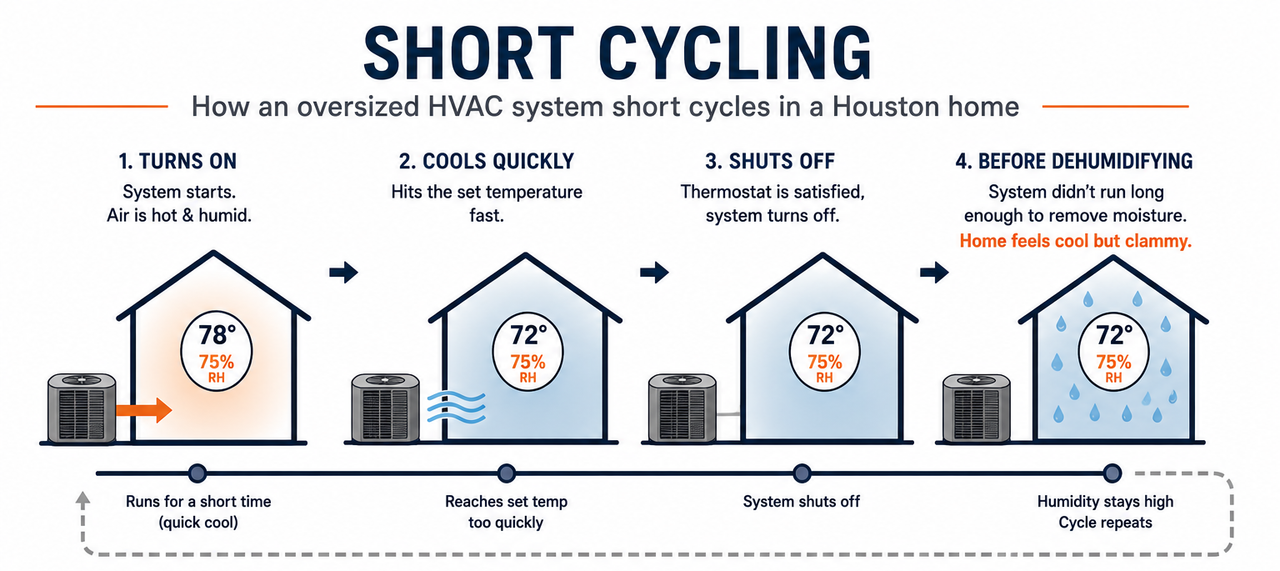
Here's why. Your AC has two jobs: it removes heat and it removes moisture. To remove moisture, it has to run long enough for the indoor coil (the part that actually pulls water out of the air) to do its job.
An oversized system cools the air so fast that it shuts off before that happens.
The temperature drops, the humidity stays, and the house feels worse than the thermostat says it should.
In Cypress and Katy, where outdoor humidity is a fact of life from April through October, this is the symptom that gives oversizing away first.
(Read more: Why Your House Feels Humid (Even With AC Running))
2. Your AC Is Short Cycling (Turning On and Off Frequently)
Short cycling is what you see when oversizing is happening behind the scenes.
The system kicks on, runs for a few minutes, shuts off, and kicks back on a few minutes later. All day, all night, all summer.
A properly sized system runs in longer, gentler cycles; an oversized one sprints, stops, and sprints again.
Short cycling is hard on more than your patience. Every time your system starts up, it uses the most energy it will use during the entire cycle. So when it’s constantly turning on and off, it’s constantly hitting that most expensive moment, and that shows up on your power bill.
It also wears the system down faster. That repeated starting and stopping puts stress on the system over time, which is why short-cycling systems tend to fail earlier than they should.
If you've noticed your outdoor unit kicking on and off in tight intervals, it's worth pairing that observation with sign #1 above. Together, they make a strong case.
3. Your AC Runs All Day but Doesn’t Cool Your Home
This is the mirror image of short cycling and it's how undersizing announces itself.
It's 4 PM in August. Your thermostat is set to 72. The system has been running, without stopping, for hours. The house is at 78 and won't budge. You hear the outdoor unit running every time you walk past the window, and you find yourself blaming "the heat wave". But the truth is, the system simply doesn't have the capacity to cool the home it's installed in.
An undersized system isn't lazy; it's outmatched.
The energy bill tells the same story from a different angle. The system is running constantly, and the meter is spinning the entire time.
Homeowners often assume their bills are high because of the weather, but a system that never gets to rest is a system that never stops costing money.
4. Some Rooms Are Always Hot or Cold (Uneven Temperatures in Your Home)
This one is about specific rooms, on the same floor as the thermostat, that never feel right.
The bonus room over the garage. The west-facing office that bakes from 2 to 6 PM. The guest bedroom at the far end of the hall. The thermostat reads 72 and feels 72 where it's mounted, but that one room is consistently 4 to 6 degrees off.
This is a load calculation problem. A real Manual J accounts for window orientation, sun exposure, room size, ductwork capacity, and how far each room sits from the air handler.
A square-footage-only sizing job will miss every one of those variables.
Some rooms get more conditioned air than they need; others never get enough.
If you're wondering whether this is happening in your home, there's a simple test you can run today: put a $10 thermometer in the problem room and compare it to the thermostat reading at the same moment. A 4 to 6 degree gap during normal operation is real, and it's worth a conversation with a contractor who actually measures.
5. Your Upstairs Is Always Hotter Than Downstairs
If sign #4 is "this room is wrong," sign #5 is "this whole floor is wrong."
In two-story Cypress and Katy homes, it's common for the entire upstairs to run 4 to 6 degrees warmer than the downstairs every afternoon, while the downstairs feels almost too cool. In winter, the dynamic flips: upstairs feels fine and downstairs feels drafty.
Two-story homes have fundamentally different cooling loads on each floor. Heat rises. The second floor sits directly under a hot attic. The first floor sits on a cooler slab.
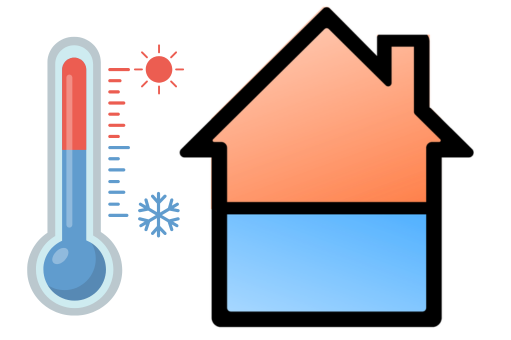
A load calculation done right looks at each floor as its own problem, not as one big number divided by two.
When that step gets skipped, you end up with one system trying to satisfy two very different climates, and neither floor wins.
The most common bad fix, closing downstairs vents to "force more air upstairs", actually makes things worse. It restricts airflow through the system, which can put extra stress on the equipment and still doesn’t move enough air to the rooms that need it most.
The right answers are usually duct rebalancing, zoning, or adding a second system.
This problem is its own conversation. We've written a full breakdown here:
(Read more: Why Is Upstairs Hotter Than Downstairs? (And How to Fix It))
6. Your HVAC System Was Replaced Without a Load Calculation
This sign is a little different from the others. It's not a symptom you feel, it's a piece of history you may know.
When your last system was replaced, did the contractor measure your home? Or did they look at the old unit, write down the tonnage, and quote the same size?
If it's the second one, the math was skipped. And here's why that matters: even if the original system was correctly sized in 2010, the house in 2026 may not be the same house.
New windows shift the load.
A radiant barrier in the attic shifts it.
A finished bonus room shifts it.
A mature tree that came down in a storm shifts it.
An addition shifts it dramatically.
A Manual J load calculation looks at the house as it actually is today, not the house someone sized for fifteen years ago.
This is also where builder oversizing tends to live. New construction in our area is often equipped with systems sized one to two tons larger than the home actually needs, because builders would rather get a few summer warranty calls about "cold spots" than calls about a system that can't keep up.
The first replacement is often the first chance the home gets to be sized correctly, and most homeowners don't realize that's the moment to ask.
If a contractor isn't willing to do a load calculation before quoting your replacement, that's a question worth asking out loud.
7. Your HVAC System Failed Sooner Than Expected
Properly maintained residential HVAC systems generally last 10 to 15 years, sometimes longer. When systems start failing at 7, 8, or 9 years, sizing is often a hidden contributor.
The pattern looks like this:
- An oversized system turns on and off constantly, which wears it down faster over time.
- An undersized system runs nonstop, which puts continuous strain on the system and shortens its lifespan.
- A system that's always fighting its house never gets to run the way it was intended, and small problems accumulate into bigger ones over time.
The cost of getting sizing wrong isn't just discomfort and high bills, it's a $12,000+ replacement years before you should have needed one.
The right size, installed once, costs less over fifteen years than the wrong size installed twice.
What Is a Manual J Load Calculation (And Why It Matters in Houston)
A Manual J load calculation is the process used to determine how much heating and cooling your home actually needs. It’s not based on square footage alone. A proper calculation looks at how your specific home gains and loses heat including: window placement, insulation levels, ceiling height, sun exposure, ductwork, and how air moves between rooms.
In Houston’s climate, where humidity is as much a factor as temperature, this step is critical. A system that cools the air quickly but doesn’t run long enough won’t remove moisture, which is how homes end up feeling cold and humid at the same time.
Without a load calculation, a system is sized on assumptions instead of measurements. That’s how you end up with equipment that either shuts off too quickly or runs constantly without ever catching up.
A Manual J doesn’t guarantee a perfect system on its own, but skipping it almost guarantees problems.
Manual J Isn’t the Only Step (Why Sizing Alone Doesn’t Fix Everything)
Once the load calculation is done, there are two more pieces that determine whether your system will actually perform the way it should.
The first is equipment selection: making sure the system installed matches what the home actually needs. This is where oversizing often still happens, even when a calculation was done.
The second is airflow: making sure the right amount of conditioned air reaches each room. This is what separates a home that feels evenly comfortable from one where certain rooms are always too hot or too cold.
Most homeowners never hear about these steps, but they’re part of the same process.
A system that’s sized correctly on paper still won’t perform if the equipment selection or airflow design is off.
What to Do If Your HVAC System Is the Wrong Size
If you read through this list and recognized two, three, or four of these signs, your system is almost certainly mismatched to your home. That doesn't necessarily mean you need to replace anything tomorrow. It means you've been handed a system that someone else sized for someone else's expectations, and you've been paying the price ever since.
Here's where we'd suggest starting:
- Ask any contractor, including us, whether they perform a Manual J load calculation before quoting a system. If the answer is no, or if the answer is "we'll just match what's there," keep looking. This is the single most important question you can ask.
- Pay attention to how your home is actually behaving this summer. Note which rooms feel off, when they feel off, how long the system runs, and how the home feels when you walk in from the garage. The more specific the symptoms, the better the diagnosis.
- If the system is older than 10 years and you're seeing more than one of these signs, it's worth having someone who measures come out and look. Replacement isn't always the answer; duct rebalancing, sealing, or zoning can sometimes solve the problem without new equipment. But a real evaluation requires real measurement.
If you’re in Cypress or Katy and more than one of these signs sounds familiar, it’s worth having the system measured instead of guessed at.
From there, we can evaluate what the home actually needs and lay out clear options, so you can decide what makes the most sense for how you want your home to feel.
Schedule a system evaluation and see what your system is actually doing.
Frequently Asked Questions
How do I know if my HVAC system is the wrong size?
If your home is consistently humid, has hot and cold spots, or your system either runs constantly or turns on and off frequently, those are strong indicators the system may be improperly sized. These issues often show up long before anything "breaks."
Is it better for an AC unit to be bigger or smaller?
Neither. An oversized system cools too quickly and doesn't remove humidity, which can leave your home feeling damp and uncomfortable. An undersized system runs constantly and struggles to keep up in peak heat. The right size is the one that matches your home's actual load, not a rule of thumb.
Why does my house feel humid even when the AC is running?
In many cases, this points to an oversized system. When the unit shuts off too quickly, it doesn't run long enough to remove moisture from the air. In Houston's climate, that leads to a home that feels cool but still uncomfortable.
Can an HVAC system be fixed if it's the wrong size?
Sometimes. Depending on the issue, solutions like duct adjustments, airflow balancing, or zoning can improve performance without replacing the system. In other cases, especially with significant oversizing or undersizing, replacement may be the long-term fix.
What is a Manual J load calculation, and do I really need one?
A Manual J load calculation measures how much heating and cooling your home actually needs based on factors like insulation, windows, layout, and sun exposure. Without it, system sizing is based on guesswork which is how many comfort problems start.
Why do some contractors skip load calculations?
Because it takes time, and many rely on shortcuts like matching the size of the existing system. The problem is, that approach assumes the original system was sized correctly which often isn't the case.
Will a bigger AC unit cool my house faster?
Yes, but that's not a good thing. Faster cooling means shorter run times, which reduces humidity control and can lead to uneven temperatures. Comfort isn't just about temperature, it's about how the air feels.
How long should an HVAC system last if it's sized correctly?
Most residential systems last around 10–15 years when properly maintained and correctly sized. Systems that are too large or too small often wear out sooner due to short cycling or constant operation.
How much does it cost to fix an improperly sized HVAC system?
It depends on what's actually causing the problem. In some homes, the issue can be improved with duct adjustments, airflow balancing, or sealing, which may cost significantly less than replacing the system. In others, especially when the equipment is significantly oversized or undersized, replacement ends up being the more reliable long-term solution. The important thing to understand is that the cost isn't tied to one fix, it's tied to what the home actually needs. Without measuring the system and how the home is performing, any price you're given is just a guess. If you want a breakdown of what replacement costs look like in our area, your next step is to read our full guide on HVAC system pricing so you can see how those numbers are determined.