Jump to section
If your house feels heavy, sticky, or harder to breathe in lately, you're not imagining it.
Many homeowners in Cypress and Katy notice this around spring, when allergy season ramps up, but what they're actually feeling isn't just pollen.
It's often humidity.
So why does your home feel worse during allergy season, even indoors? And what does humidity have to do with it?
In this article, we'll break down how humidity, airborne particles, and your HVAC system all interact so you can understand what's actually happening in your home, and what you can do about it.
Why Your Home Feels Worse During Allergy Season
What Humidity Has to Do With It
Most people think of allergies as an outdoor problem. But your home plays a bigger role than you might expect.
Every time you:
- Walk inside
- Open a door
- Run your HVAC system
…you're bringing particles into your home: pollen, dust, debris from outside. And once those particles are inside, they don't just disappear.
They stay in the air and your HVAC system determines what happens next.
You might have tried a portable air purifier in one room, and for many people, that actually helps. If you have a specific area where symptoms feel worse, like a bedroom, a room purifier can make a noticeable difference.
But if you find yourself needing one in multiple rooms, that's usually a sign that what you're dealing with isn't a single-room issue. It's something happening throughout the home. And that's where your HVAC system, and things like humidity, start to play a bigger role.
How Humidity Affects How Your Home Feels
Why Humidity Matters More Than You Think
Here's where things start to connect.
If your home feels sticky, heavy, or "off," humidity is usually involved. If your home feels uncomfortable even when the temperature looks right, humidity is often the reason.
And during allergy season, it plays an even bigger role.
When there's too much moisture in the air:
- Particles stay suspended longer
- The air feels heavier
- Your body doesn't cool itself as effectively
That means allergens linger in the air instead of settling, your home feels harder to breathe in, and your system has to work harder to keep up.
When humidity is high, your home doesn't just feel uncomfortable, particles stay in the air longer, making it harder to breathe.
Think of it this way: your body cools itself by sweating, and sweat cools you as it evaporates. But when the air is already full of moisture, that process slows down. So even if your thermostat reads 72°F, the air can still feel heavy and uncomfortable because temperature and humidity are two different things.
Why Humidity Problems Are Worse in Houston Homes
In Cypress and Katy specifically, this becomes even more noticeable because of:
- Consistently high outdoor humidity
- Long cooling seasons
- Homes that are tightly sealed
That means your system isn't just cooling your home. It's constantly trying to remove moisture from the air. And during spring, when temperatures are milder, your AC may not run long enough to do that effectively.
The EPA specifically notes that in warm, humid climates, outdoor air can introduce additional moisture into the home even when its relative humidity appears lower than indoors. That makes the problem more persistent here than in drier parts of the country. Your system is fighting outdoor conditions every time a door opens, every time the attic isn't properly sealed, and every time air moves through ductwork that isn't airtight.
Humidity affects how your home feels just as much as temperature, sometimes more.
Why Allergy Season Makes Humidity Problems More Noticeable
During allergy season, more particles, pollen, dust, and debris, are constantly entering your home. But the key issue isn't just that there are more particles. It's how those particles behave once they're inside.
When humidity is high:
- Particles stay suspended in the air longer
- They circulate more easily through your home
- They're more likely to be breathed in
At the same time, spring temperatures in Houston are often mild enough that your AC doesn't run for long stretches. When the system runs in short cycles, it doesn't have time to pull meaningful amounts of moisture out of the air.
That combination (more particles and higher humidity) is what makes your home feel noticeably worse during allergy season, even indoors.
How Your HVAC System Controls Humidity
Most people think their AC system just cools the air. But it actually does two jobs:
- Removes heat
- Removes humidity
Here's how it works: as air passes over the cold evaporator coil, moisture condenses into water, similar to how water forms on the outside of a cold glass. That moisture drains away, which is how your system helps control humidity.
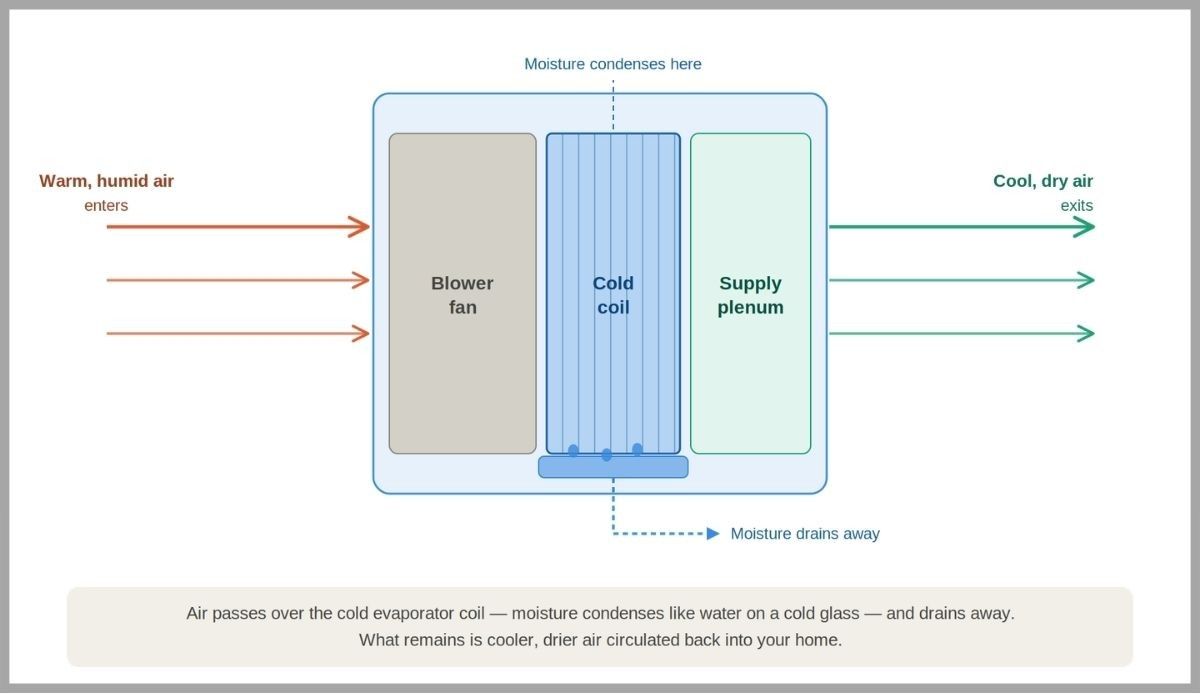
This system is simplified to demonstrate one concept.
When the system is working properly and running long enough, it maintains both comfortable temperatures and comfortable humidity levels. When something is off, one or both of those suffer.
An oversized system can lower the temperature quickly, but it often leaves humidity behind.
5 Reasons Your House Feels Humid (Even With AC Running)
If your home still feels humid, there's usually a reason. Here are the five most common ones.
1. The AC System Is Too Large
Oversized systems cool too fast and don't remove enough moisture. The temperature drops, but humidity stays.
An oversized system is one of the more underappreciated causes of humidity problems. It cools the space so quickly that it shuts off before air has spent enough time moving across the coil to lose its moisture. The EPA identifies oversized air conditioners as a major cause of indoor humidity problems, which is why proper system sizing matters far beyond just energy efficiency.
In Cypress and Katy, this is more common than most homeowners realize. Many contractors size systems using a rough rule of thumb based on square footage. The industry standard is a Manual J load calculation: a mathematical process that accounts for your home's insulation, window placement, sun exposure, ceiling height, and air leakage. It's how you get a system actually sized for your home, not just your square footage.
If you want to understand what this process should look like, read our full guide: How to Choose the Right HVAC Company in Cypress & Katy.
2. Your AC System Isn't Running Long Enough
Humidity removal takes time. Short cycles mean less moisture removed. This is especially common on mild spring days when the AC only kicks on for a few minutes at a time.
3. You Have Ductwork or Airflow Issues
If air isn't moving properly through your home, humidity isn't removed evenly and some rooms feel worse than others. Ductwork that is leaky, undersized, or improperly balanced can significantly undermine your system's ability to manage comfort throughout the house.
4. Outside Humidity Is Getting Into Your Home
Humidity from outside can enter through attic spaces, duct leaks, and gaps around doors and windows. In Houston, where outdoor humidity is consistently high, even small air leaks can significantly increase the moisture load your system has to manage.
5. Your HVAC System Needs Maintenance
A dirty or poorly maintained system doesn't move air properly and doesn't remove moisture efficiently.
When a system isn't maintained, several things happen gradually:
- The evaporator coil accumulates dirt and loses its ability to transfer heat and pull moisture from the air
- The blower motor works harder to move the same volume of air, reducing efficiency
- The condensate drain line can clog with algae and debris, causing moisture to back up instead of drain away
- Electrical components wear without detection, leading to unexpected shutdowns
The result isn't always a dramatic breakdown. Sometimes it's just a home that never quite feels right. Humid when it shouldn't be, uncomfortable even when the thermostat says otherwise.
In Houston, where systems run eight to ten months out of the year, that wear accumulates faster than most homeowners expect. A system that isn't inspected regularly is quietly losing its ability to do both of its jobs: cooling and dehumidifying.
Why High Humidity in Your Home Is More Than a Comfort Issue
It's easy to think of humidity as just a comfort issue. But it affects more than that.
Humidity impacts:
- How your system performs
- How long it lasts
- How the air in your home behaves
When humidity is high, allergens stay airborne longer, particles circulate more easily, and your home can feel harder to breathe in.
For many families, including ours, air quality is personal. We've dealt with sleep apnea, a son who needed surgery to remove his tonsils and adenoids, and a daughter who had emergency room visits for breathing problems when she was young.
When you're watching your child struggle to breathe or sleep through the night, you stop thinking about air quality as a technical topic. It becomes something you pay attention to every single day.
What Is the Ideal Humidity Level for Your Home?
The EPA recommends keeping indoor relative humidity below 60 percent. For a Houston home, 45 to 50 percent is the practical target.
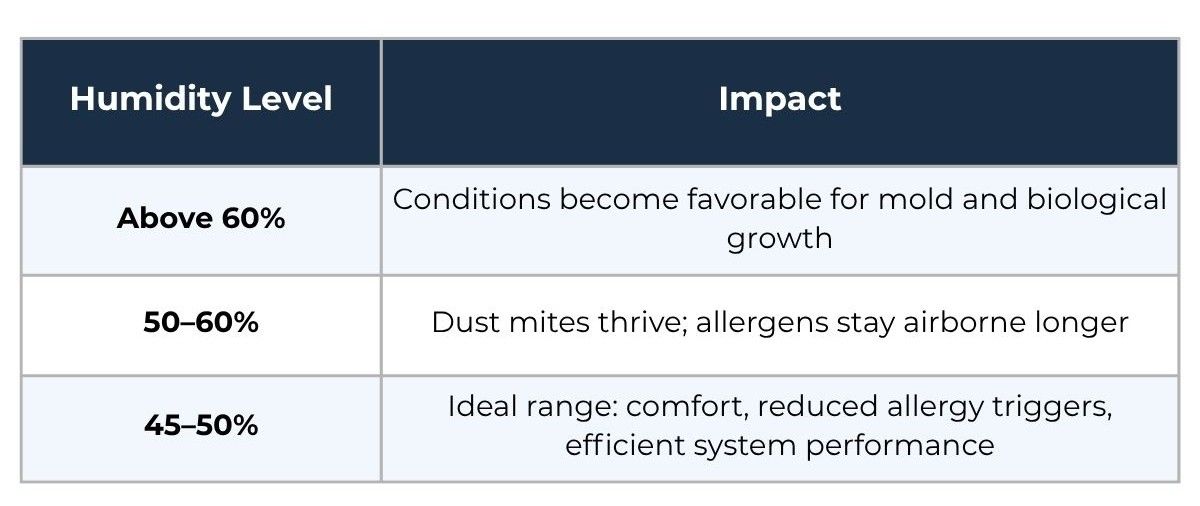
If your home regularly sits above that range, especially on mild days when the AC isn't running much, temperature control alone won't fix it.
How to Fix High Humidity in Your Home
If your home feels heavy, sticky, or uncomfortable during allergy season, the solution isn't just lowering the temperature. It's understanding what's happening with humidity.
Find out what’s causing humidity in your home.
Some homes may need:
- Proper system sizing so it runs long enough to remove moisture
- Ductwork adjustments to improve airflow and consistency
- Air sealing to reduce outside humidity coming in
On mild Houston days, think March, April, October, early November, the AC may run for only a few minutes at a time. That's not long enough to move much moisture.
A whole-house dehumidifier runs independently of your AC and maintains that 45–50 percent range year-round, regardless of whether the system is actively cooling. It's the product most homeowners don't know exists, and often the one that makes the biggest difference in how a Houston home feels.
The Bottom Line on Why Your House Feels Humid
If your home feels worse during allergy season, even indoors, it's usually not just about the allergens themselves.
In many cases, it's how humidity is affecting the air inside your home: how particles move, how long they stay suspended, and how your system handles them.
Now that you understand how humidity impacts comfort and air quality, you're in a much better position to evaluate what's actually happening in your home. The next step is understanding whether your HVAC system is properly managing humidity, airflow, and overall performance.
If you're in Cypress, Katy or other West Houston cities and want clear answers, a proper evaluation can show you exactly why your home feels the way it does, and what would actually improve it.
How We Can Help
If you want to understand what's actually happening in your home, how your system is handling humidity, whether it's sized correctly, and why it feels the way it does, the next step is a proper evaluation.
At The General Heating & Air, we look at your system, airflow, and overall setup so you get clear answers, not guesswork.
If you're in Cypress, Katy or the surrounding West Houston communities, we're happy to walk through that with you.
(832) 558-8539 | thegeneralhvac.com
Frequently Asked Questions
Does humidity make allergies worse inside your home?
Yes. High humidity allows allergens like dust, pollen, and other particles to stay suspended in the air longer instead of settling. That means they circulate more easily and are more likely to be breathed in, which can make symptoms feel worse indoors, even in a space that should feel comfortable.
What humidity level should your home be at in Houston?
Most homes in the Houston area should stay between 45–50% relative humidity for the best balance of comfort and air quality. Once humidity rises above 60%, conditions become more favorable for biological growth and airborne allergens, which can impact both comfort and health.
Why does my house feel humid even with the AC on?
If your house still feels humid with the AC running, your system may not be running long enough to remove moisture or may not be properly sized. Oversized systems are especially common in Houston and often cool the air quickly but shut off before removing enough humidity.
Can lowering the thermostat fix humidity problems?
Not always. Lowering the temperature can sometimes make humidity problems worse by causing the system to turn on and off more frequently. That shorter run time reduces the system's ability to remove moisture from the air.
What's the difference between temperature and humidity comfort?
Temperature measures how hot or cold the air is, while humidity measures how much moisture is in it. Both affect how your home feels. A house at 72° with high humidity can feel just as uncomfortable as a warmer space because the excess moisture makes the air feel heavier and harder to breathe in.