
What Should the Humidity Level Be in Your House?
For Houston-area homes, keep indoor humidity between 45 and 50 percent. Above 60 percent is where problems start.
Humidity moves through the day. What matters is where it settles, not one reading.
What should the humidity be in an air-conditioned house?
45 to 50 percent. Exact ranges vary depending on the source.
That range keeps the air from feeling sticky and keeps dust mites and biological growth in check.
Is the humidity in my house too high?
| Reading | What it means |
|---|---|
| 45 to 50% | Where you want to be. |
| 50 to 60% | Fine now and then. A problem if it lives there. |
| Above 60% | Worth looking into. |
One high reading after a shower or during a storm is normal.
Below 40 percent is uncommon in Houston and rarely the problem here.
Is your humidity staying above 60%?
If it's regularly above 60 percent, that's worth investigating, especially if your home feels sticky or you're seeing recurring condensation.
Find out what's causing it before buying equipment.
How do you measure humidity in your house?
Your thermostat or a hygrometer.
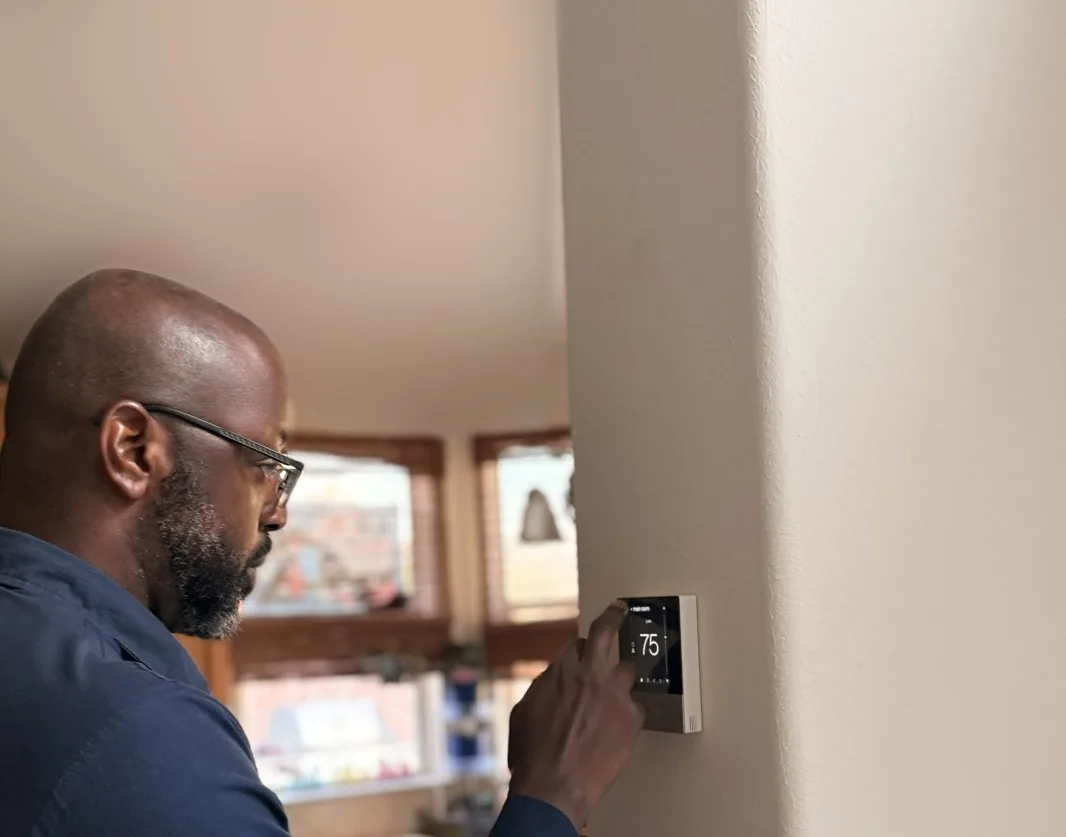
Your thermostat. Many thermostats display indoor humidity next to the temperature.
A hygrometer. A small digital humidity meter. Inexpensive, and you can move it from room to room.
Where and when. Measure away from the kitchen and bathrooms, and look at the range over time rather than a single value.
A professional evaluation. A Home Comfort Diagnostic measures humidity alongside airflow, temperature, and duct condition to find what is driving it.
We also offer 24/7 monitoring on our membership plans, with sensors that track temperature, moisture, and pressure continuously.
Why is the humidity in my house so high?
Usually because the system is not running long enough to remove it.
Your air conditioner only pulls moisture out of the air while it is actually running. Common reasons it falls behind:
- It doesn't run long enough. Mild days are the worst days for humidity here.
- Leaking return ducts. They pull hot attic air into the system.
- Airflow across the coil. Too fast and the coil never gets cold enough to pull water out.
- Required ventilation. Newer homes bring in outdoor air by code, and that air carries moisture.
- A system too large for the house. It cools fast and shuts off early.
Read the full explanation: Why Your House Feels Humid (and Why It Gets Worse During Allergy Season)
How can I lower the humidity in my house?
Here are four simple things you can try yourself.
- Set your fan to AUTO instead of ON. On ON, the blower keeps running after the compressor stops, and air moving across a wet coil sends moisture that had already condensed back into your house.
- Check your thermostat schedule. Away modes and setbacks that leave the system idle for hours give humidity time to climb, because nothing is removing moisture while it is off.
- Use bath and kitchen exhaust fans while you are making moisture, during a hot shower or while cooking, and turn them off afterward. Leaving them running can pull humid outdoor air in through the rest of the house.
- Change your filter on schedule. A loaded filter restricts airflow, and airflow is part of how the system pulls water out of the air.
Turning the thermostat colder usually does not help. Relative humidity is measured against the air temperature, so cooling the air without removing any moisture can push the reading higher instead of lower.
If it is still high after that, the next step is a professional evaluation.
Does high humidity mean I need a whole-home dehumidifier?
Not necessarily. There may be other reasons your humidity is high, and therefore other solutions.
A whole-home dehumidifier is the right answer for plenty of Houston homes. For others the cause is duct leakage, airflow, or how the system is running, and a dehumidifier would leave that problem in place.
If you want to know which one applies to your home, that is what the Home Comfort Diagnostic determines. If you would rather read about how whole-home dehumidifiers work first, start with whole-home dehumidification.
Why is my house humid even when the AC is running?
Because cooling the air and drying it are two different jobs.
Your air conditioner removes moisture only while it is actually running. On a mild day it can bring the house down to temperature in a few minutes and shut off, which is not long enough for much moisture to condense and drain away. The condition of your ductwork, how much air the system moves, and how it was sized all affect this as well.
We wrote a longer piece on why this happens and why it gets worse in spring and fall: Why Your House Feels Humid (and Why It Gets Worse During Allergy Season).
When is high humidity actually a problem?
- Your reading sits above 60 percent regularly
- The house feels sticky even at a comfortable temperature
- Condensation that keeps coming back
- Musty smells
- Visible biological growth
- Allergy or breathing symptoms worse indoors than out
What if my humidity stays high and I don't know why?
Get it measured before you buy anything.
The Home Comfort Diagnostic starts with your symptom and measures what's causing it. You get written findings and your options.
Home Comfort Diagnostic, $299. The $299 is waived if you move forward with a recommended solution.
Other questions homeowners ask
Does indoor humidity change throughout the day?
Yes. Showers, cooking, weather, and how much your system ran can all affect the humidity in your home.
Does turning the AC colder lower humidity?
Usually not. Relative humidity is measured against the air temperature, so cooling the air without removing any moisture can push the reading higher instead of lower.
Can a dirty filter cause high humidity?
It can contribute. A loaded filter restricts airflow, and airflow is part of how your system pulls moisture out of the air.
Can ductwork affect indoor humidity?
Yes. A return duct leaking in a hot attic pulls humid attic air into the system every time the fan runs.
Should I use a portable dehumidifier?
A portable unit can help in a single problem room. It is not built to control humidity across a whole house.
Where does a whole-home dehumidifier go?
Placement depends on your system and your space, usually in the attic attached to your ductwork so it treats the entire home. More on how they work.
Why is there condensation on my AC vents?
Vents are cold, so moisture in the air can collect on them when indoor humidity is high. If it keeps happening, or you see water dripping or staining the ceiling, have it looked at. That can point to a leak rather than a humidity problem.
Can high humidity affect indoor air quality?
Yes. Moisture affects how long particles stay suspended in the air and how favorable conditions are for dust mites and biological growth. More on indoor air quality.
Sources
- US Environmental Protection Agency, indoor air quality guidance on moisture and relative humidity
- US Centers for Disease Control and Prevention, indoor relative humidity guidance
- World Health Organization, Guidelines for Indoor Air Quality (2009)
- US Department of Energy, Building America, whole-house dehumidification guidance
- ASHRAE Handbook of Fundamentals (2021), climatic design conditions, Houston
- Florida Solar Energy Center, studies on fan operation, duct leakage, and airflow