Jump to section
Executive Summary
High indoor humidity in a Houston home can come from the HVAC equipment, ductwork, ventilation, problems with the house itself, or several of these working together.
The right solution depends on how moisture is getting into the home and why the home isn't removing enough of it.
Some humidity problems can be corrected through the HVAC system, including problems with runtime, airflow, duct leakage, thermostat settings, and ventilation. Other homes have air-sealing, insulation, water-intrusion, or construction issues that require work outside the HVAC system.
And sometimes the HVAC system is working properly, but the home still needs dedicated humidity control. In those homes, a whole-home dehumidifier may be the appropriate long-term solution.
In this article, we'll cover:
- How to tell whether your home actually has a humidity problem
- Which humidity problems are related to the HVAC system
- How problems with the house itself can contribute
- What an HVAC company can realistically evaluate and correct
- When a whole-home dehumidifier makes sense
Why Can Your AC Cool the House and Still Leave It Extremely Humid?
We recently went to a Houston-area home for a routine HVAC tune-up. The homeowner hadn't called us for a humidity problem.
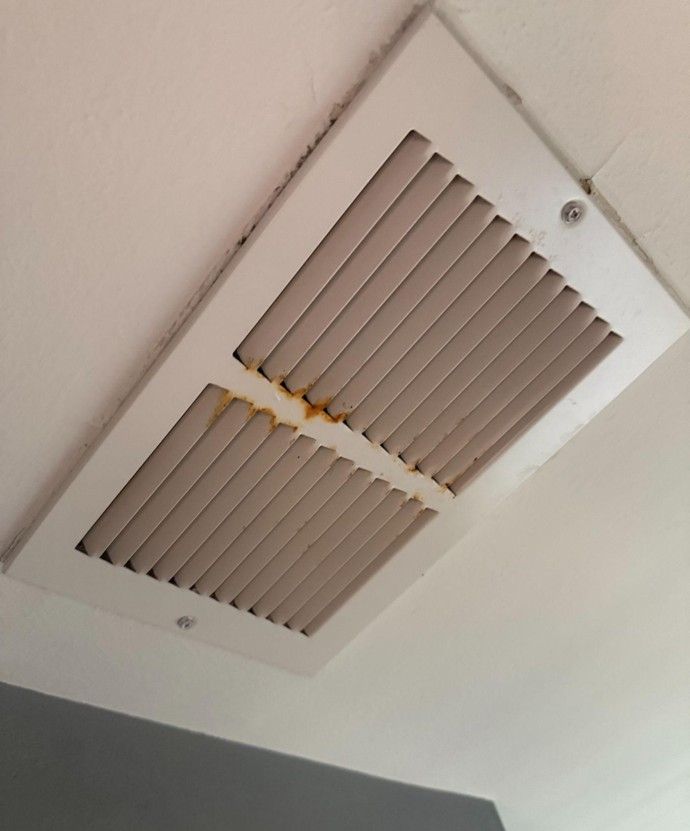
But while evaluating the system, we noticed something else: the return grille had begun to rust.
The homeowner had 24/7 HVAC monitoring, so we could look at what had been happening with the home's temperature and humidity over time.
The home's indoor relative humidity was consistently around 80%.
We could see physical evidence of the moisture problem, too. The return grille had begun to rust.
That combination matters:
- The house was getting cool.
- Humidity remained extremely high over time.
- The home was already showing a physical sign of prolonged moisture exposure.
A homeowner could look at the thermostat, see that the house is reaching temperature, and have no reason to suspect how high the humidity actually is.
Cooling the house and controlling its humidity are related jobs, but success at one doesn't guarantee success at the other.
In this home, 24/7 HVAC monitoring showed us something the temperature alone couldn't: the house had a persistent humidity problem.
So why does that matter?
Why Does High Indoor Humidity Matter?
High humidity affects more than how comfortable your home feels.
When indoor humidity stays elevated, it can create conditions that support biological growth and dust mites. Dust mites are a common indoor allergen, and controlling humidity is one way to help control their populations in the home.
Excess moisture can also begin showing up in the house itself through things like:
- Condensation on surfaces
- Musty odors
- Rust and corrosion
- Moisture around HVAC grilles and vents
- Biological growth
- Damage to materials and finishes over time
For Houston homes, we generally aim for indoor relative humidity around 45% to 50%.
For our climate, that gives homeowners a practical target for comfort, moisture control, and indoor air quality.
When humidity stays well above that range, the next question is why the home isn't keeping it under control.
Is High Humidity an HVAC Problem or a Problem With the House?
What's causing all this humidity?
In Houston, there isn't always one culprit.
Think about indoor humidity as a balance between how much moisture is getting into your home and how much moisture your home is able to remove.
Moisture can come from:
- Humid outdoor air entering the house
- Ventilation bringing outdoor air inside
- Duct leaks pulling humid air from attics or other unconditioned spaces
- Everyday activities like showering, cooking, and laundry
- Water or moisture problems involving the house itself
At the same time, your HVAC system has to remove enough moisture to keep indoor humidity under control.
Humidity becomes a problem when the moisture coming in consistently exceeds the home's ability to remove it.
Some Humidity Problems Come From the HVAC System
Your HVAC system's runtime, airflow, ductwork, thermostat settings, equipment operation, and ventilation can all affect how well your home controls humidity.
Those are things an HVAC contractor can evaluate and, depending on what we find, correct.
Some Humidity Problems Come From the House Itself
Problems with air sealing, insulation, water intrusion, windows, walls, attics, roofs, or other parts of the house can add moisture that HVAC equipment can't correct at the source.
Some repairs are relatively straightforward. Others can require specialized contractors and significant work on the home.
When the source is the house itself, HVAC may still help control the indoor humidity without repairing the underlying problem.
And Sometimes It's Both
A house can have a high moisture load and an HVAC system that isn't managing that load effectively.
Finding one problem doesn't necessarily mean you've found the whole problem.
The goal is to determine what can be corrected through the HVAC system, what can be managed, and what may require another type of expert.
Which Humidity Problems Can an HVAC Company Actually Fix?
When the HVAC system is contributing to high humidity, the problem usually involves how effectively the system is removing moisture or how much additional moisture it has to manage.
Here are some of the HVAC-related issues we look for.
1. Your AC Isn't Running Long Enough to Remove Enough Moisture
Your air conditioner removes moisture while it cools which means how long it’s actually running matters.
A home can reach the temperature on the thermostat without the AC running long enough to adequately control the humidity.
Oversizing is one way this happens. A system with too much cooling capacity can drop the temperature quickly, shut off, and repeat that cycle without spending enough time removing moisture.
But oversizing isn't the only reason.
We recently performed a Home Comfort Diagnostic in a home with three HVAC systems; two of the systems barely ran. There wasn't anything mechanically wrong with them. Based on how the home and thermostats were set up, those systems simply weren't being called on to cool very often.
The result was the same underlying problem: very little AC runtime meant very little opportunity for those systems to remove moisture.
2. Your HVAC Airflow or Equipment Operation Is Limiting Moisture Removal
Runtime is only part of dehumidification. Your system also needs the right conditions to remove moisture while it's operating.
Problems with airflow across the indoor coil, equipment configuration, coil condition, staging, or overall system performance can affect how much moisture gets removed from the air.
Cold air coming from your vents doesn't necessarily tell you how effectively your system is removing humidity.
3. Your Duct System Is Bringing Additional Humidity Into the Picture
Your ductwork can contribute to a humidity problem, particularly when it runs through a hot, humid attic.
Leaks in the duct system can allow humid, unconditioned attic air to enter the system or affect pressure inside the home in ways that draw more outdoor air inside.
Return-side leaks can pull humid attic air directly into the system, while supply-side leaks can lose conditioned air to the attic and contribute to pressure imbalances in the house.
Either way, the HVAC system now has additional moisture to manage, making it harder to keep indoor humidity under control.
4. Your Thermostat Fan Is Running Continuously
There is also one HVAC-related humidity problem you can check without calling an HVAC company.
When your AC is cooling, water condenses on the indoor coil. Some moisture remains on that coil after the compressor shuts off.
If your thermostat fan is set to ON, the blower continues pushing air across that wet coil between cooling cycles. That can re-evaporate some of the moisture and send it back into the house.
For humidity control in our climate, your thermostat fan should generally be set to AUTO rather than ON.
In humid-climate research, continuous fan operation increased indoor relative humidity from 55% to 65% under low-runtime conditions. And moisture removal was decreased by more than 60%
This one has a simple fix: check your thermostat and switch the fan from ON to AUTO.
5. Your Ventilation System Is Bringing in More Moisture Than the Home Can Handle
Some homes intentionally bring outdoor air inside through mechanical ventilation. In Houston, that outdoor air can carry a significant amount of moisture.
During mild, humid weather, ventilation can continue bringing moisture inside while the AC isn't running enough to remove it.
How much outdoor air is being introduced and how the system is configured can therefore contribute to high indoor humidity.
What If the Humidity Problem Is Coming From the House Itself?
Sometimes the source of excess moisture is outside the HVAC system.
Problems with air sealing, insulation, windows, doors, walls, attic or roof assemblies can allow humid outdoor air or moisture into the home. Water intrusion from a roof, window, plumbing, or drainage problem can add even more.
When the house itself is contributing significantly to the moisture problem, HVAC equipment can't correct that source.
What Do Problems With the House Actually Look Like?
Every home is different, but an investigation may uncover issues such as:
- Gaps and penetrations allowing uncontrolled air movement
- Missing, damaged, or improperly installed insulation
- Problems where conditioned and unconditioned parts of the home meet
- Window, door, roof, or wall problems allowing moisture intrusion
- Other construction or enclosure defects that require evaluation outside the HVAC system
These problems can also interact with the HVAC system. Pressure differences created when the system runs can move air through openings in the house, and duct problems can make those effects worse.
That's why humidity can become a whole-house problem rather than a single broken-component problem.
Correcting the Source Can Become a Much Bigger Project
Some problems with the house have relatively manageable repairs. Others may require extensive air sealing, insulation work, opening walls or ceilings, repairing portions of the structure, or bringing in building-science and other specialized contractors.
Depending on what is wrong, fully correcting the house can become a significant remodeling project.
For some homeowners, that work is the right next step. For others, the cost and scope may put it out of reach, at least for now.
That doesn't mean there are no options for controlling the humidity inside the home.
In some homes, dedicated dehumidification can provide the additional moisture removal the house needs. In others, it can help control indoor humidity even when a larger problem with the house still needs to be addressed.
Those are two different situations: sometimes dehumidification is the humidity solution, and sometimes it's part of a larger solution.
Active water intrusion is different. A leaking roof, plumbing leak, or other source of liquid water needs to be repaired at the source.
What If Your HVAC System Is Working Properly and Your House Is Still Humid?
We recently performed a Home Comfort Diagnostic in a spray-foam-insulated home with persistent high humidity.
After evaluating the HVAC system, we found that it was operating properly. The home simply needed more humidity control than the air conditioner alone could provide.
Houston's Most Humid Weather Isn't Always Its Hottest Weather
Your air conditioner removes moisture while it cools your home. But in Houston, we often need moisture removal at times when we don't need much cooling.
ASHRAE weather data shows that some of Houston's most humid conditions occur when it's only about 82–84°F outside, rather than during our hottest 96–98°F summer conditions.
On those warm, muggy days, your home may already be at a comfortable temperature. The thermostat doesn't call for much cooling, so the AC doesn't run very long even though there is still plenty of moisture in the air.
You can need dehumidification even when you don't need much air conditioning.
This can be especially noticeable in well-insulated homes that stay comfortable with very little AC runtime.
That's what we found in the spray-foam home. There wasn't an HVAC repair that would solve the humidity problem because the HVAC system was operating properly.
The home needed a way to remove moisture without waiting for the thermostat to call for cooling.
We recommended a whole-home dehumidifier.
That brings us to the next question: When is a whole-home dehumidifier actually the right solution?
When Does a Whole-Home Dehumidifier Make Sense?
A whole-home dehumidifier removes moisture independently of whether your home needs cooling.
It can make sense when:
- The AC doesn't run enough during mild, humid weather to control moisture
- A well-insulated home stays cool while humidity continues to rise
- Mechanical ventilation adds more moisture than the AC can manage
- Correctable HVAC issues have been addressed but humidity remains high
- The house has a persistent moisture load that requires additional humidity control
A whole-home dehumidifier allows the home to respond to humidity without waiting for the temperature to rise.
How Can You Tell If Your Houston Home Is Too Humid?
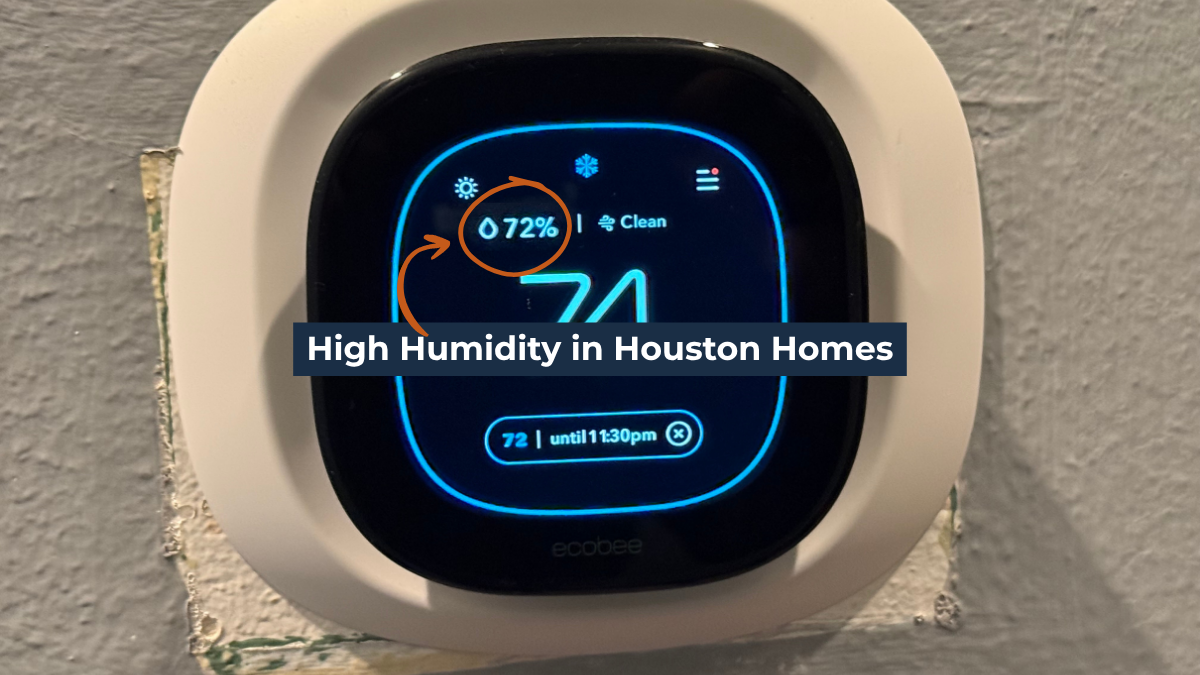
Start by checking your indoor relative humidity.
Many thermostats display humidity on the screen or in the thermostat app. If yours doesn't, you can use an inexpensive digital hygrometer.
For Houston homes, we generally aim for indoor relative humidity around 45% to 50%.
Don't judge your home from one unusual reading. Check the humidity at different times over several days and pay attention to whether it stays elevated, especially during rainy weather or mild, muggy days when the AC isn't running as much.
You can also look for physical signs of excess moisture, including:
- Condensation
- Musty odors
- Rust or corrosion
- Moisture around HVAC grilles or vents
- Visible biological growth
If you have 24/7 HVAC monitoring, you can also look at the home's humidity history to see whether elevated readings are brief spikes or an ongoing pattern.
If your humidity is consistently above 60%, it's worth investigating why.
What Do We Actually Check When a Home Has High Humidity?
When we perform a Home Comfort Diagnostic for high humidity, we look for HVAC-related conditions that could be contributing to the problem.
1. Thermostat Settings and AC Runtime
We check whether the AC is actually running regularly and review the thermostat settings that can affect runtime and humidity control.
That includes:
- Temperature settings and schedules
- Away settings that may limit how often the system runs
- Whether the indoor blower fan is set to AUTO
- Outdoor-air (OA) settings that may be bringing too much humid air into the home
A functioning AC can't remove much moisture if its settings keep it from running enough.
2. Blower Speed and Actual Airflow
We check the blower speed and measure how much air the system is actually moving.
Too much airflow across the indoor coil can affect how effectively the system removes moisture.
3. Indoor Coil Size
We document the size of the indoor evaporator coil relative to the outdoor equipment.
Coil size helps us understand how the existing system is configured for cooling and moisture removal. It is one piece of the evaluation, not automatically something that needs to be changed.
4. Static Pressure
We measure static pressure to see how air is moving through the HVAC system.
The readings can point us toward airflow restrictions or duct-system problems that warrant further investigation.
5. Equipment and Duct Sealing
With the system running, we inspect accessible equipment and duct connections for air leakage.
We're looking for places where hot, humid attic air may be getting into the HVAC system or conditioned air may be escaping.
6. Physical Duct Damage
We inspect accessible ductwork for tears, disconnected sections, and other physical damage.
Static-pressure readings can also help point us toward duct problems that aren't immediately obvious.
What Happens After the Evaluation?
If we find a correctable HVAC issue, that gives us a place to start.
If these checks don't uncover an HVAC problem that explains the persistent humidity, we can then consider whether the home needs dedicated dehumidification or whether the findings point toward a problem with the house itself.
What Should You Do About High Humidity in Your Houston Home?
If your home consistently stays above 60% humidity, or you're noticing signs like condensation, musty odors, rust, or biological growth, the next step is figuring out why.
Start with what you can check yourself: look at the humidity on your thermostat or with a hygrometer, make sure the thermostat fan is set to AUTO, and pay attention to whether schedules or settings are limiting how often your AC runs.
If the humidity remains high, a more thorough evaluation can help determine whether the problem involves your HVAC equipment, airflow, ductwork, ventilation, the house itself, or a need for dedicated humidity control.
At The General Heating & Air, our Home Comfort Diagnostic is designed to find the factors contributing to your home's comfort and humidity problems so you can understand what actually needs to be addressed.
If you're dealing with persistent high humidity in your Houston-area home, schedule a Home Comfort Diagnostic to find out what's causing it and what your options are.
Frequently Asked Questions
What Humidity Level Is Too High Inside a Houston Home?
For Houston homes, we generally aim for indoor relative humidity around 45% to 50%. An occasional higher reading isn't necessarily a problem. If your home is consistently above 60% humidity, it's worth investigating why, particularly if you're also noticing condensation, musty odors, rust, or biological growth.
Can My House Be Too Humid Even If the AC Is Cooling Properly?
Yes. Your AC removes moisture while it runs, but your home can reach the thermostat setting without getting enough runtime to adequately control humidity. A comfortable temperature doesn't necessarily mean you have a comfortable humidity level. This can happen because of thermostat settings, equipment sizing or operation, mild but humid weather, or in well-insulated homes that don't require much cooling.
Will a Whole-Home Dehumidifier Fix High Humidity?
It can, depending on why the home is humid. For some homes, a whole-home dehumidifier is the appropriate long-term solution for controlling indoor humidity. This can happen when the HVAC system is operating properly but the home still needs moisture removal when the AC isn't running. In other homes, a dehumidifier may be part of a larger solution because air sealing, insulation, water intrusion, or other problems with the house are also contributing. Active water intrusion from a roof, plumbing leak, window, or similar source still needs to be repaired at the source.
Does Spray Foam Insulation Cause High Humidity?
Spray foam insulation doesn't automatically cause high humidity. A well-insulated spray-foam home may stay at a comfortable temperature without requiring much AC runtime. In Houston, the home can still need moisture removal even when it doesn't need much cooling. We've encountered this ourselves. In one spray-foam home with persistent high humidity, our Home Comfort Diagnostic found that the HVAC system was operating properly. The home needed dedicated dehumidification rather than an HVAC repair.