Jump to section
Executive Summary
If your air conditioner suddenly stops cooling, starts making unusual noises, or just doesn't seem to be working properly, your first instinct may be to call an HVAC company.
Sometimes that's exactly the right decision.
Other times, the problem turns out to be something simple, like a clogged air filter, an incorrect thermostat setting, or a tripped breaker—things you can safely check yourself in just a few minutes.
This guide walks you through the checks homeowners can safely perform before scheduling service. You'll learn:
- What to check first when your HVAC system isn't working properly
- Which problems you may be able to resolve yourself
- Which symptoms usually require professional service
- What you should never attempt to inspect or repair on your own
By the end of this article, you'll know whether you've found an easy fix, gathered useful information for your technician, or identified a problem that deserves immediate attention.
Introduction
Your air conditioner isn't cooling the house the way it should.
Maybe warm air is coming from the vents. Maybe the system won't turn on at all. Or maybe you noticed water around the indoor unit or heard a noise you've never heard before.
When something like that happens, most homeowners ask the same question:
Should I call an HVAC company right now, or is there something simple I should check first?
The answer depends on what's happening.
There are several things you can safely inspect yourself, and in some cases, they can solve the problem in just a few minutes. Even when they don't, these quick checks often tell you something useful about what's going on, making it easier for a technician to diagnose the issue if you do need service.
At The General Heating & Air, we believe homeowners should know the difference between a problem they can safely investigate and one that calls for a professional. If you can avoid an unnecessary service call, that's a win. And if you do need to call, you'll have a better understanding of what you've already ruled out.
By the end of this guide, you'll know what to check first, what not to touch, and when it's time to stop troubleshooting and schedule service.
Start Here: The 5-Minute Checklist
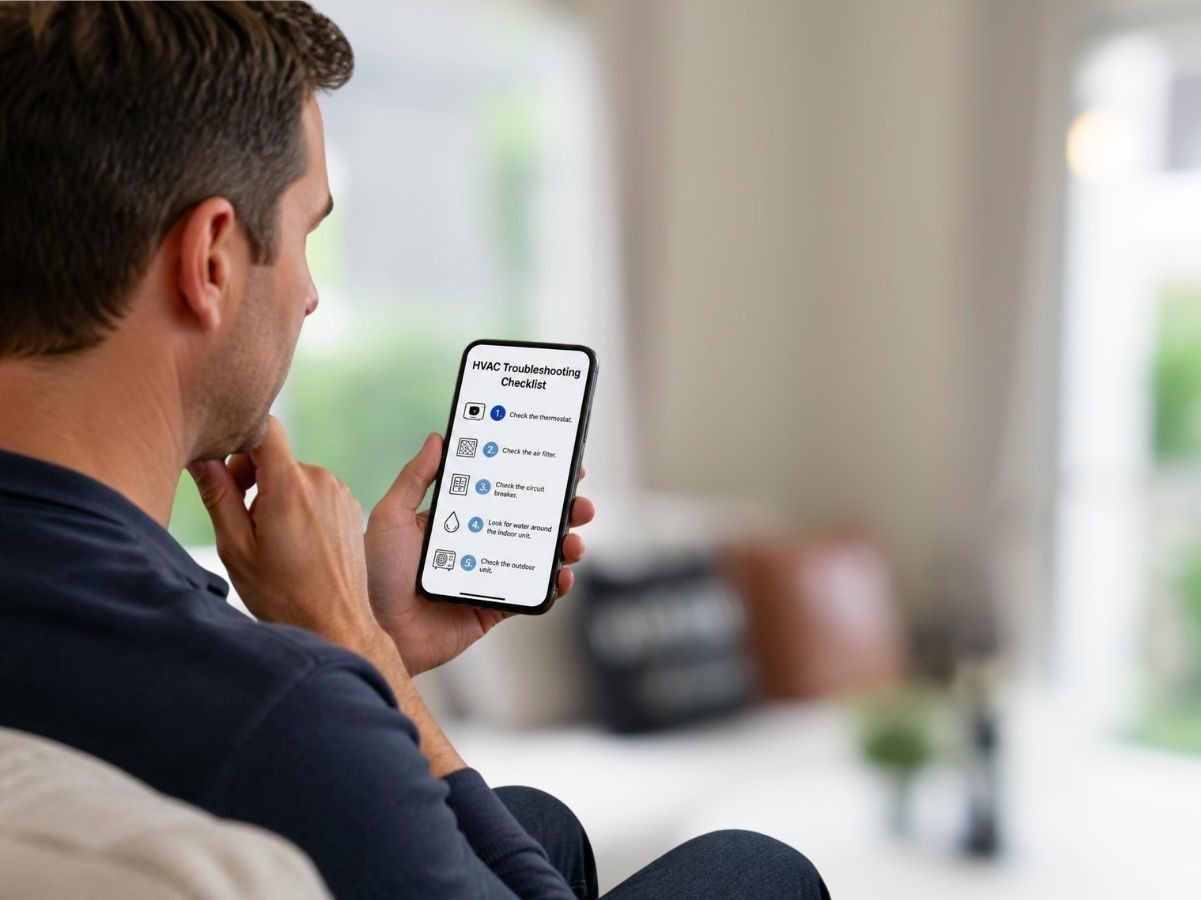
Before scheduling service, spend about five minutes checking these five things.
These quick checks solve more air conditioning problems than you might expect. If they don't, they'll often give you useful information to share with your HVAC company.
1. Check the thermostat.
- Is it set to COOL?
- Is the temperature set below the current room temperature?
- Is the fan set to AUTO?
- Is a schedule overriding your manual setting?
- If it uses batteries, are they working?
2. Check the air filter.
- Locate the filter.
- If it's visibly dirty, replace it.
- Standard 1-inch filters and thicker media filters should be evaluated differently. We'll explain how below.
3. Check the circuit breaker.
- Has the breaker tripped?
- Reset it once if you're comfortable doing so.
- If it trips again, stop there and schedule service.
4. Look for water around the indoor unit.
- Is there standing water?
- Is the drain pan full?
- Is the system shut off because the condensate drain is clogged?
5. Check the outdoor unit.
- Is the outdoor fan running?
- Is anything blocking airflow?
- Do you see ice on the refrigerant lines?
- Do you hear unusual noises?
If one of these checks identifies the problem, the sections below explain what to do next. If everything looks normal and your system still isn't working properly, keep reading.
Check the Thermostat First
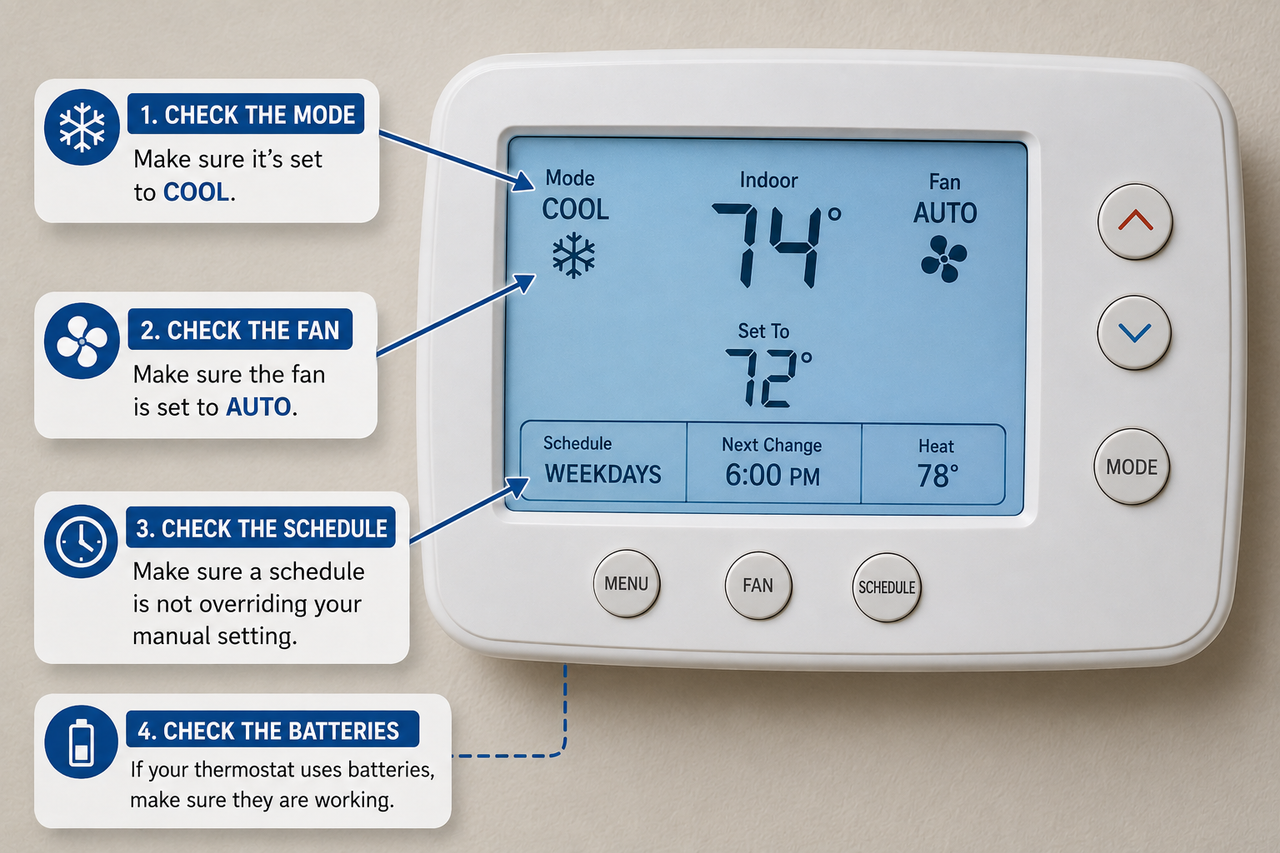
The thermostat is the first place to look because it tells your HVAC system when—and whether—to cool your home.
It sounds obvious, but thermostat settings account for more service calls than you might expect. Before assuming something is wrong with your air conditioner, take a minute to make sure the thermostat is telling it to do what you expect.
Is it set to COOL?
Start with the basics.
Confirm the thermostat is set to COOL, not HEAT or OFF. Then make sure the temperature is set below the current room temperature. If your home is 76 degrees and the thermostat is set to 78, the system is behaving exactly as it's supposed to.
Is a schedule overriding your settings?
Many programmable and smart thermostats automatically change the temperature throughout the day.
If you lower the temperature but it keeps changing back on its own, check whether the thermostat is following a programmed schedule. A previous homeowner, a family member, or even an old energy-saving program may have created a schedule that's still active.
If you're testing whether the air conditioner is working, temporarily override the schedule or place the thermostat on Hold, if your model offers that option.
Is the fan set to AUTO?
The fan setting should normally be AUTO, not ON.
When it's set to AUTO, the blower runs only while the system is actively heating or cooling.
When it's set to ON, the blower runs continuously. That means you'll still feel air coming from the vents even after the cooling cycle has ended. The air may feel neutral or even warm, leading you to think the air conditioner has stopped cooling when it's simply circulating indoor air.
Does the thermostat need new batteries?
Some thermostats are powered by the HVAC system, while others rely on batteries.
If the display is blank, fading, or behaving unpredictably, replacing the batteries is an easy first step. It's also worth checking that the thermostat is securely attached to its wall plate, since a loose connection can interrupt communication with the system.
If everything looks correct and your home still isn't cooling, move on to the next check: the air filter.
Check the Air Filter
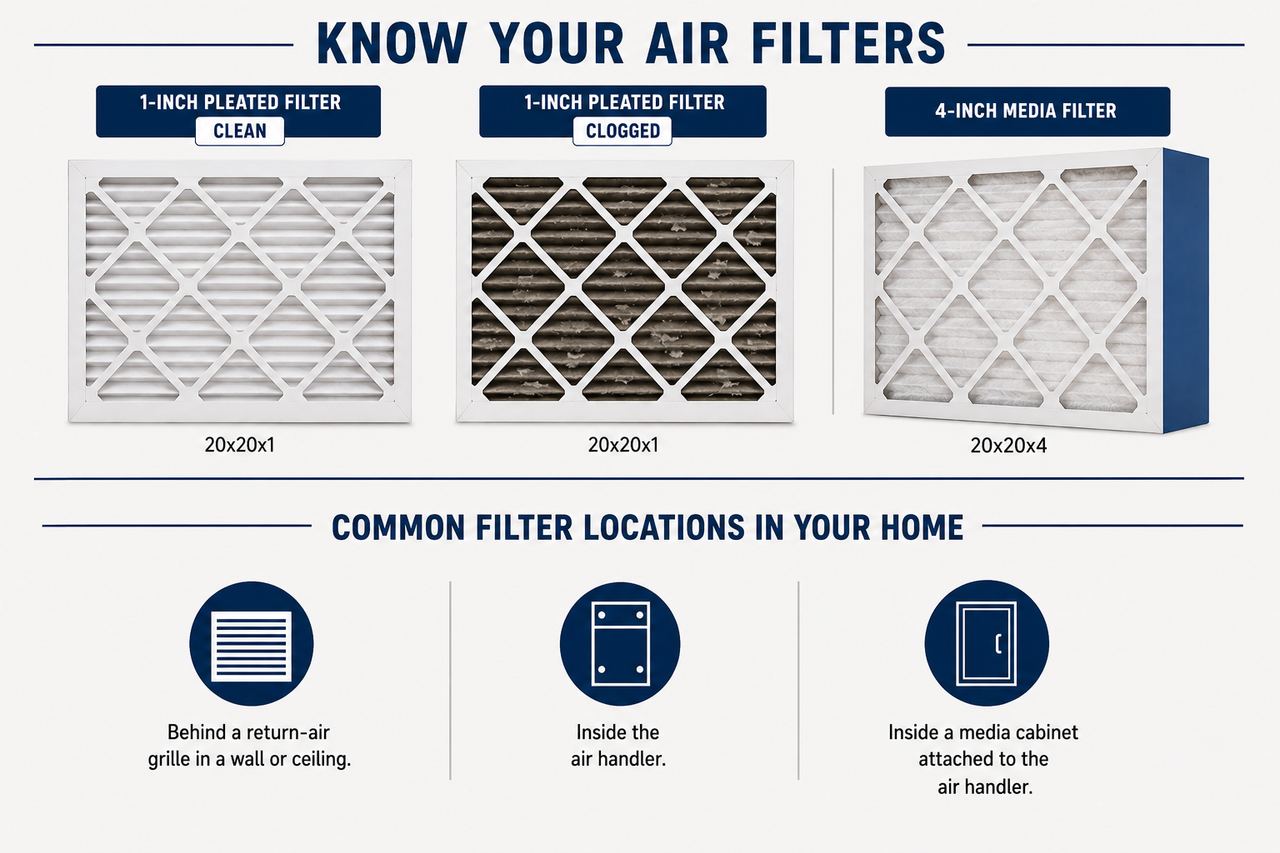
Your HVAC system depends on moving a specific amount of air across the indoor coil. As the filter fills with dust, pet hair, and other debris, it becomes harder for the system to pull air through it. That restricted airflow can make your home feel warmer, reduce efficiency, and in more severe cases, cause the evaporator coil to freeze.
Find your filter first.
Not every home has the same type of filter or keeps it in the same place.
Your filter may be:
- Behind a return-air grille in a wall or ceiling.
- Inside the air handler.
- Inside a media cabinet attached to the air handler.
If you aren't sure where your filter is located, check your owner's manual or ask your HVAC company during your next maintenance visit.
Is the filter dirty?
How you answer that depends on the type of filter you have.
A standard 1-inch filter can often be held up to a light. If it's heavily coated with dust and debris, or very little light passes through it, it's probably time for a replacement.
Thicker 4-inch or 5-inch media filters are designed differently. Instead of using the light test, look for heavy dust buildup, discoloration, or follow the replacement interval recommended by the manufacturer. These filters usually last much longer than standard filters.
Replace the filter before deciding there's a bigger problem.
If the filter is dirty, replace it and give the system time to recover before deciding the problem isn't solved.
If restricted airflow caused the evaporator coil to become cold enough to develop ice, the system may need time to thaw before normal cooling returns. That can take anywhere from several minutes to a few hours, depending on how much ice has formed.
How often should you replace the filter?
That depends on the filter, your home, and how often the system runs.
As a general guideline:
- Standard 1-inch filters should be checked every 30 to 60 days.
- Thicker media filters often last six months to a year, depending on the manufacturer's recommendations and conditions inside the home.
Pets, construction, allergies, and heavy system use may mean your filter needs attention sooner than the recommended schedule.
If the filter is clean and your system still isn't cooling properly, the next place to check is your electrical panel.
Check the Circuit Breaker
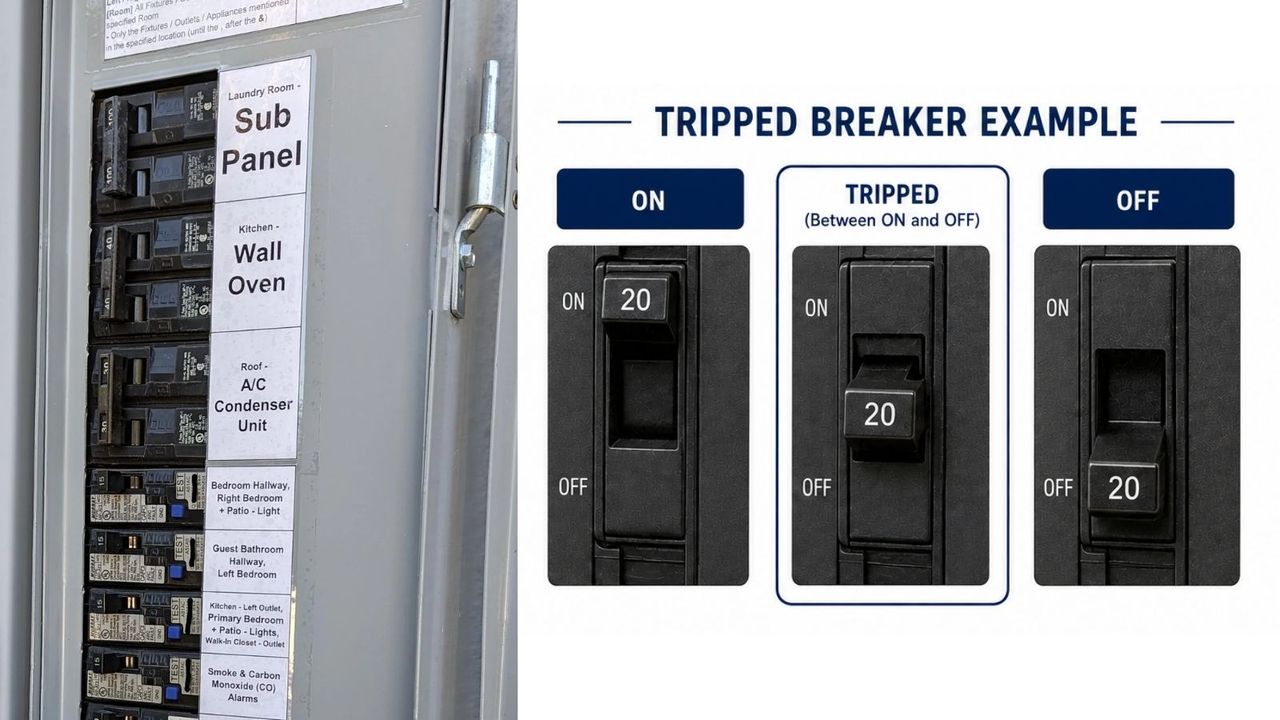
If your HVAC system isn't running at all, the circuit breaker is one of the first things to check.
Your air conditioner relies on electricity to power both the indoor and outdoor equipment. If a breaker trips, part or all of the system may stop working.
Find the HVAC breakers.
Locate your home's electrical panel.
Many homes have two separate breakers for the HVAC system:
- One for the indoor air handler or furnace.
- One for the outdoor condenser.
If you're unsure which breakers belong to your HVAC system, look for labels such as AC, Air Conditioner, Condenser, Air Handler, or Furnace.
Has a breaker tripped?
A tripped breaker usually won't look completely OFF.
Instead, it will sit somewhere between the ON and OFF positions.
If you're comfortable working around your electrical panel, you can reset it by moving it firmly to OFF first, then back to ON.
What happens if it trips again?
A breaker that trips repeatedly is telling you something is wrong.
Circuit breakers are safety devices. They're designed to shut power off when they detect a problem that could damage your equipment or create a safety hazard.
If the breaker trips again shortly after you reset it, don't keep resetting it.
Repeatedly forcing a breaker back on won't solve the underlying problem, and it may allow additional damage to occur. At that point, it's time to schedule service so the cause can be diagnosed properly.
If the breaker stays on but the system still isn't working, continue to the next section and check for signs of a condensate drain problem.
Check the Condensate Drain
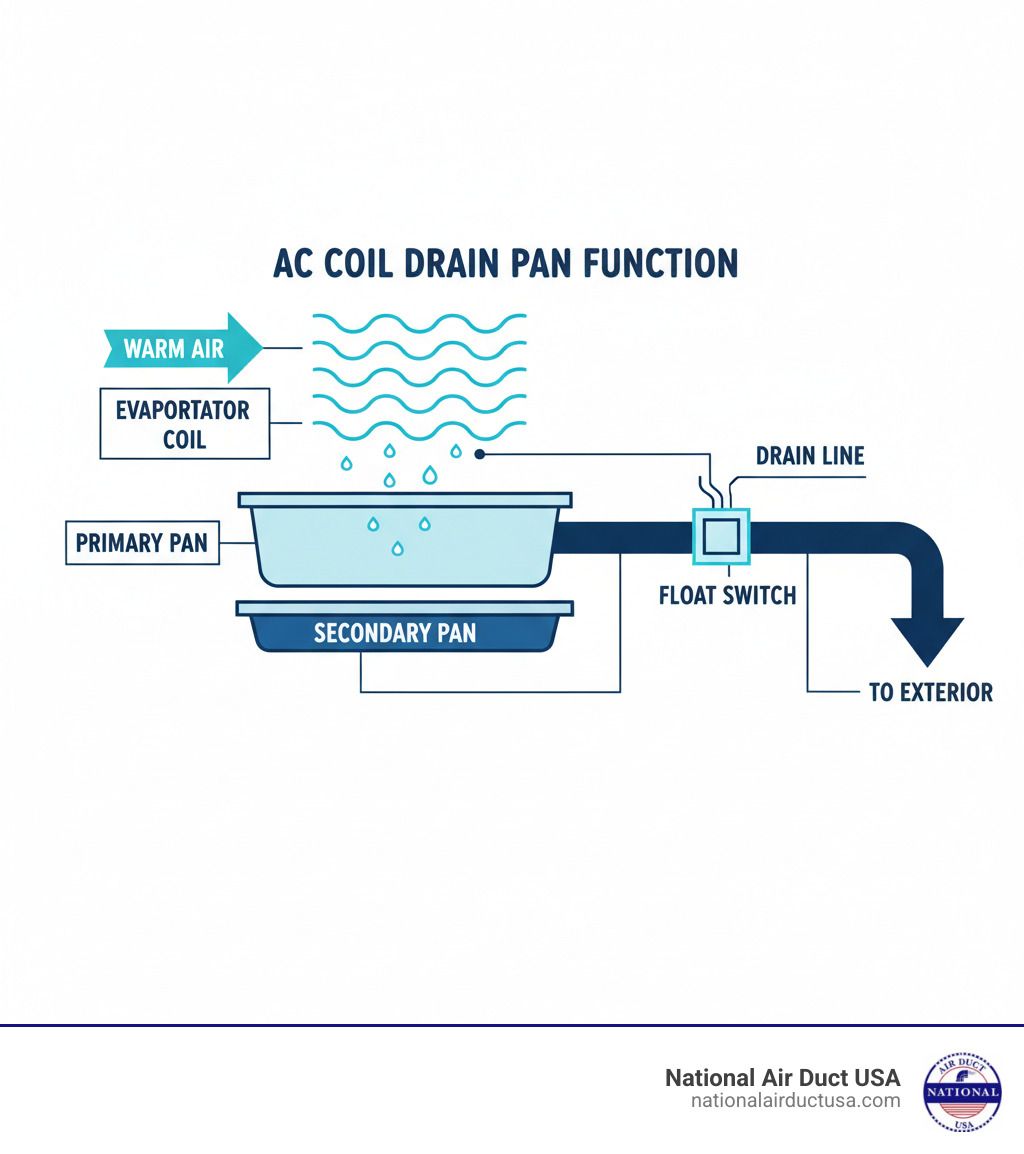
If you find water around your indoor unit, a clogged condensate drain may be the reason your air conditioner stopped running.
As your air conditioner cools your home, it also removes moisture from the air. That moisture collects in a drain pan and flows out of your home through a condensate drain line, usually a white PVC pipe connected to the indoor unit.
Is there standing water around the air handler?
Take a look around your indoor unit.
Water on the floor, a full drain pan, or damp drywall nearby usually means the condensate drain isn't draining properly.
Many modern HVAC systems include a float switch, a safety device that shuts the air conditioner off when water rises in the drain pan. It doesn't mean your air conditioner has failed. It means the system is trying to prevent water damage to your home.
Can you clear the drain yourself?
In many cases, yes.
If you can locate the drain line's cleanout opening, pour about one cup of undiluted white vinegar into the pipe. The vinegar helps dissolve the algae and organic buildup that commonly causes drain clogs.
You can also connect a wet/dry shop vacuum to the outdoor end of the drain line and run it for about 30 to 60 seconds. That often removes the clog without taking anything apart.
What if the drain keeps clogging?
A drain that clogs repeatedly usually points to a maintenance issue rather than a one-time blockage.
If you find yourself clearing the drain more than once during the cooling season, it's worth having the system inspected. A technician can clean the drain line more thoroughly and determine whether there's another reason it's continuing to back up.
If you'd like to understand why condensate drains require so much attention in our climate, read Why Your House Feels Humid (and Why It Gets Worse During Allergy Season).
Check the Outdoor Condenser Unit
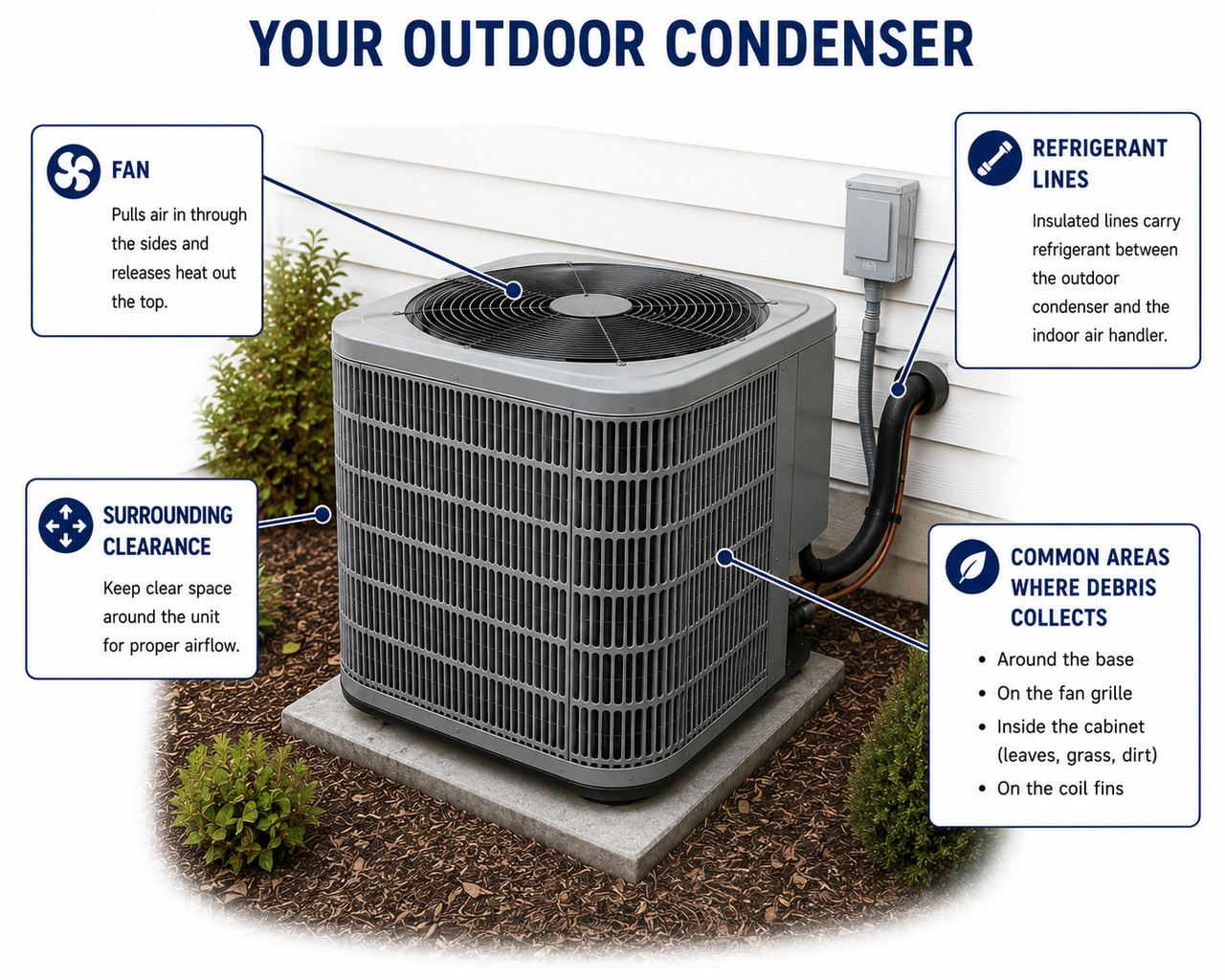
Your outdoor unit can tell you a lot about what's happening with your air conditioner without taking anything apart.
Once you've checked the thermostat, air filter, circuit breaker, and condensate drain, step outside while the thermostat is calling for cooling.
Is the outdoor unit running?
Listen for the fan and compressor.
If the indoor unit is blowing air through the vents but the outdoor unit is completely silent, that helps narrow the possible causes. It could be something as simple as a tripped breaker, or it could indicate a problem that requires professional diagnosis.
Is anything blocking airflow?
Your outdoor unit needs room to move air.
Leaves, grass clippings, weeds, and other debris can collect around the condenser and restrict airflow. Remove anything that's built up around the unit, and make sure vegetation isn't growing against it.
If the outside of the coil looks dirty, you can gently rinse it with a garden hose. Avoid using a pressure washer, which can bend the delicate aluminum fins and reduce the unit's performance.
Do you see ice on the refrigerant lines?
Ice on the refrigerant lines is a sign that something isn't operating normally.
Take a look at the insulated copper lines that run between the outdoor unit and your home.
If you see frost or ice, turn the system off or switch the thermostat to FAN ONLY to help the ice melt. Ice can develop for several reasons, including restricted airflow from a dirty filter or low refrigerant, and the underlying cause should be identified before the system is put back into regular operation.
Does the unit sound different than usual?
Pay attention to what you hear.
Grinding, banging, squealing, or other unusual noises usually indicate that something mechanical needs attention. If the unit is making sounds it normally doesn't make, turn it off and schedule service before continuing to run it.
If everything outside appears normal, there's one more simple check to make before deciding it's time to call: your supply vents and return registers.
Check Your Supply Vents and Return Registers
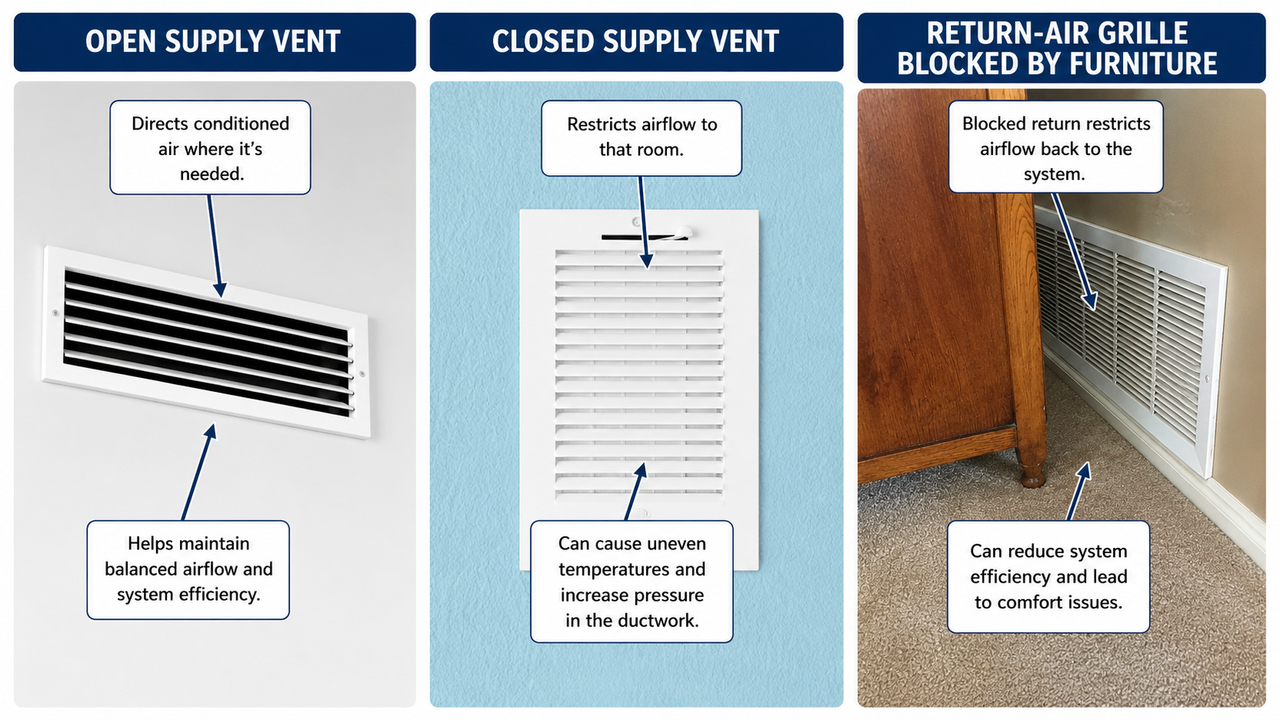
Your HVAC system can only move air if that air has a clear path through your home.
Before assuming there's a problem with the equipment itself, take a quick walk through the house.
Are your supply vents open?
Supply vents are the registers that blow conditioned air into each room. Most have a small lever or dial that opens and closes the damper.
Make sure the vents are fully open and that furniture, rugs, or curtains aren't blocking the airflow.
Some homeowners close vents in rooms they aren't using, hoping to save energy. In most systems, that doesn't work the way people expect. Closing multiple vents can actually make it harder for the system to move air properly and, in some cases, contribute to airflow problems.
Is anything blocking your return-air grilles?
Return-air grilles pull air back into the HVAC system so it can be cooled again.
These grilles are usually larger than supply vents and don't have adjustable louvers.
Check that they aren't blocked by furniture, boxes, or other items that restrict airflow. If the grille itself is covered with dust, it's also a good time to vacuum the surface.
Are some rooms much warmer than others?
Uneven temperatures usually point to an airflow or system design issue, not simply a vent that needs to be opened.
If one room is consistently comfortable while another struggles to cool, there may be a larger issue involving airflow, ductwork, insulation, or the way the system was designed for your home.
If that's the problem you're experiencing, our article Why Is Upstairs Hotter Than Downstairs? (And How to Fix It) explores the most common causes and the solutions that may help.
If your HVAC system is running but your home still has uneven temperatures or poor airflow, a Home Comfort Diagnostic can help evaluate what’s actually causing the comfort problem.
What Shouldn't You Check Yourself?
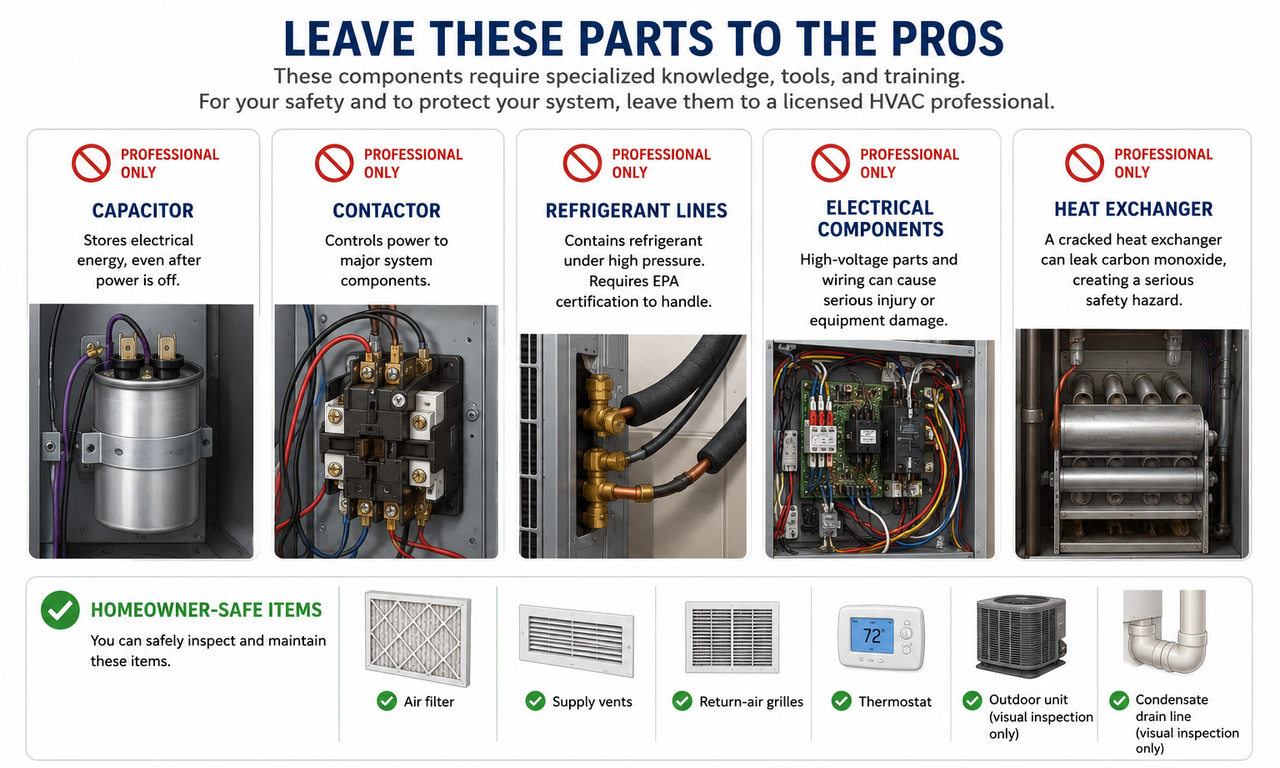
Some parts of your HVAC system can be safely inspected. Others should be left to a licensed professional.
Knowing where that line is helps protect both you and your equipment.
Refrigerant
If you suspect your system is low on refrigerant, don't try to add more yourself.
Air conditioners are sealed systems. If refrigerant is low, there's usually a leak that needs to be found and repaired before additional refrigerant is added.
Handling refrigerants also requires EPA certification, making this a job for a licensed HVAC professional.
Electrical components
The outdoor condenser and indoor air handler contain high-voltage electrical components.
That includes parts such as capacitors, contactors, and electrical wiring.
Even after the power is turned off, some electrical components can continue storing energy.
If you suspect an electrical problem, don't remove access panels or attempt to test these components yourself.
The heat exchanger
If your system includes a gas furnace, leave the heat exchanger alone.
A damaged heat exchanger can allow carbon monoxide to enter your home's air supply, making it a safety concern rather than a simple repair.
If you ever smell gas, your carbon monoxide detector alarms, or you suspect a problem with the furnace, stop using the system and contact the appropriate emergency services or your HVAC company immediately.
Anything that requires taking the system apart
As a general rule, if the next step requires removing panels, disconnecting wiring, opening refrigerant lines, or using specialized testing equipment, it's time to stop troubleshooting.
By this point, you've already completed the checks that are safe and worthwhile for a homeowner.
Symptoms That Mean It's Time to Call Today
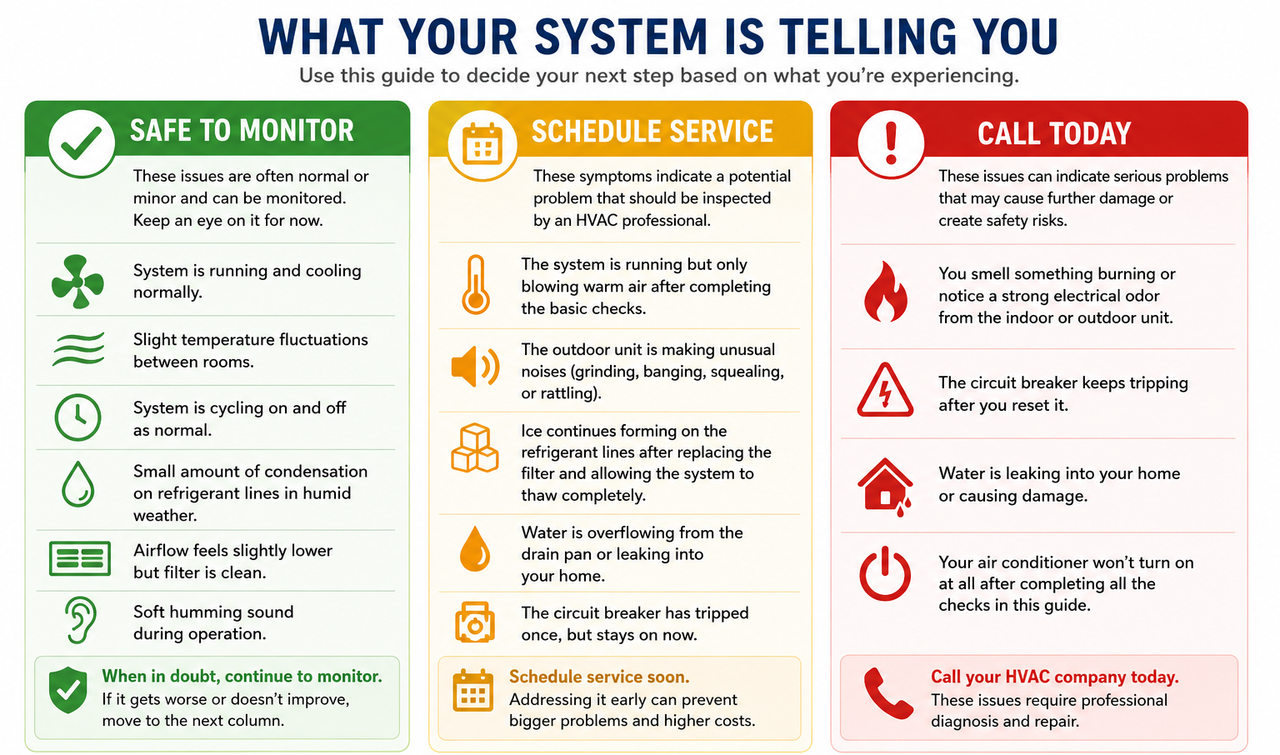
If you've worked through the checks in this guide and you're seeing any of the symptoms below, it's time to schedule service rather than continue troubleshooting.
Call an HVAC company if:
- The system is running but only blowing warm air after you've confirmed the thermostat settings, checked the air filter, and verified the breaker hasn't tripped.
- The outdoor unit is making grinding, banging, squealing, or other unusual mechanical noises.
- You smell something burning or notice a strong electrical odor coming from the indoor or outdoor unit.
- Ice continues forming on the refrigerant lines after replacing a dirty filter and allowing the system to thaw completely.
- The circuit breaker keeps tripping after you've reset it once.
- Water is overflowing from the drain pan or leaking into your home.
- Your air conditioner won't turn on at all after you've completed the checks in this guide.
At this point, you've ruled out many of the simple issues that homeowners can safely address. The next step is having the system inspected so the underlying problem can be identified correctly.
If you're deciding who to call, our article How to Choose the Right HVAC Company in Cypress & Katy explains what to look for before scheduling service.
If you have questions about how HVAC systems work or common air conditioning problems, you may also find these resources helpful:
What Does an HVAC Tune-Up Actually Include? (And Why the Name Causes So Much Confusion) — Learn what happens during a professional maintenance visit and what it can (and can't) identify.
Why Is Upstairs Hotter Than Downstairs? (And How to Fix It) — Understand why uneven temperatures often point to airflow or system design issues rather than a single broken component.
AC Repair vs. Replace: How to Actually Decide — If your system needs a major repair, this guide can help you decide whether repairing or replacing it makes the most sense.
Conclusion
If your air conditioner isn't working properly, it's easy to assume the worst.
Sometimes the problem is something simple, like a thermostat setting, a dirty air filter, or a tripped breaker. Other times, it's a sign that your system needs professional attention.
Knowing the difference can save you time, reduce frustration, and help you decide what to do next with confidence.
By working through the checks in this guide, you've ruled out many of the issues homeowners can safely address on their own. If your system is still struggling after those checks, the next step isn't more troubleshooting. It's having the system inspected so you can understand what's actually causing the problem.
If you'd like to learn more before scheduling service, our article How to Choose the Right HVAC Company in Cypress & Katy explains what to look for in an HVAC contractor and the questions worth asking before inviting someone into your home.
When you're ready, you can schedule a Service Call with The General Heating & Air. We'll inspect the system, explain what we find, answer your questions, and walk you through your options so you can decide what makes the most sense for your home.
Frequently Asked Questions
Should I turn my air conditioner off if it's blowing warm air?
It depends on what's causing the problem. If the system is simply circulating warm air but isn't making unusual noises or showing signs of ice, you can usually leave it on while you work through the checks in this guide. If you notice ice on the refrigerant lines, repeated breaker trips, burning smells, or unusual mechanical noises, turn the system off and schedule service.
How long should I wait after changing my air filter?
If a dirty filter restricted airflow enough to affect cooling, it may take some time for the system to return to normal. If the evaporator coil froze, the ice must melt before the system can cool properly again. Depending on how much ice formed, that may take several hours. If cooling doesn't improve after the system has completely thawed, it's time to have it inspected.
Is it safe to reset a tripped breaker?
Yes, once. If the breaker trips again after you reset it, don't continue resetting it. Circuit breakers are designed to protect your HVAC system from electrical problems, and repeated trips usually indicate an issue that needs professional diagnosis.
Why is my air conditioner running but my house isn't getting cooler?
Several problems can cause this, including: A dirty air filter A thermostat setting or schedule Restricted airflow A frozen evaporator coil Low refrigerant A mechanical or electrical problem Working through the checks in this guide can help narrow down the possibilities before you schedule service.
Should I cover my outdoor unit with a tarp if it's dirty?
No. If leaves or grass clippings have collected around the condenser, remove the debris and gently rinse the outside of the unit with a garden hose. Avoid using a pressure washer or covering the unit while it's operating.
Can I use my air conditioner if I see ice on the refrigerant lines?
No. Turn the system off or switch the thermostat to FAN ONLY so the ice can melt. Running an air conditioner while ice is present can make the problem worse and may lead to additional damage. Once the ice has melted, the underlying cause still needs to be identified before returning the system to normal operation.
When should I stop troubleshooting and call an HVAC company?
If you've completed the safe checks in this article and your system still isn't working properly, it's time to schedule service. You should also stop troubleshooting immediately if you notice repeated breaker trips, burning smells, water leaking into your home, persistent ice on the refrigerant lines, or loud mechanical noises.