Jump to section
Executive Summary
Despite the name, an HVAC tune-up isn't primarily about tuning up your equipment. It's about evaluating its condition.
During a professional maintenance visit, your technician inspects the system, tests how it's operating, takes objective measurements, and documents anything that needs attention. If they identify a concern—such as a failing capacitor, restricted airflow, or signs of low refrigerant—they'll explain what they found and recommend the appropriate next steps rather than automatically performing additional work during the visit.
Understanding the purpose of a tune-up helps explain:
- What's typically included
- Why repairs and deep cleaning are usually separate services
- Why additional recommendations may be made
- How to tell whether you're receiving a thorough maintenance visit
By the end of this guide, you'll know what to expect from a professional HVAC tune-up and how to evaluate the quality of the service you receive.
What Is an HVAC Tune-Up?
One of the first things that confused me when I entered the HVAC industry was the phrase "HVAC tune-up."
I knew what an inspection was.
I knew what a repair was.
But I wasn't sure where a tune-up fit.
The word made me picture a technician actively adjusting, cleaning, or fixing the equipment.
As I learned more, I realized that's not actually the primary purpose of the visit.
The name creates one expectation. The service is designed to accomplish something different.
The comparisons that finally made it click
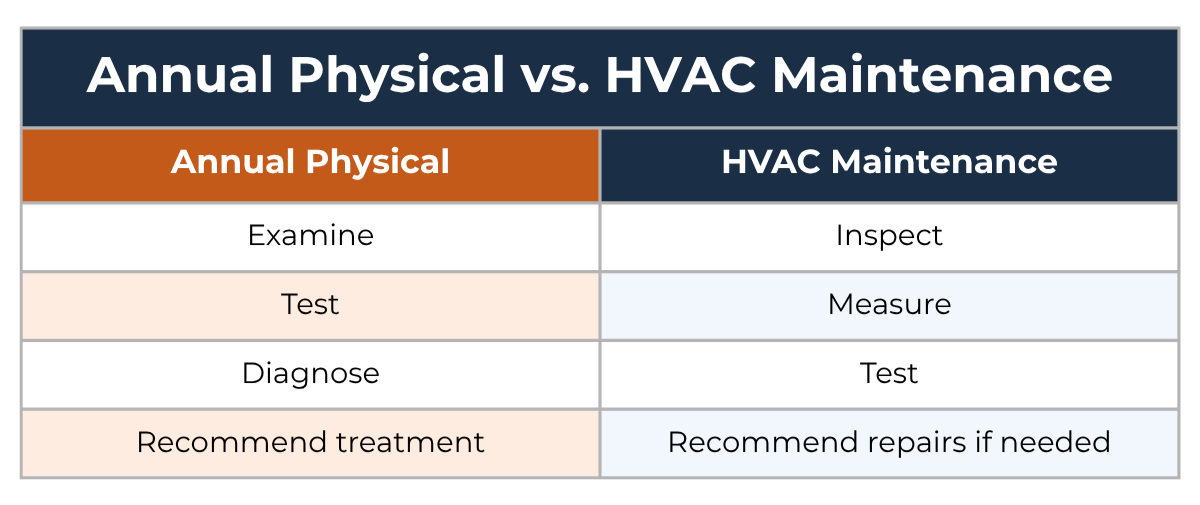
As a physician, the first comparison that helped me understand HVAC maintenance was an annual physical.
Your doctor doesn't automatically treat every health condition you might have during your yearly checkup.
Instead, they:
- Review your medical history
- Check your vital signs
- Perform an examination
- Order additional testing
- Recommend treatment if they find a problem
The appointment is designed to evaluate your health, not perform every treatment you might need.
As I continued learning about HVAC, I realized there was another comparison much closer to home.
Before we started The General Heating & Air, my husband spent years in the Air Force maintaining mission-critical equipment. The goal was to catch issues before they became problems. His job was to inspect, test, measure, document its condition, and address concerns proactively.
That's the same philosophy behind professional HVAC maintenance.
Whether you're caring for a person, military equipment, or an HVAC system, the first step is understanding its condition before deciding whether anything needs to be repaired.
So what is the technician actually doing?
During a maintenance visit, the technician is evaluating your system's overall condition.
That includes inspecting components, testing performance, taking measurements, checking safety controls, and documenting anything that needs attention.
If they discover a rusty drain pan, a weak capacitor, or signs that your refrigerant charge may be low, they'll explain what they found and recommend the appropriate corrective service.
That doesn't mean your tune-up was incomplete.
It means the maintenance visit accomplished exactly what it was designed to do: identify developing problems before they turn into expensive breakdowns.

What Is Included in an HVAC Tune-Up?
While every HVAC company has its own maintenance checklist, a quality tune-up should answer one simple question:
How is your HVAC system performing, and is there anything that needs attention?
To answer that question, a technician evaluates your system's safety, performance, and overall condition. They're looking for signs that something could become a problem before your system fails on the hottest day of summer or the coldest day of winter.
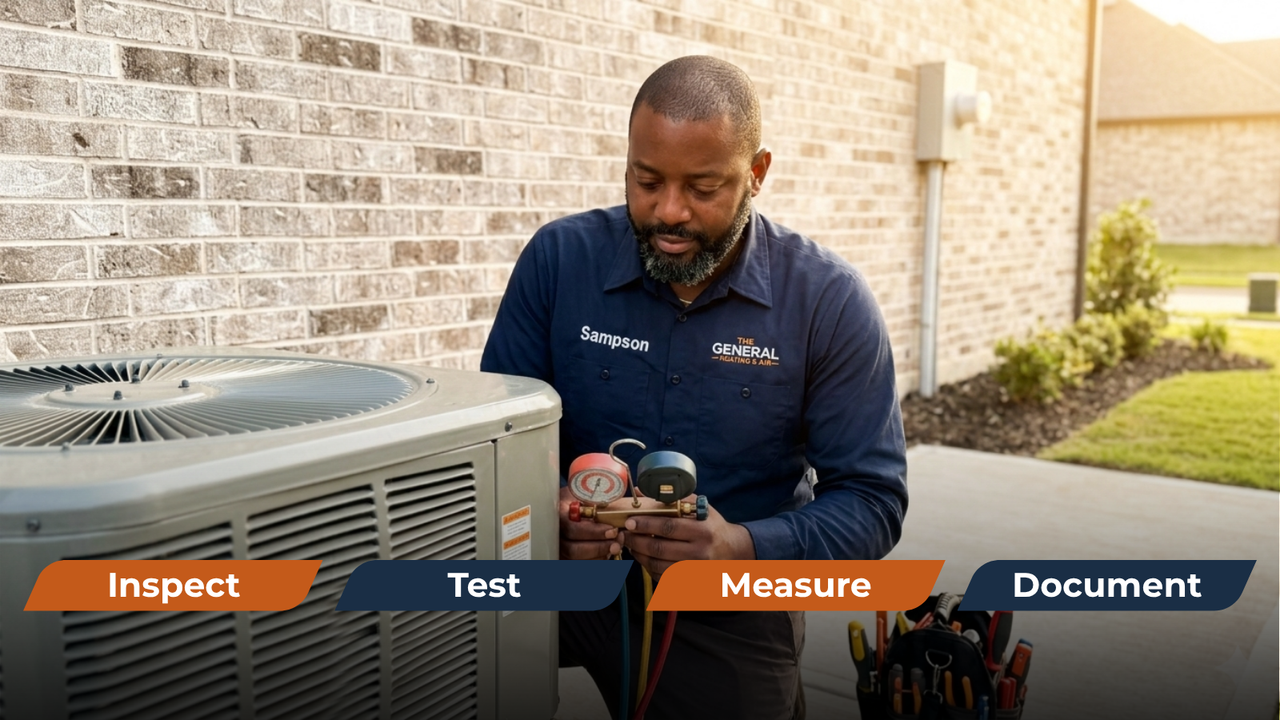
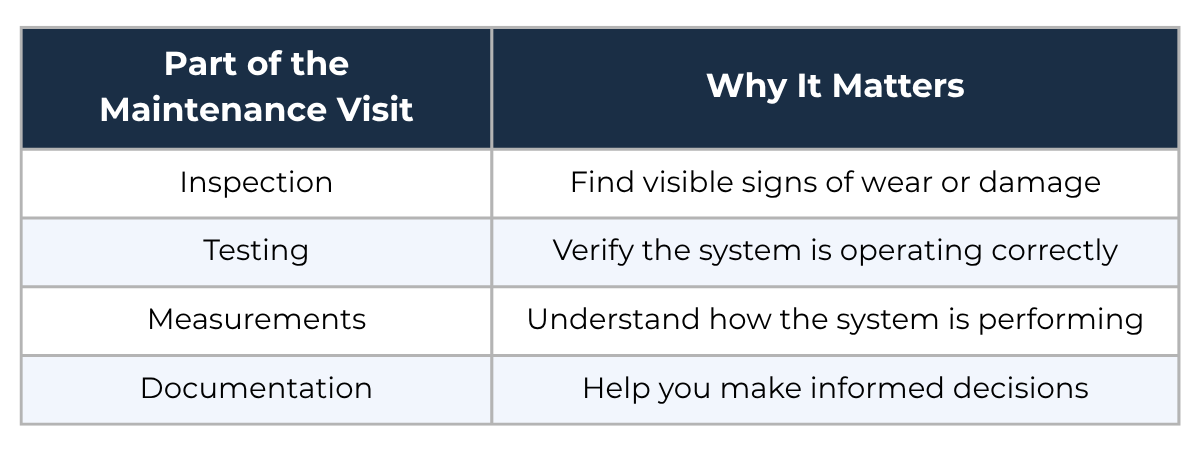
Most professional maintenance visits include four core activities:
- Inspect system components for wear, damage, or safety concerns.
- Test how the equipment is operating.
- Measure system performance against manufacturer specifications.
- Document the findings so you understand your system's condition and any recommended next steps.
Everything else in a quality tune-up builds on these four steps.
What Does an HVAC Technician Inspect?
Inspection is about identifying visible signs of wear, damage, or safety concerns before they lead to larger problems.

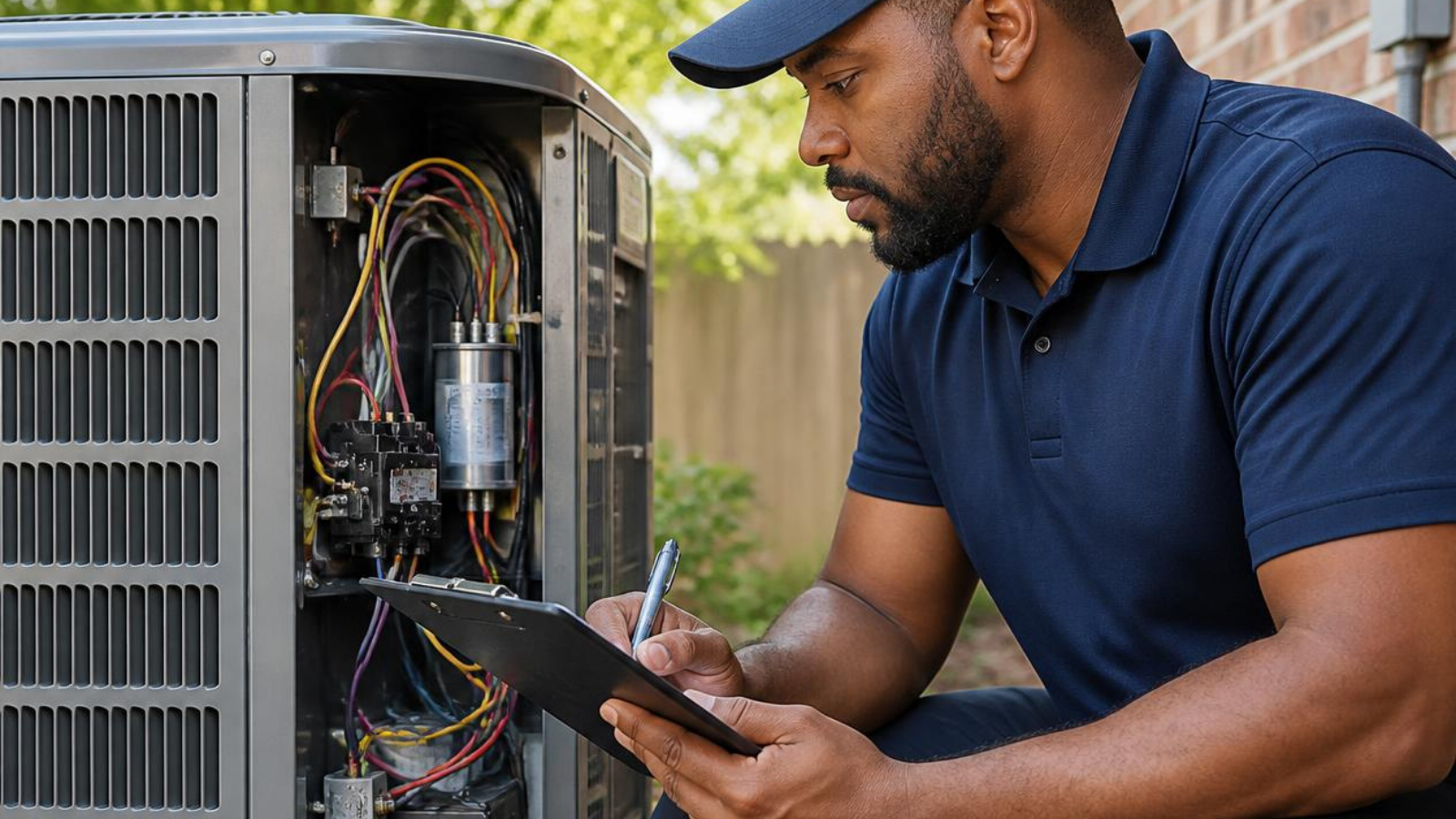
During a maintenance visit, your technician visually examines the condition of many parts of your HVAC system. Depending on your equipment, this may include:
- Air filter
- Indoor and outdoor coils
- Blower assembly
- Electrical wiring and connections
- Capacitors and contactors
- Refrigerant lines
- Condensate drain and drain pan
- Duct connections near the equipment
- Thermostat
- Safety controls
The goal is to identify anything that appears worn, damaged, dirty, or unsafe before it develops into a larger problem.
What Does the Technician Test?
A visual inspection only tells part of the story. Testing shows how your HVAC system is actually operating.
While the system is running, your technician checks how its components work together and whether they're operating as expected.
This often includes testing:
- Temperature difference across the system (temperature split)
- Refrigerant operating pressures
- Compressor operation
- Fan motor performance
- Safety switches
- Thermostat operation
- System startup and shutdown sequence
These tests help verify that your equipment is performing the way it was designed to.
What Measurements Are Taken?
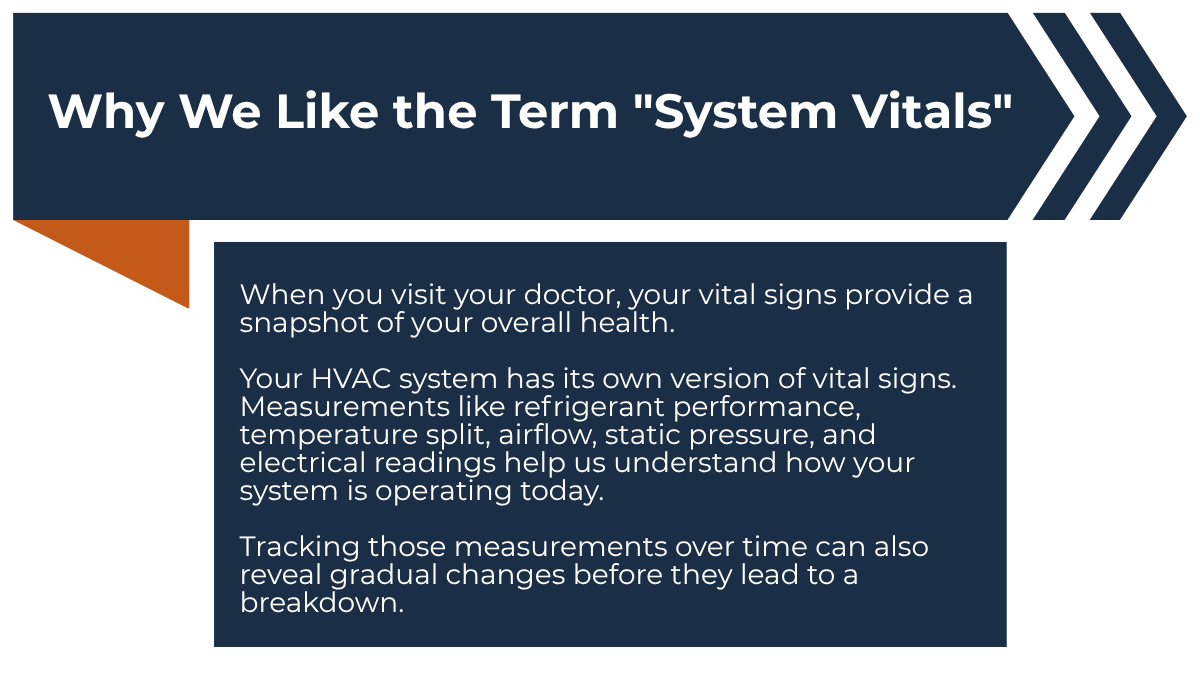
Measurements replace guesswork with objective data.
Many homeowners are surprised to learn how much measuring is involved during a professional maintenance visit.
Rather than relying on assumptions, technicians use specialized tools to evaluate how your HVAC system is performing.
Common measurements include:
- Electrical voltage
- Electrical amperage
- Capacitor readings
- Refrigerant pressures
- Air temperature entering and leaving the equipment
- Airflow (when appropriate)
- Static pressure (when appropriate)
These measurements provide objective data that helps identify developing problems before they become expensive repairs.
What Gets Documented?
Documentation helps you understand your system's condition and supports any recommendations your technician makes.
The findings should be documented so you understand:
- How your system is performing today
- Any maintenance concerns that were discovered
- Repairs that may be needed now
- Items that should be monitored in the future
- Recommendations to improve efficiency, reliability, or system lifespan
Good documentation also creates a performance history for your equipment, making it easier to track changes over time.
What Good Documentation Looks Like
A quality maintenance visit shouldn't end with, "Everything looks good," or "You need this repaired."
You should leave with documentation that helps you understand how your system is performing and why any recommendations are being made.
At The General Heating & Air, every maintenance visit includes a detailed report. Depending on the equipment and the tools we're using, that may include operating measurements, technician notes, photos, videos, or a combination of all four.
Some customers also receive a MeasureQuick® System Vitals Report, which provides additional performance data for compatible systems.
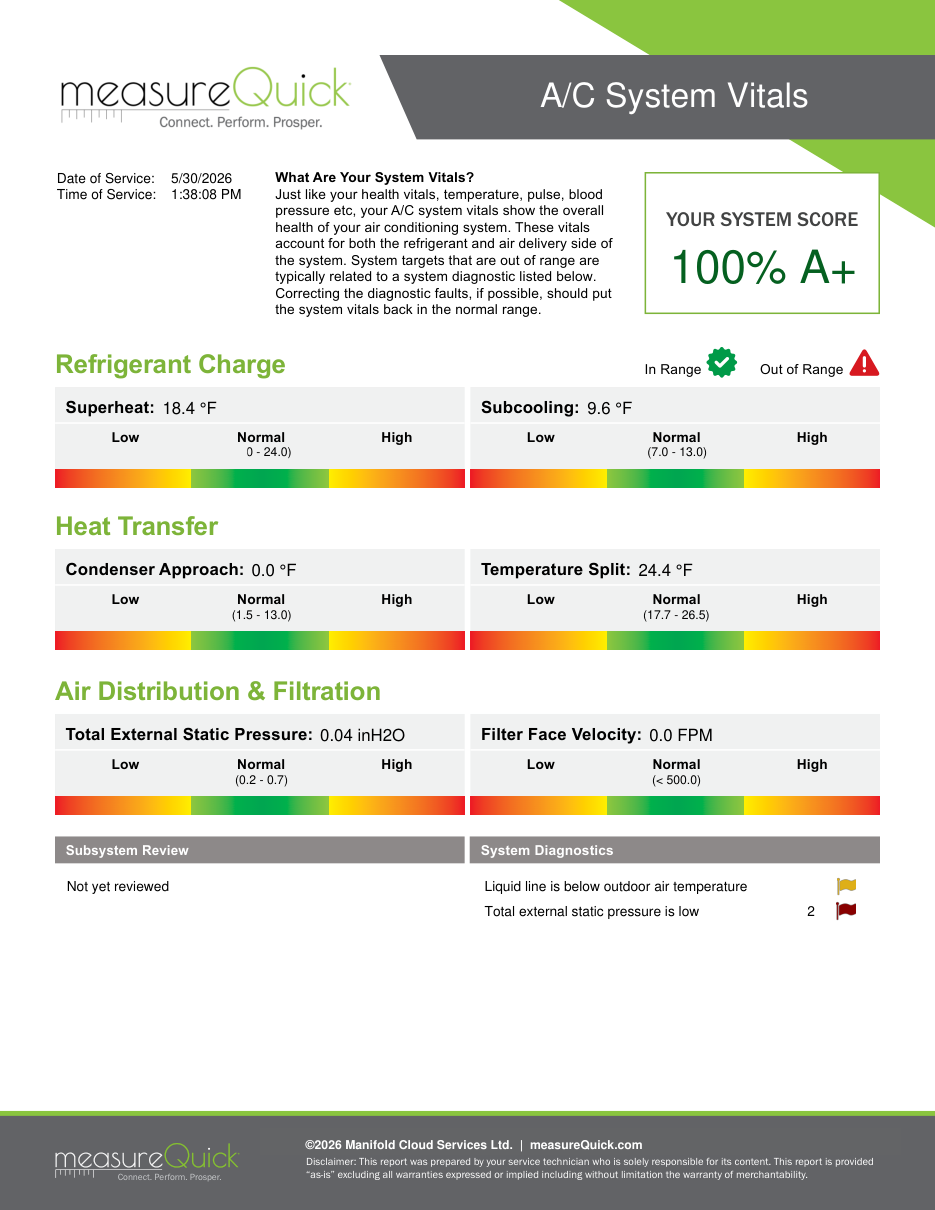
A System Vitals Report gives homeowners objective measurements of their HVAC system's performance. Not every maintenance visit includes this exact report, but every customer receives documentation explaining our findings and recommendations.
Why Doesn't a Tune-Up Include Every Repair or Cleaning?
This is where the term "tune-up" causes the most confusion.
If a technician discovers an improperly installed drain line, a weak capacitor, or another developing issue during maintenance, many homeowners naturally wonder:
"If you found it, why didn't you just fix it?"
The answer comes down to the purpose of the visit.
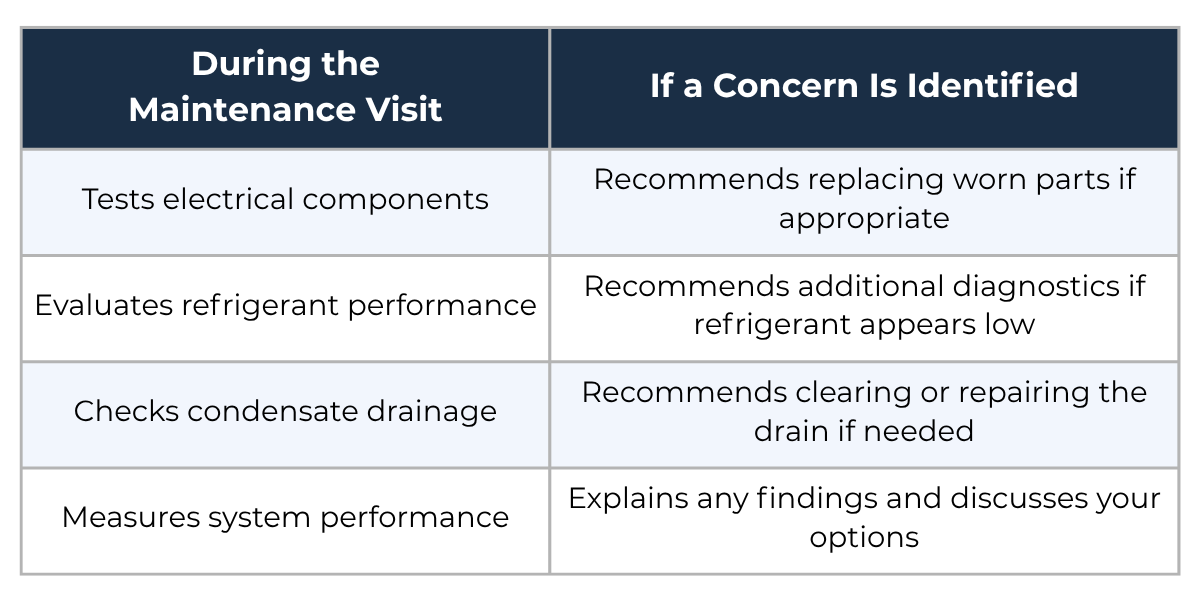
A maintenance appointment is designed to evaluate your system and identify anything that needs attention. Once the technician understands your system's condition, they explain what they found, answer your questions, and recommend any corrective services that may be appropriate.
From there, the decision is yours.
Maintenance gives you information not obligations.
That distinction is important.
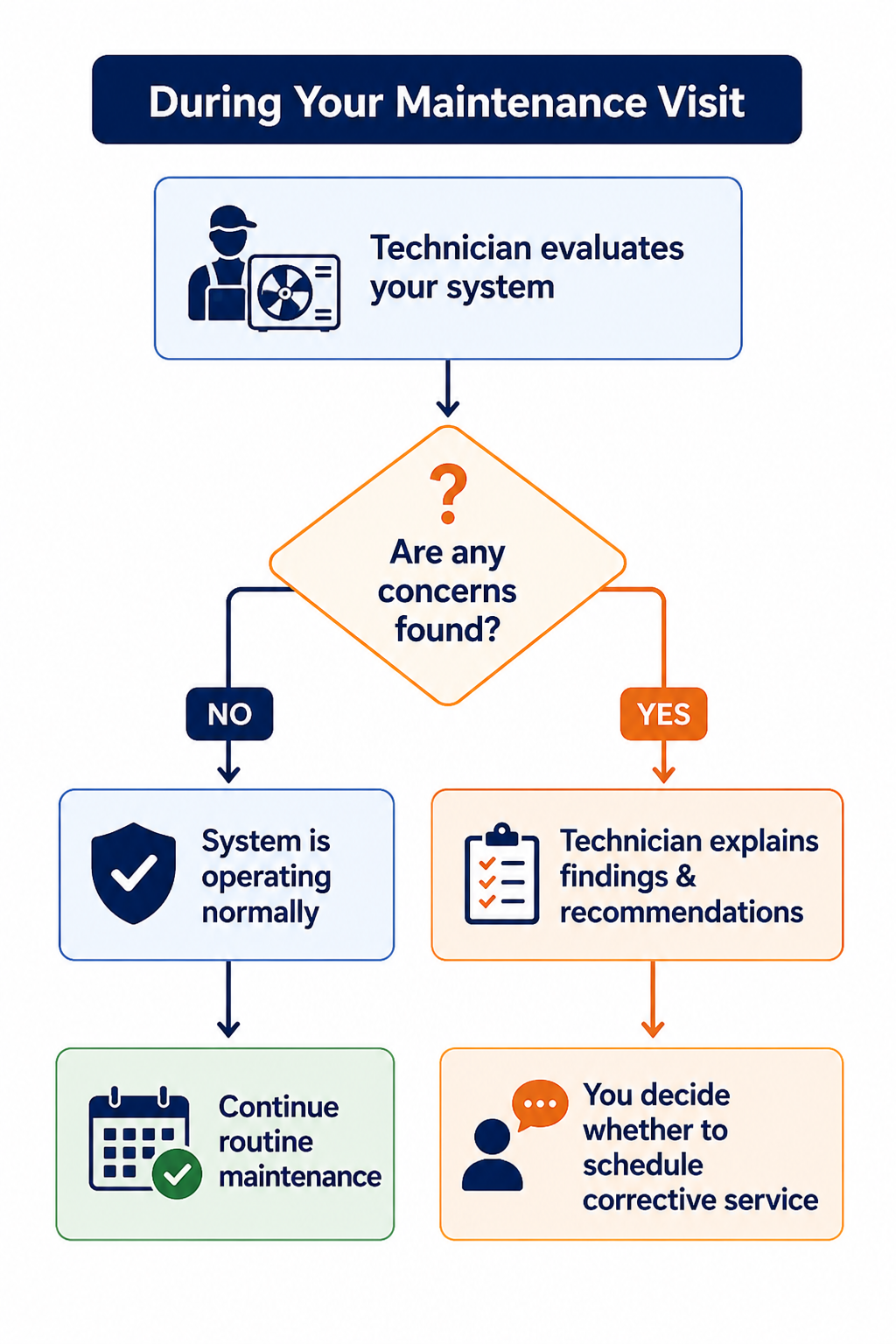
Many of the issues identified during maintenance aren't emergencies. They're early warning signs that give you the opportunity to address a problem proactively or continue monitoring it until you're ready to act.
Corrective services—whether that's replacing a worn electrical component, cleaning a dirty evaporator coil, repairing a drain issue, or performing additional diagnostics because the system appears to have a low refrigerant charge—require additional time, labor, materials, and sometimes replacement parts.
Those services are separate from the maintenance visit so you can make an informed decision about whether and when you'd like to move forward.
Does Every HVAC Company Include the Same Things in a Tune-Up?
No, and that's one reason homeowners have very different experiences with HVAC maintenance.
While most professional HVAC companies inspect, test, measure, and document your system during a maintenance visit, not every company follows the same checklist.
Some visits are comprehensive.
Others focus on only a handful of inspection points.
The amount of time a technician spends, the equipment they use, and the depth of the evaluation can vary significantly from one company to another.
That's why it's important to understand what's actually included before scheduling a tune-up.
Questions to Ask Before Scheduling Maintenance
If you're comparing HVAC companies, here are a few questions worth asking:
- How long does a typical maintenance visit take?
- Do you inspect both the indoor and outdoor equipment?
- Will you provide a written summary of your findings?
- Do you measure system performance or only perform a visual inspection?
- If you find a problem, will you explain my options before performing additional work?
The answers to these questions will tell you far more about the quality of a maintenance visit than the advertised price alone.
Why Are Some HVAC Tune-Ups So Cheap?
Some HVAC tune-ups are advertised at prices that seem too good to be true.
In many cases, that's because the tune-up is being used as a loss leader.
A loss leader is a service sold at little or no profit to create an opportunity for a longer-term customer relationship, or to uncover additional work while the technician is already in the home.
That business model is not automatically dishonest. A technician may find legitimate problems during a low-cost tune-up, just as they might during a full-price maintenance visit.
But the lower the advertised price, the more important it is to ask:
- What is actually included?
- How much time is scheduled for the visit?
- Will the technician take and document objective measurements?
- Will you receive photos, videos, or a written report?
- Are technicians expected or incentivized to generate repair or replacement opportunities?
- Will you be shown evidence before being asked to approve additional work?
Very inexpensive tune-ups can create pressure to recover the cost of the visit through repair recommendations, replacement opportunities, or ongoing service agreements.

At The General Heating & Air, we price our maintenance visits as professional evaluations not deeply discounted lead-generation offers. Every customer receives documentation of our findings, with photos and videos when appropriate, so they can understand what we found before deciding whether to move forward with any recommended work.
Maintenance Is a Category, Not a Single Service
Up to this point, we've focused on what happens during a maintenance visit.
But there's one distinction that helps explain much of the confusion surrounding HVAC maintenance.
The word maintenance can mean two different things.
Sometimes people are referring to the maintenance visit: The appointment where a technician inspects, tests, measures, and documents the system.
Other times they're referring to everything required to maintain the system over time, including repairs, adjustments, and cleaning when those services are actually needed.
Those aren't the same thing.
The maintenance visit is an evaluation. Ongoing maintenance is the broader category of services that keep your HVAC system operating safely and efficiently throughout its life.
Once you understand that distinction, it becomes much easier to understand why some services are included in the visit while others are recommended separately.

If you read HVAC manufacturer maintenance instructions, you'll often see phrases like "as required" or "where appropriate."
That's because manufacturers distinguish between evaluating a system and performing corrective work. Components are inspected during routine maintenance, while cleaning, adjustments, or repairs are performed only if the system's condition calls for them.
Understanding that distinction helps explain why a maintenance visit doesn't automatically include every possible service.
Is an HVAC Tune-Up Worth It?
If you expect a tune-up to fix every problem with your HVAC system, you'll probably be disappointed.
If you expect it to help you understand your system's condition, identify developing problems, and reduce the likelihood of unexpected breakdowns, it's one of the most valuable services you can schedule.
Like changing the oil in your car, routine HVAC maintenance can't guarantee that a part will never fail.
What it can do is reduce surprises by helping you catch issues before they become more expensive or before they leave you without heating or cooling when you need it most.
What Are the Benefits of Regular HVAC Maintenance?
The biggest benefit of maintenance is simple: it replaces uncertainty with information.
1. It May Help Protect Your Manufacturer's Warranty
Many HVAC manufacturers require routine maintenance as a condition of their warranty coverage. If a major component fails during the warranty period, you may be asked to show that the system has been properly maintained.
Warranty requirements vary by manufacturer, so keeping your maintenance documentation is an important part of protecting your investment.
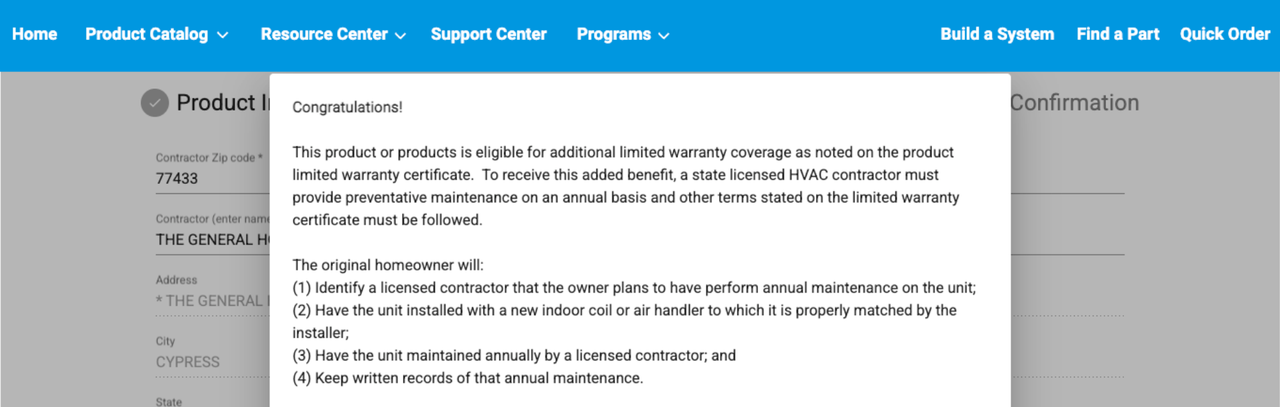
Actual message from Daikin after registration of new HVAC equipment.
2. It Helps You Catch Problems Early
Many issues discovered during maintenance aren't emergencies.
Instead, they're early warning signs that allow you to decide whether you'd rather address the problem proactively or wait until it requires repair.
Rather than being surprised by an unexpected breakdown, you have time to understand the issue and consider your options.
3. It Gives You Confidence in Your System
One of the biggest benefits of maintenance is simply knowing where your system stands.
After a quality maintenance visit, you should understand:
- How your system is performing
- Whether any concerns were identified
- Which recommendations are worth addressing now versus monitoring over time
Instead of wondering whether your system is ready for another Texas summer, you'll have objective information about its condition.
4. It May Improve System Performance
Maintenance helps identify conditions that can reduce your system's performance or efficiency.
Addressing those issues when appropriate can help your HVAC system operate more effectively and may reduce unnecessary strain on its components.
What Maintenance Can't Do
Understanding what maintenance can't do is just as important as understanding what it can.
A tune-up cannot:
- Guarantee your system won't break down
- Prevent every repair
- Reverse normal wear and tear
- Eliminate the need for future part replacements
- Fix existing problems without additional corrective service
Even a well-maintained HVAC system contains mechanical and electrical components that eventually wear out.
Maintenance isn't about preventing every failure. It's about helping you make better decisions before failures happen.
What Is the Difference Between a Tune-Up and an HVAC Membership?
A tune-up is a single maintenance visit.
An HVAC membership is an ongoing service relationship that combines scheduled maintenance with additional benefits, such as system monitoring, priority service, and repair savings.
The details vary from one company to another, so a membership shouldn't be judged only by how many tune-ups it includes.
At The General Heating & Air, our monitored membership plans extend preventive care beyond the day of your maintenance visit. Along with an annual in-person visit, SmartAC sensors monitor your system between appointments and track things like delivered-air performance, filter pressure, and moisture near the drain pan. Customers receive alerts and monthly health reports, and our team reviews technical notifications when the system begins to drift from normal operation.
Depending on the plan, memberships may also include:
- Priority scheduling
- Repair and replacement discounts
- Reduced or waived diagnostic fees
- Comfort Reserves that accumulate toward qualifying future work
If all you want is a one-time maintenance visit, a tune-up may be all you need. If you'd rather take a more proactive approach to caring for your HVAC system year-round, a membership may be worth exploring.
Related resource: Learn more about The General’s membership plans and how 24/7 HVAC monitoring works.
Conclusion
An HVAC tune-up isn't really about tuning up your system, it's about understanding its condition.
A quality maintenance visit should inspect, test, measure, and document how your system is performing. If your technician identifies a concern, they should explain what they found, provide evidence to support their recommendations, and give you the information you need to decide what happens next.
That's what good maintenance is really about: replacing uncertainty with information.
Whether you're choosing an HVAC company for a one-time tune-up or considering an ongoing maintenance membership, look for a company that takes the time to inspect, test, measure, document, and clearly explain their findings. A quality maintenance visit should leave you with a better understanding of your system.
At The General Heating & Air, that's the standard we hold ourselves to. Every maintenance visit is designed to give you a clear picture of your system's condition, supported by detailed reports, photos, videos, and objective measurements when appropriate, so you can make informed decisions with confidence.
If you're ready to schedule a professional HVAC maintenance visit, we'd be honored to help. And if you're looking for a more proactive approach to protecting your system year-round, explore our HVAC Membership Plans and 24/7 HVAC Monitoring to see how continuous monitoring complements annual maintenance.
Frequently Asked Questions
What's the difference between an HVAC tune-up and HVAC maintenance?
Most HVAC companies use the terms "tune-up" and "maintenance" interchangeably. In most cases, they're referring to the same type of preventive service visit. The term "tune-up" can be misleading because it sounds like the technician will automatically adjust, repair, or clean the system during the appointment. In reality, the primary purpose of the visit is to inspect, test, measure, and document your system's condition. If additional work is needed, your technician should explain their findings and recommend the appropriate next steps.
How long does an HVAC tune-up take?
At The General Heating & Air, a maintenance visit takes approximately two hours for your first HVAC system. If your home has additional systems, plan on about 45 minutes for each additional system. We intentionally schedule enough time to thoroughly inspect, test, measure, and document your equipment rather than rushing through a checklist.
How often should I have my HVAC system professionally maintained?
Most HVAC systems should be professionally maintained at least once a year, although many manufacturers recommend maintenance before each heating and cooling season. Be sure to follow your equipment manufacturer's recommendations, especially if you want to maintain your warranty coverage.
Should I schedule maintenance if my system seems to be working fine?
Yes. In fact, that's the best time to schedule it. The purpose of maintenance isn't to fix a broken system, it's to evaluate one that appears to be working normally. A maintenance visit can identify developing issues before they become unexpected breakdowns, giving you the opportunity to decide whether to address them now or continue monitoring them.
Why did the technician recommend repairs during my tune-up?
Because identifying potential problems is one of the primary purposes of maintenance. Finding an issue doesn't automatically mean you need to approve the repair that day. A quality maintenance visit should provide the measurements, documentation, and explanation you need to understand your options and decide what makes sense for your home and budget.
Should refrigerant be added during every tune-up?
No. Refrigerant isn't a routine maintenance item. If your technician's measurements suggest your system may have a low refrigerant charge, additional diagnostics are usually needed to determine why before refrigerant is added. Simply adding refrigerant without identifying the underlying issue is rarely the appropriate long-term solution.
Can I perform HVAC maintenance myself?
Homeowners can perform a few routine maintenance tasks, such as replacing the air filter, keeping the outdoor unit free of leaves and debris, and making sure supply and return vents aren't blocked. A professional maintenance visit goes much further. Technicians use specialized tools to test electrical components, measure refrigerant performance, evaluate airflow, verify safety controls, and document your system's operating condition.
What's the difference between a tune-up and an HVAC membership?
At The General Heating & Air, our monitored membership plans combine annual maintenance with continuous SmartAC monitoring, monthly system health reports, and alerts that can help identify potential problems between maintenance visits. Related Reading: Learn more about our HVAC Membership Plans and 24/7 HVAC Monitoring.