Jump to section
Executive Summary
Shopping for a new HVAC system usually starts with one question:
Which brand should I buy?
The answer isn't as simple as picking the most expensive system or the manufacturer with the best reputation.
Some brands are known for premium equipment. Others focus on affordability. Some manufacturers have stronger dealer networks, broader product lines, or better parts availability. Those differences can affect what it's like to own the system over the next 10 to 20 years.
At the same time, many of the brands homeowners compare are owned by the same parent company. They may share engineering, manufacturing, and major components while offering different features, warranties, and price points.
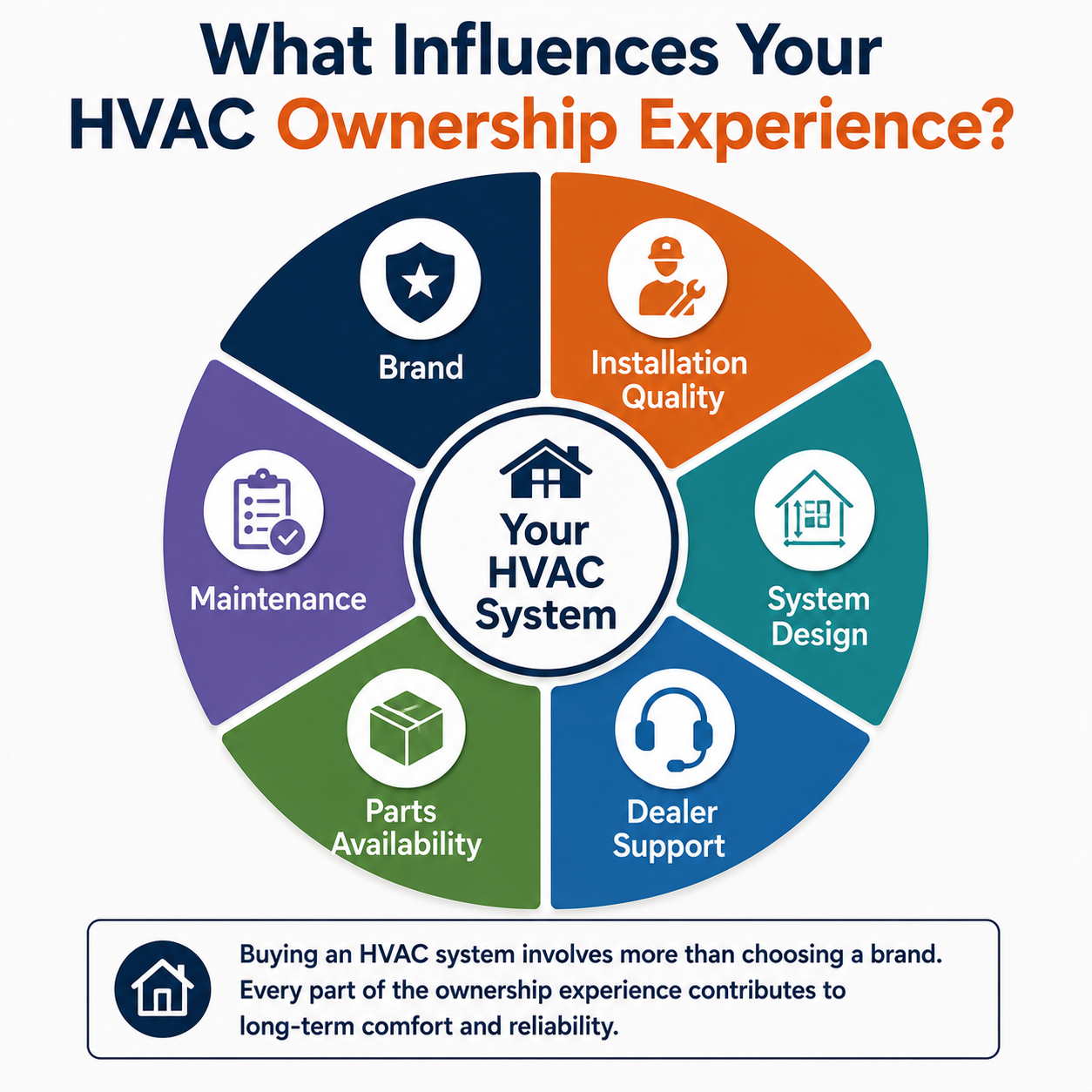
The contractor who installs the equipment also plays a major role. A quality installation, proper system design, and long-term dealer support all affect how well the system performs after it's installed.
This guide explains how the major HVAC brands compare, why there are so many of them, and what you should know before choosing a new system.
Does the HVAC Brand Matter?
Yes. The brand matters, but probably not as much as you think.
Brand can influence the available equipment features, warranty options, replacement parts, dealer support, and the price you pay.
Those are all good reasons to compare manufacturers before making a decision.
The brand, however, is only one part of the picture.
The quality of the installation, the contractor's experience, and the support available after the installation also influence how the system performs over time.
The next few sections explain how those pieces fit together, starting with a question many homeowners don't expect:
Why are there so many HVAC brands in the first place?
Why Are There So Many HVAC Brands?
Many of the HVAC brands you recognize are owned by the same parent company.
If you've started shopping for a new HVAC system, you've probably noticed something.
There are a lot of brands.
But most residential HVAC brands belong to a handful of large manufacturers. In many cases, those brands share factories, engineering, and major components while serving different parts of the market.
There are some differences though.
Manufacturers often build premium, mid-tier, and value-oriented brands. Those brands may offer different features, warranty options, efficiency ratings, and dealer programs.
Understanding who owns each brand helps explain why two systems with different names may have more in common than you expect.
Which HVAC Brands Are Owned by the Same Company?
Many brands that compete with each other are built by the same parent company.
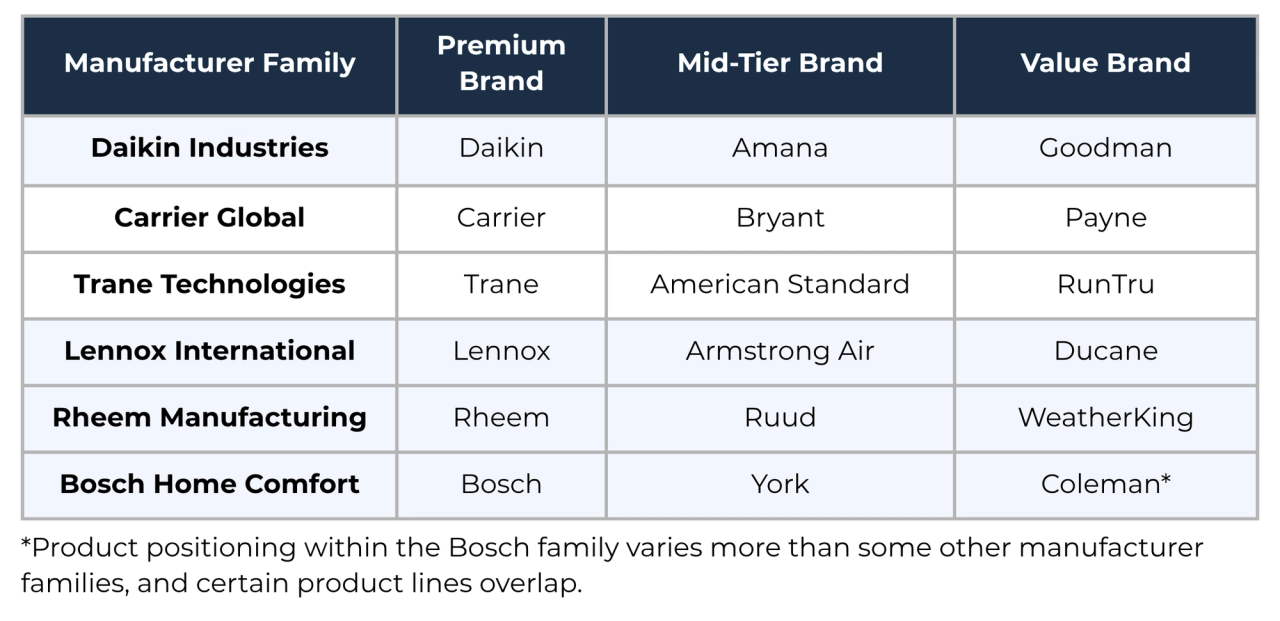
The table below shows the major residential HVAC manufacturers and the brands they own.
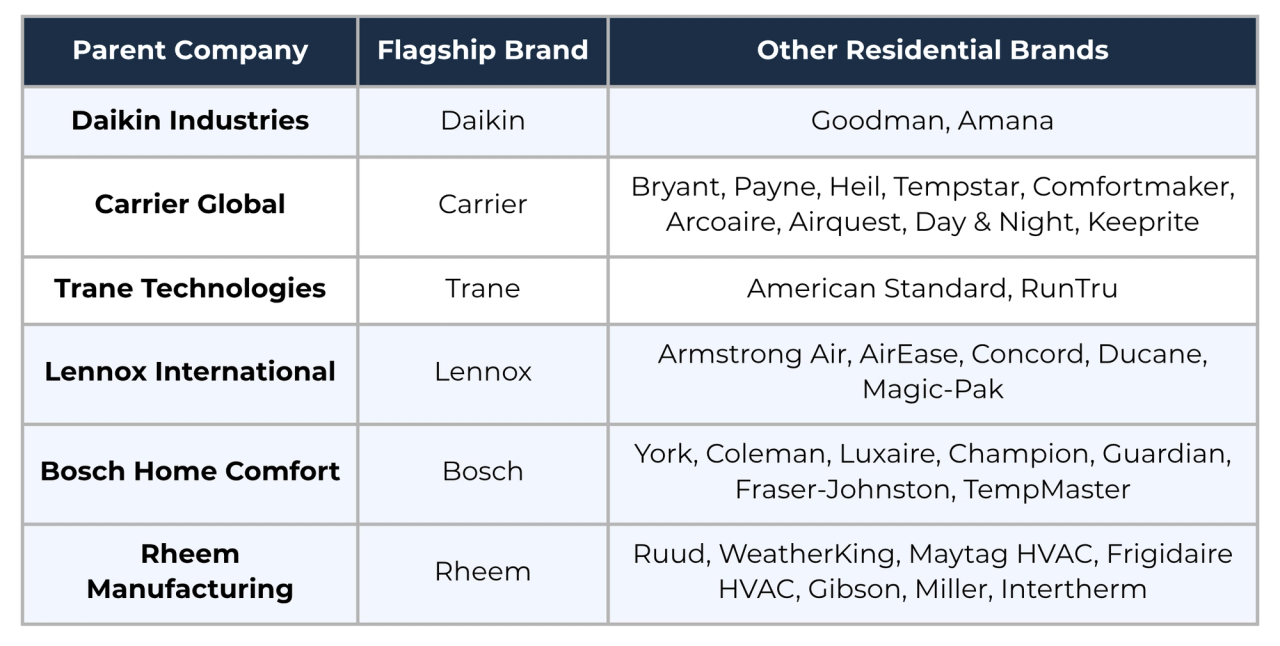
Some brands share factories.
Others share engineering or major components while offering different features, warranties, cabinet designs, and dealer programs.
For homeowners, that means two systems with different brand names may have much more in common than they first appear.
If Many Brands Are Owned by the Same Company, What's the Difference?
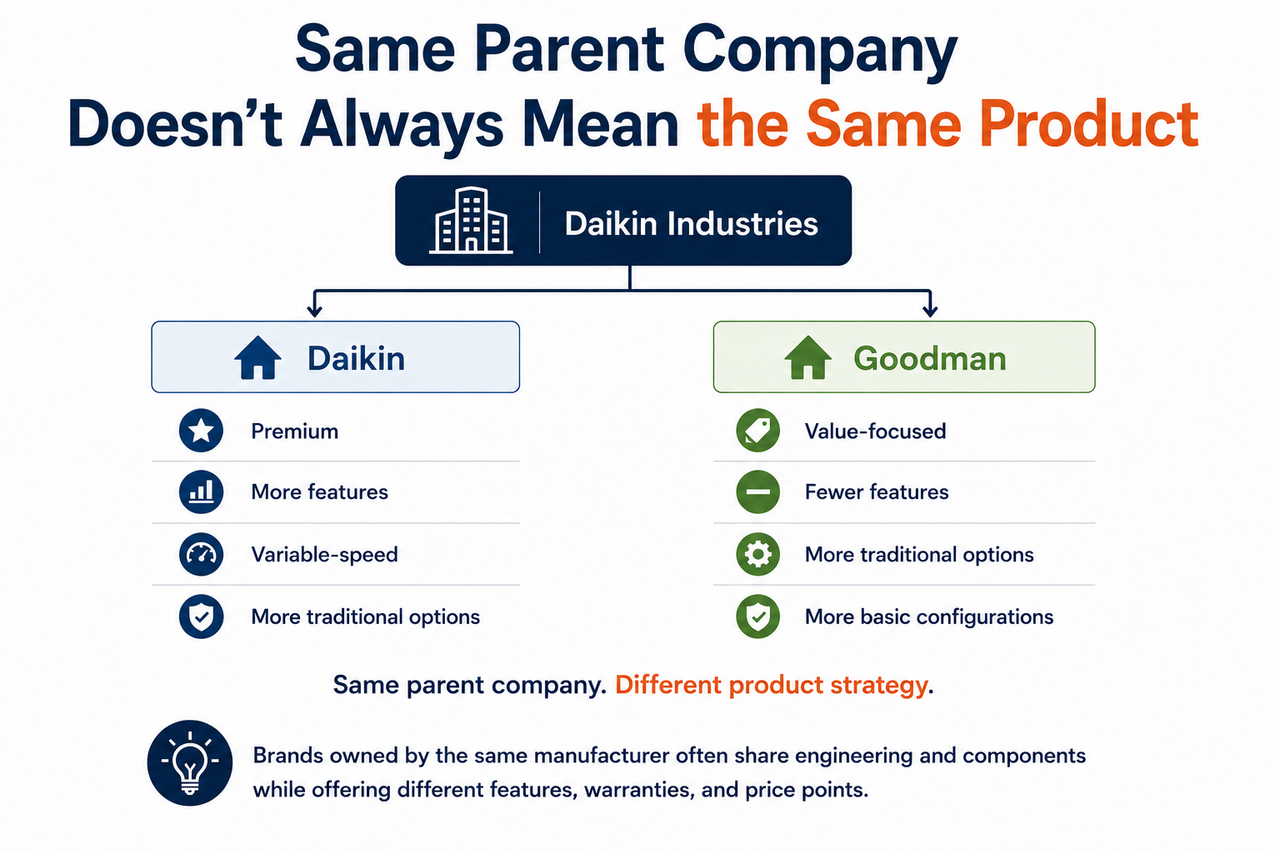
Brands owned by the same company often share engineering, but they aren't always the same product.
Manufacturers build multiple brands because homeowners have different budgets, comfort goals, and feature preferences.
One brand may focus on premium equipment with more available features.
Another may offer dependable equipment with fewer features at a lower price.
Some brands are sold through different dealer networks.
Others are more common in new construction than replacement projects.
A good example is the auto industry.
Toyota builds both Toyota and Lexus.
General Motors builds Chevrolet, GMC, Cadillac, and Buick.
Those vehicles share engineering, but they're built for different buyers.
HVAC manufacturers use a similar approach.
Why Do HVAC Contractors Recommend Different Brands?
Most HVAC contractors recommend the brands they know best because those are the systems they install and service every day.
If you've collected estimates from several HVAC companies, you've probably noticed that different contractors recommend different brands.
One may recommend Carrier.
Another may prefer Trane.
Another may install Daikin or Rheem.
That doesn't mean one contractor has found the only good manufacturer.
Most HVAC contractors become authorized dealers for one or more brands.
Those manufacturers provide training, technical support, warranty processing, equipment information, software updates, and access to replacement parts.
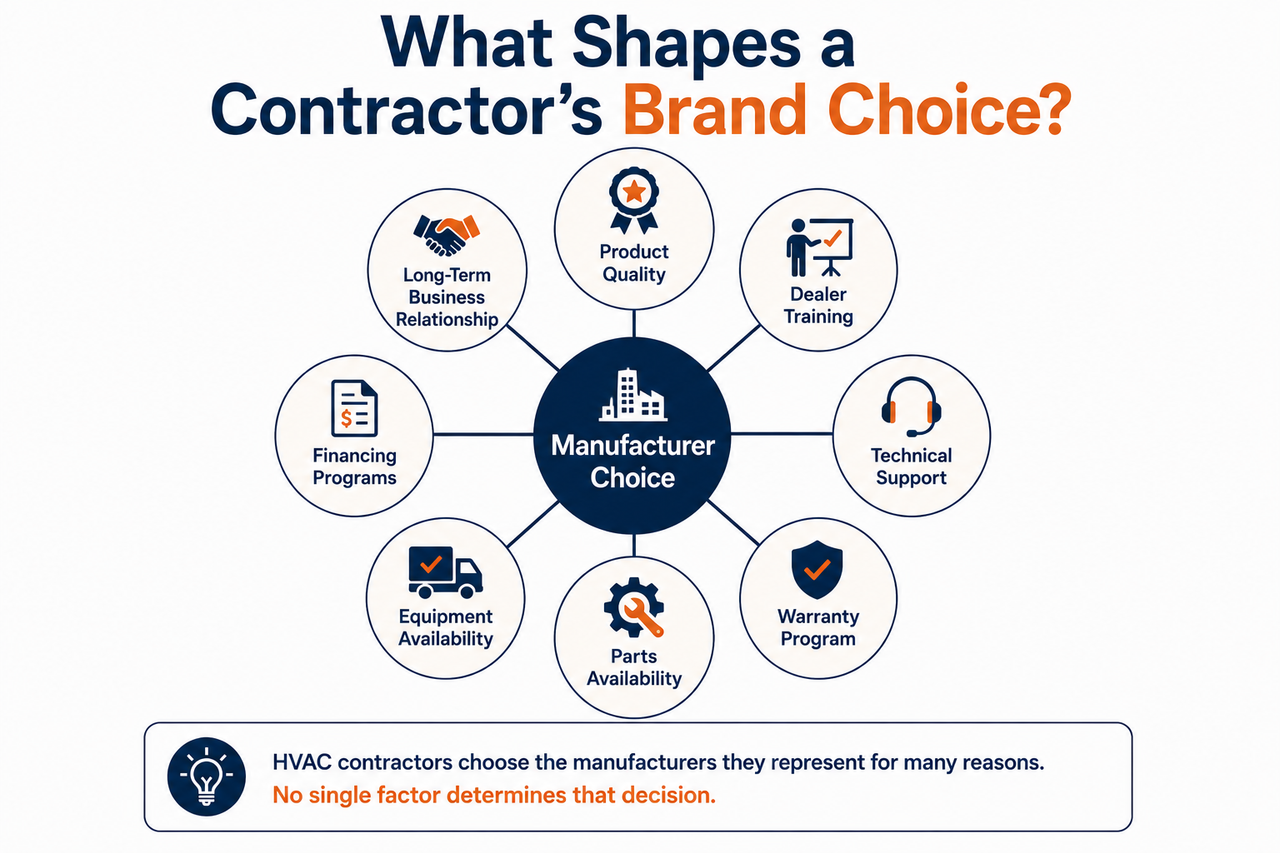
Contractors also make business decisions when choosing which manufacturers to represent. These factors influence those decisions:
- Product quality
- Dealer support
- Equipment availability
- Financing programs
- Replacement parts
- Training
- Long-term relationships
- Dealer pricing
Over time, contractors become very familiar with the equipment they install most often.
They know how to install it correctly.
They know how to troubleshoot it.
They know how the warranty works.
They know which parts commonly need replacement.
That experience can benefit homeowners throughout the life of the system.
Why Dealer Support Matters
The support a manufacturer gives its dealers can affect your experience long after the installation is finished.
Buying an HVAC system starts a long-term relationship with both your contractor and the manufacturer behind the equipment.
Manufacturers support their dealers in different ways.
That support may include:
- Technical training
- Engineering assistance
- Warranty processing
- Software updates
- Replacement parts
- Continuing education
Those resources help contractors install, maintain, and repair the systems they sell.
They can also affect how quickly a warranty claim is processed or how easily replacement parts are available years later.
Dealer support isn't something most homeowners think about, but it can make a difference throughout the life of the system.
Why Does Installation Matter So Much?
Even the best HVAC equipment can have problems if it isn't installed correctly.
An HVAC system doesn't arrive at your home ready to run.
It has to be installed according to the manufacturer's instructions and accepted industry standards.
That means much more than setting the equipment in place and connecting a few wires.
The installer has to make sure air can move through the system the way it was designed.
Water has to drain away from the equipment.
Refrigerant has to be charged correctly.
Every electrical and safety component has to work as intended.
Small mistakes during installation can turn into expensive repairs later.
Examples of Installation failures
A drain line that doesn't slope the right way may not carry water away from the system.
A capped secondary drain is capped that can't protect your home if the primary drain clogs.
Flexible ducts that are kinked, crushed, or pulled too tight, can restrict airflow.
Ducts touching each other in an attic, condensation can build up where it shouldn't.
An indoor unit installed too low may not allow condensate to drain properly.
None of these problems are caused by the brand of equipment.
They happen because something went wrong during the installation.
Organizations such as ENERGY STAR and ACCA identify proper installation as one of the biggest factors affecting comfort, efficiency, reliability, and equipment life.
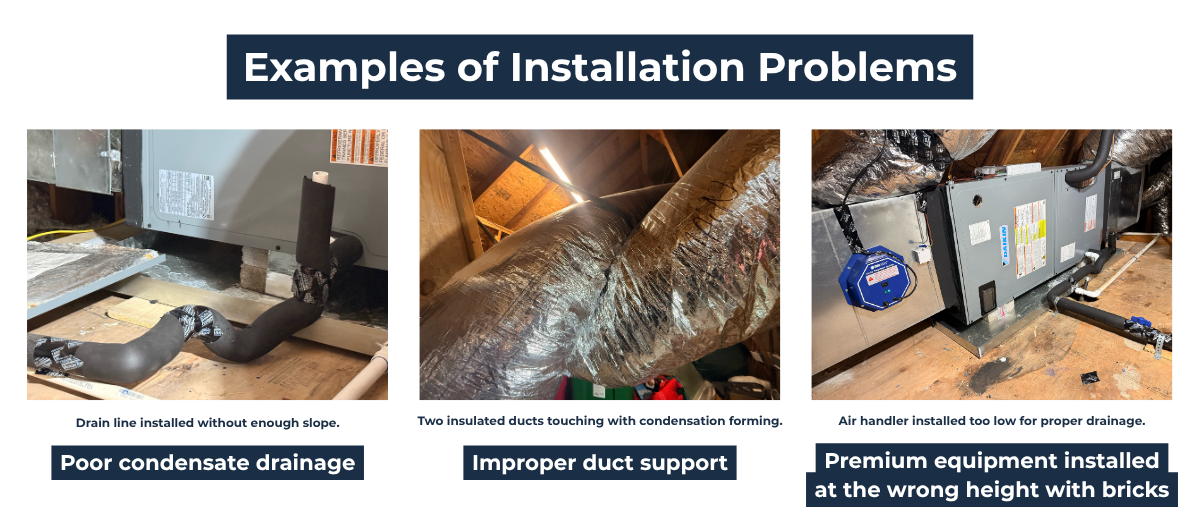
Many HVAC problems begin with installation details that homeowners never see.
Why Does Proper System Design Matter?
Installing the equipment correctly is only part of the job. The system also has to be the right fit for your home.
Two homes can have the same square footage and need different HVAC systems.
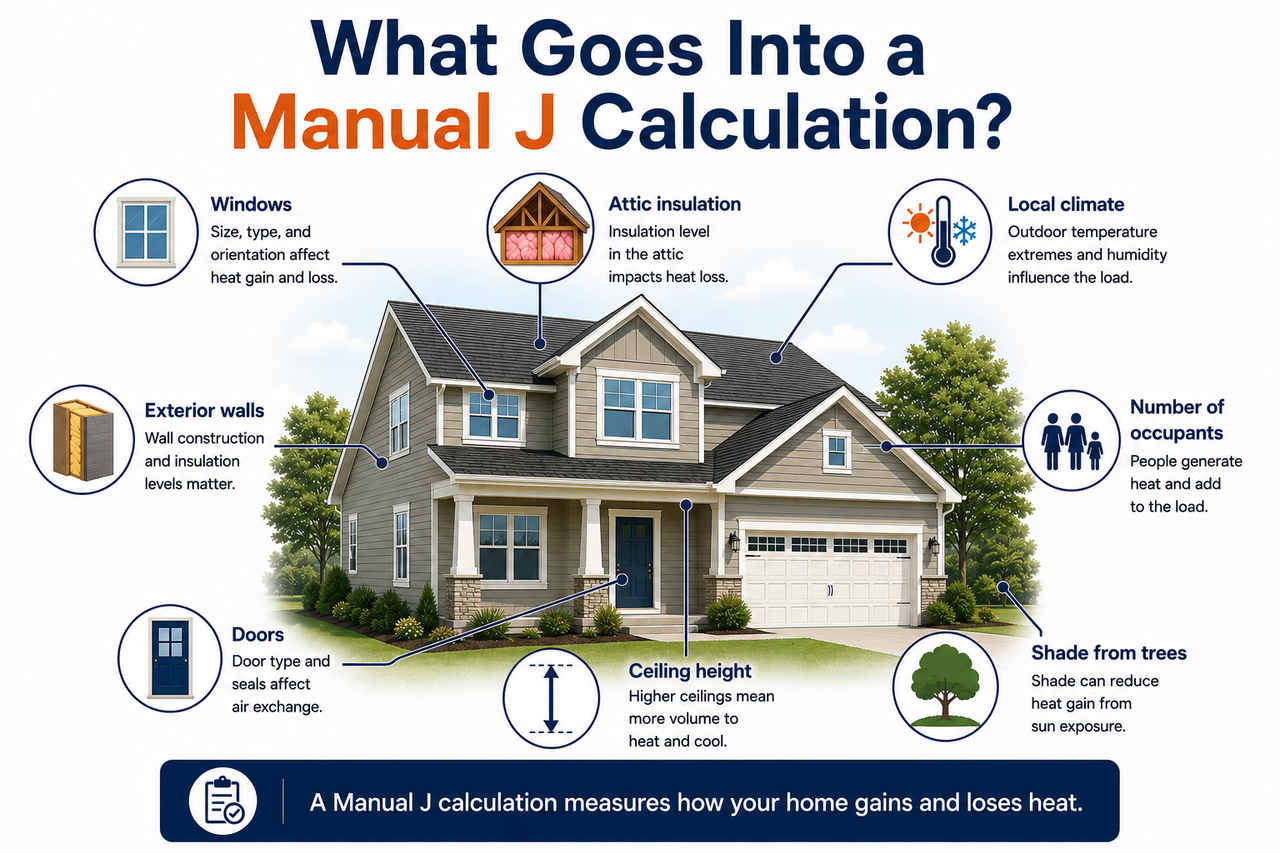
Windows, insulation, ceiling height, shade, and air leaks all affect how much heating and cooling a home needs.
That's why reputable contractors perform a Manual J load calculation. A Manual J is the industry standard for choosing the right size HVAC system for a home. Consumer Reports, ENERGY STAR, and ACCA all recommend using one instead of relying on square footage alone.
If you'd like to learn more about how HVAC systems are sized, read 7 Signs Your HVAC System Is the Wrong Size (Houston Homeowners Guide)
What Is an AHRI-Matched System?
An AHRI-matched system is an indoor and outdoor unit that has been tested to work together.
Most central air conditioning systems have two main pieces of equipment.
The outdoor unit contains the compressor.
The indoor unit contains the evaporator coil, which removes heat from the air inside your home.
Those pieces are designed to work as a team.
AHRI stands for the Air-Conditioning, Heating, and Refrigeration Institute. The organization tests complete system combinations to make sure they deliver the efficiency ratings the manufacturer advertises.
An AHRI match may also affect warranty coverage, utility rebates, and some tax incentives.
If you're replacing only part of your HVAC system, ask your contractor if the new equipment will create an AHRI-certified match.
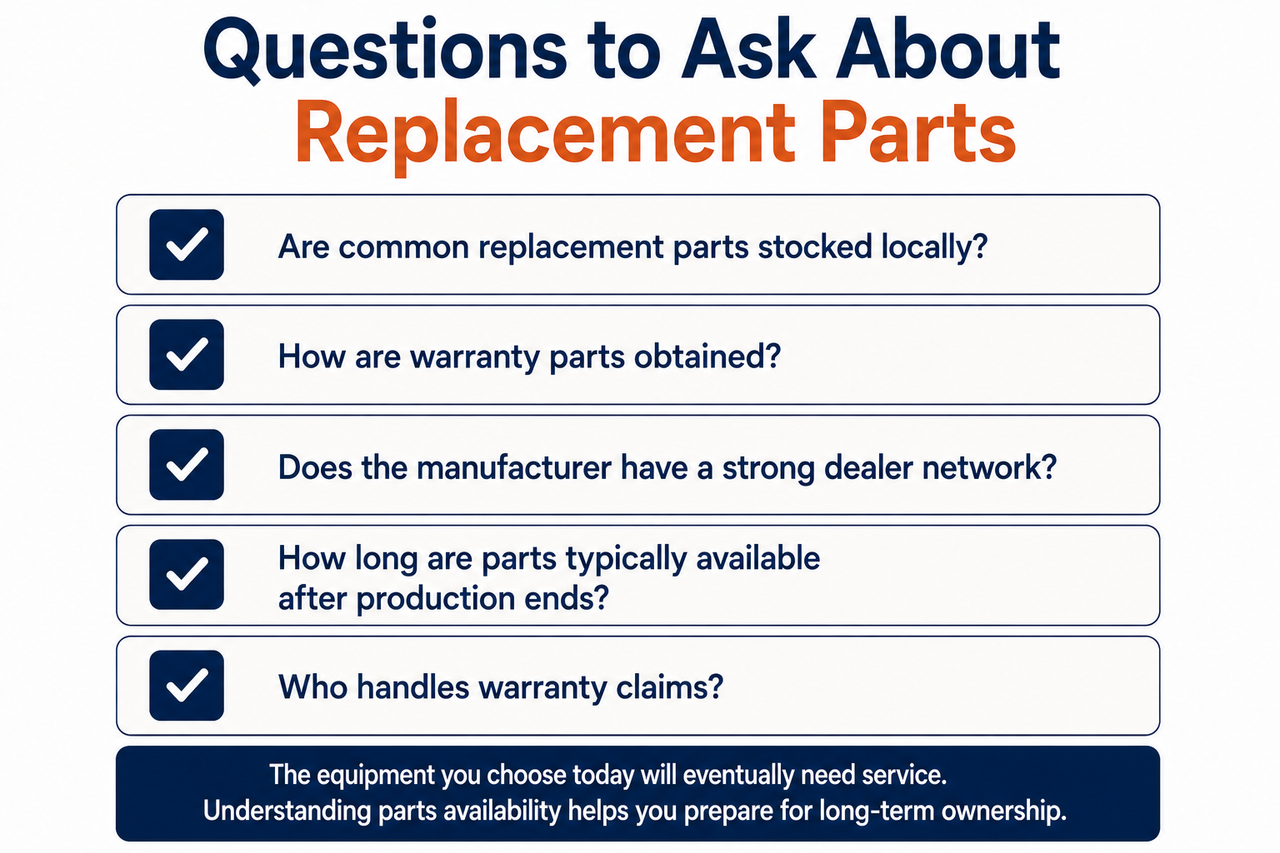
How Easy Is It to Get Replacement Parts?
Every HVAC system will need replacement parts at some point.
When that day comes, getting the right part quickly can make a big difference.
Some manufacturers use parts that are shared across several brands or models.
Others use more proprietary parts. Proprietary means the part was designed for a specific manufacturer or product line and may not be available from as many suppliers.
Because of this repair times and parts availability can vary depending on the equipment you own.
It's also worth remembering that parts availability changes over time.
Manufacturers update product lines.
Supply chains change.
Some parts become easier to find, while others become harder to get.
Before you buy a new system, ask your contractor how warranty parts are handled, whether common replacement parts are stocked locally, and what kind of manufacturer support they receive.
How Are the Major HVAC Brands Generally Positioned?
Most HVAC manufacturers offer premium, mid-tier, and value brands. The brand name gives you a general idea of where the equipment fits in the market.
The table below shows how these brands are generally viewed within the HVAC industry. These categories reflect each brand's overall position in the market, not the quality of every model it makes.
One thing that may surprise you: A premium brand doesn't build only premium equipment.
A value brand doesn't build only basic equipment.
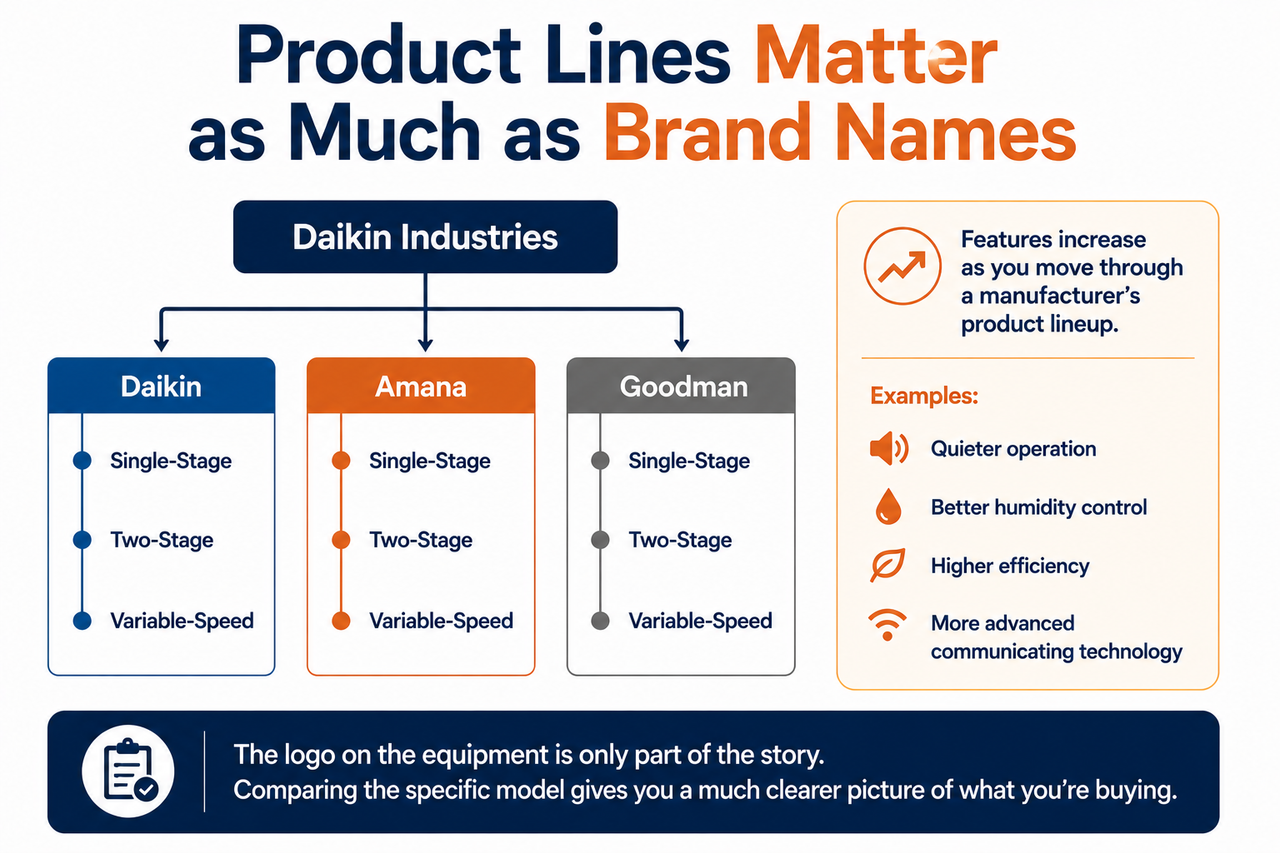
Most manufacturers offer several levels of equipment within each brand.
For example, Goodman offers single-stage, two-stage, and variable-speed systems. Daikin does the same. The same is true for Carrier, Trane, Lennox, Rheem, and most other major manufacturers.
That means comparing only the logo on the equipment doesn't tell you the whole story.
A high-end Goodman may include features that an entry-level unit from a premium brand doesn't have. On the other hand, a top-of-the-line system from a premium brand may offer quieter operation, better humidity control, and more advanced controls than an entry-level model from the same manufacturer.
That's why it's important to compare the specific model you're considering, not just the brand name.
Can You Get a Premium System Without Paying Premium Prices?
Sometimes. But it depends on the equipment, not just the brand.
Most manufacturers build equipment in several price ranges.
For example, they may offer:
- Single-stage systems: The system runs at full capacity whenever it's on. These are usually the most affordable models.
- Two-stage systems: The system can run at a lower speed most of the time and increase its output when needed. This often improves comfort and efficiency.
- Variable-speed systems: The system constantly adjusts its output to match your home's heating or cooling needs. These models usually provide the best comfort, humidity control, and energy savings, but they also cost more.
Because of that, the model you choose can be just as important as the brand.
A homeowner comparing a variable-speed Goodman to an entry-level Trane may find that the Goodman offers features that better match their needs and budget.
Comparing complete systems—not just brand names—gives you a much clearer picture of what you're buying.
Conclusion
Choosing an HVAC system isn't just about picking a brand. It's about understanding everything that comes with that system.
The manufacturer affects the features, technology, warranty, and equipment available to you.
The contractor affects how the system is selected, installed, and maintained.
Many of today's HVAC brands are owned by the same parent companies, but they still serve different parts of the market with different products, features, and price points.
Understanding those relationships makes it easier to compare systems and ask better questions before you buy.
Take time to compare the specific model you're considering, learn what features you're paying for, and choose a contractor you trust to install and service the equipment correctly.
Frequently Asked Questions
Which HVAC brand is the most reliable?
There isn't one brand that's the best for every homeowner. Several manufacturers have strong reputations for reliability. Consumer Reports has also found differences between brands, but it notes that installation quality, maintenance, and the conditions inside each home all affect how a system performs over time. When comparing systems, look at the specific model, not just the brand name.
Is Trane better than Carrier?
Both are widely considered premium manufacturers. Each builds entry-level, mid-range, and high-end systems. The better choice depends on the model you're comparing, the contractor installing it, and the features that matter most to you.
Is Goodman a good HVAC brand?
Yes. Goodman is generally considered Daikin's value-oriented residential brand. It's built by one of the world's largest HVAC manufacturers and is designed to provide dependable heating and cooling at a lower price than Daikin's flagship products. Like any HVAC system, its long-term performance depends on choosing the right model, installing it correctly, and maintaining it over time.
Are Trane and American Standard the same?
Trane and American Standard are owned by Trane Technologies. Many of their residential systems share engineering and internal components, although they're sold under different brand names and through different dealer networks.
Are Carrier and Bryant the same?
Carrier and Bryant are both owned by Carrier Global. Many of their systems share engineering and technology, but they may differ in available models, features, dealer programs, and warranties.
Should I buy the most expensive HVAC system?
Not always. More expensive systems often offer quieter operation, higher efficiency, better humidity control, and more advanced technology. Whether those features are worth the extra cost depends on your home, your budget, and the level of comfort you're looking for.
Should I replace my HVAC system just to get a different brand?
Usually not. If your current system is working well and repair costs are reasonable, replacing it just to switch brands rarely makes financial sense. Age, repair history, efficiency, and the overall condition of the system are usually more important factors.
How long should an HVAC system last?
Most residential HVAC systems last 10 to 15 years in the Houston Climate. How long yours lasts depends on the quality of the installation, regular maintenance, your local climate, and how hard the system has to work.