
Jump to section
Executive Summary
If you only read one part of this article, read this.

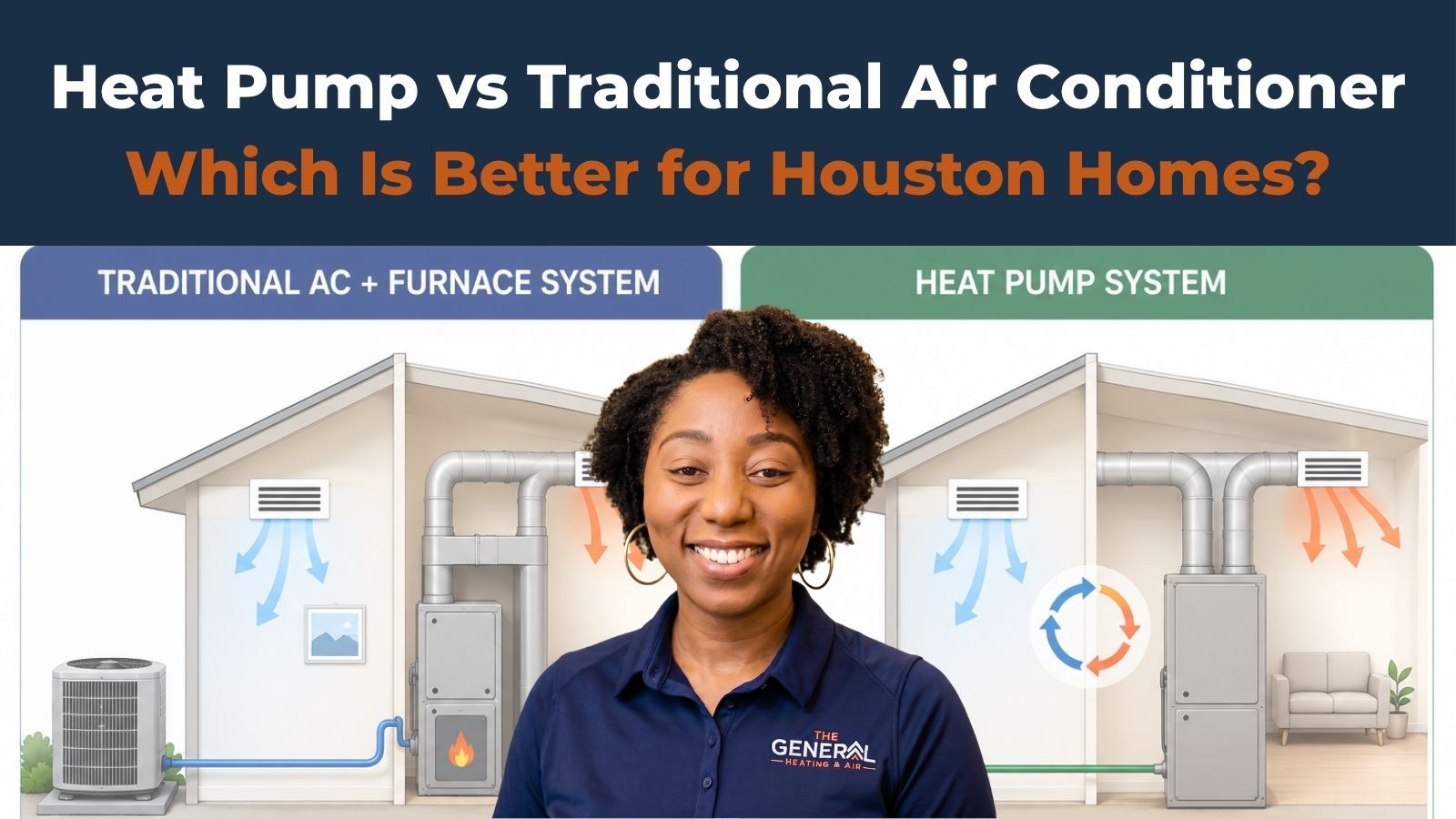
Traditional AC cools only and needs a furnace for heating. A heat pump can cool and heat your home, by moving heat between inside and outside.
A heat pump is the more efficient system. A traditional gas furnace can still make sense depending on your home and your utility costs but both work well here in Houston.
The right choice comes down to your goals, the equipment you already have, and what comfortable feels like to you.
The rest of this guide walks through how each one works, how they handle our humidity, what the 2026 rebates actually are, and how to tell which one fits your home.
Introduction
If you've started researching a new HVAC system, you've probably come across heat pumps.
I remember when my husband first told me, "Heat pumps are the future." I assumed he meant some brand-new, futuristic technology. So I was surprised to learn that heat pumps have been around for decades. That sent me down a rabbit hole, and now I'm sharing what I found with you.
There's a lot of confusion around heat pumps, and that confusion makes it hard to choose well for your home. By the end of this guide, you'll understand where the heat pump came from, why so much of the industry now calls it the future, how the two systems really compare, and how to tell which one fits your home.
What You'll Find in This Guide
- The difference between a heat pump and a traditional AC
- How similar they are during a Houston summer
- Whether heat pumps work well in Houston
- Energy efficiency versus what you actually pay to run it
- How each one handles our humidity
- Repairs, reliability, and power outages
- 2026 rebates and refrigerant changes
- Which system may fit your home
- Frequently asked questions
Heat Pump vs Traditional Air Conditioner: What's the Difference?
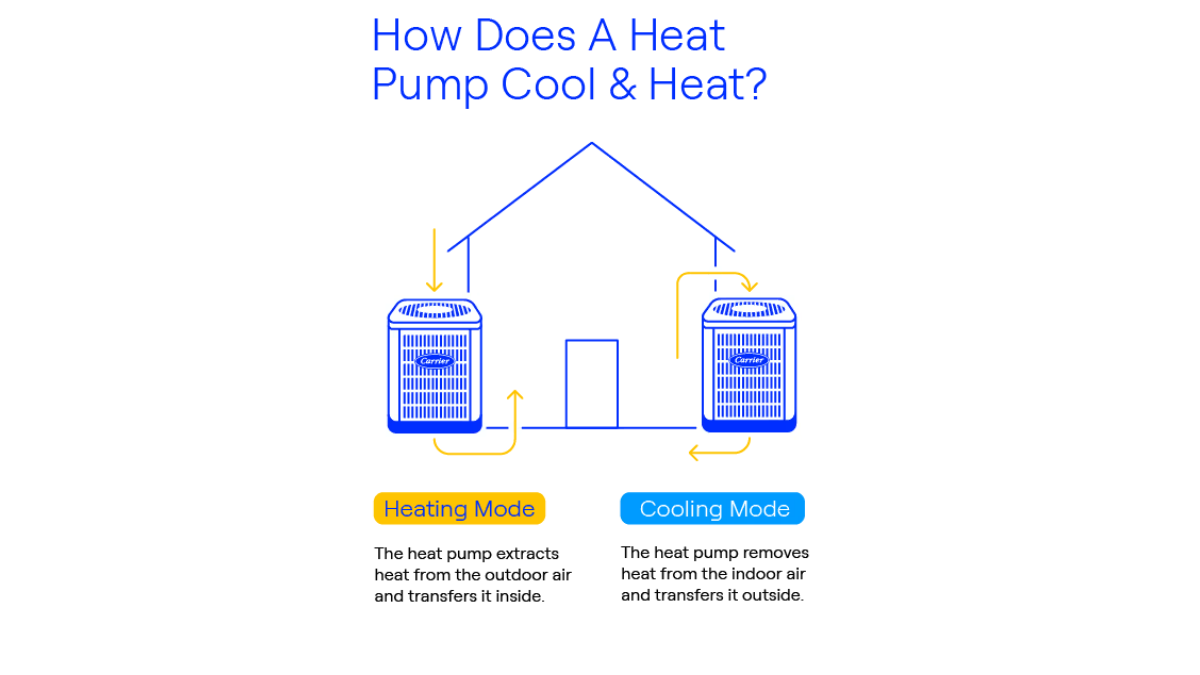
A heat pump is a type of air conditioning system that both cools and heats your home. A traditional air conditioner only cools. It moves warm air out of your home, and it needs a separate furnace to make heat.
The outdoor unit of a heat pump, the condenser, does both jobs. It can pull heat from outside and move it into your home without a furnace burning gas in your attic. It uses the same refrigerant a regular AC uses, just running the cycle in reverse so the heat is released inside instead of outside.
Traditional System
- Air conditioner outside
- Gas furnace inside
Heat Pump System
- Heat pump outside
- Air handler inside
What is a Dual Fuel System?
You may not have to choose between a heat pump and a furnace at all. A dual fuel system pairs both in the same home.
For most of the year, the heat pump handles your heating and cooling. When a cold front pushes temperatures down, the system switches over to the gas furnace. Our Houston winters are usually mild, so the heat pump does most of the work, and the furnace is there for the handful of truly cold days.
Some homeowners like the flexibility. Some like keeping gas heat available as a backup. Sometimes the best fit is both.
Heat Pumps Aren't New
A question I kept asking myself was how I'd never heard of this technology before 2026. It turns out heat pumps aren't new at all.
The first home heat pump was built in the 1940s by accident when an inventor realized his freezer was just moving heat instead of destroying it. So he captured that heat, ran it into his home, and eventually retired his coal furnace altogether.
That's the whole idea behind a heat pump, then and now. It doesn't burn fuel to create warmth from scratch. It moves heat that already exists.
How Similar Are They During Houston Summers?
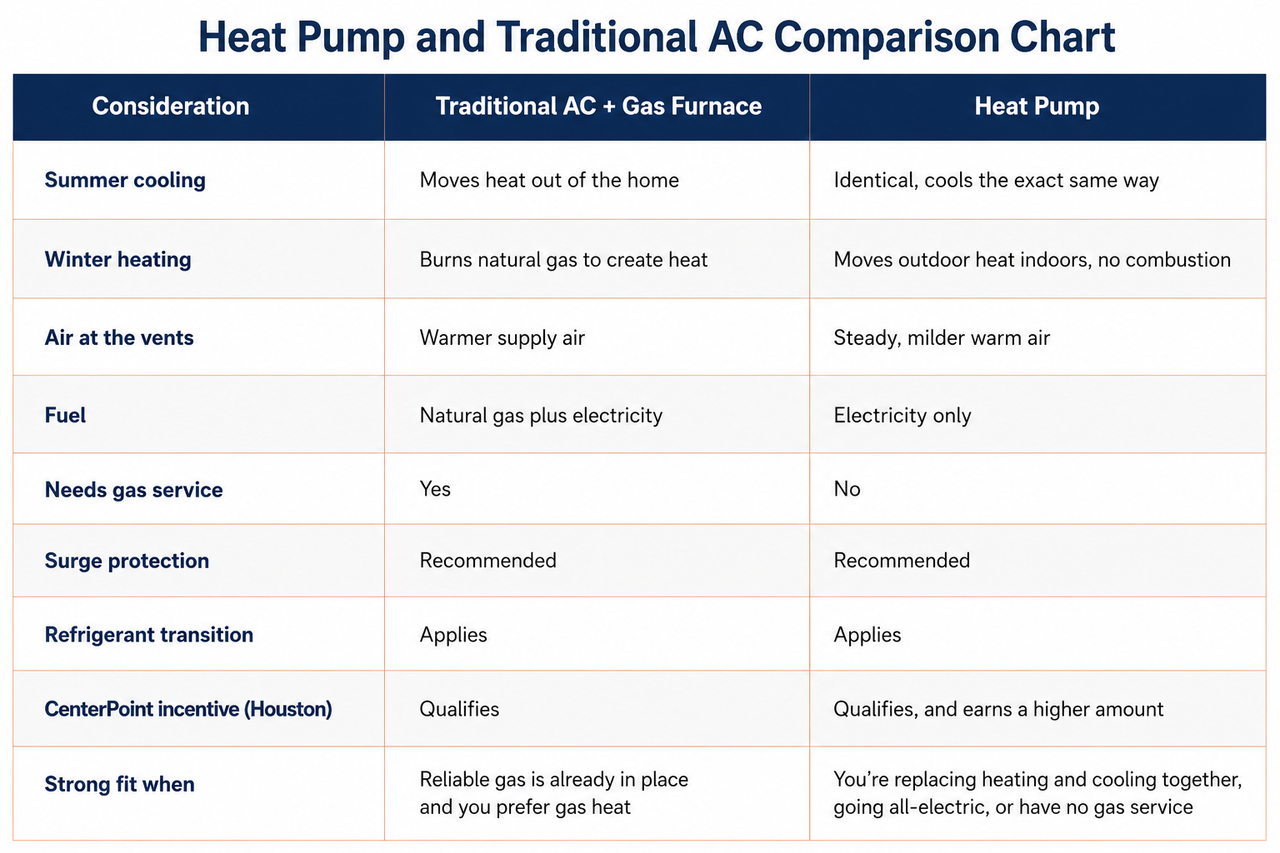
During cooling season, a heat pump and a traditional air conditioner operate almost identically.
When it comes to cooling, these two systems are nearly identical.
A traditional air conditioner removes heat and humidity from inside your home and moves it outdoors using four main parts:
a compressor
a condenser coil
an expansion device
an evaporator coil
A heat pump cools using the exact same process. The only added piece is a reversing valve, which lets it run that cycle in either direction. In summer it moves heat out of your home. In winter it moves heat into your home.
So during our long cooling season, a properly sized heat pump and a properly sized AC will feel the same. Both remove heat, both pull out humidity, and both circulate cool, conditioned air. The differences only show up when it's time to heat.
One more note worth highlighting: modern heat pumps pull usable heat from outdoor air even when it's colder than people expect.
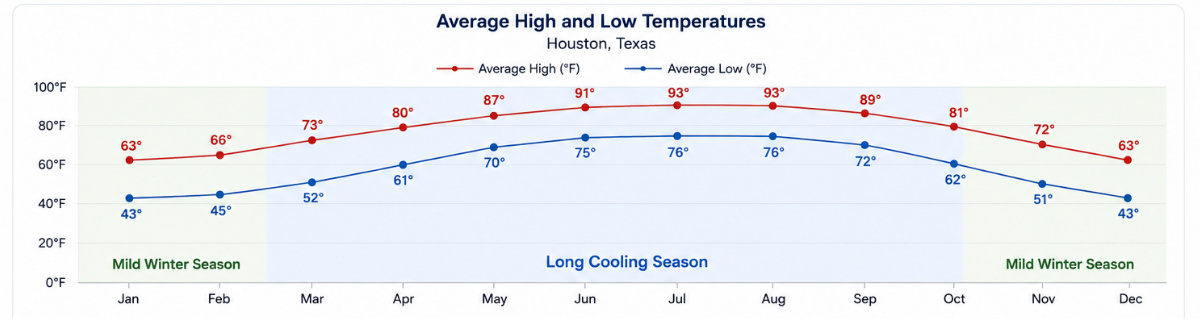
The U.S. Department of Energy notes that today's heat pumps perform far better in cold weather than earlier generations did. And Houston isn't Minneapolis. Our mild winters are one reason heat pumps deserve a serious look here.
Do Heat Pumps Work Well in Houston?
They do! In fact, our climate is one of the strongest arguments in favor of a heat pump.
Why Houston Favors Heat Pumps
Most of our yearly HVAC demand is cooling, and our winters are mild compared with most of the country. That means you spend the majority of the year asking your system to cool, not heat. Heat pumps are excellent in cooling mode and handle our mild heating demand comfortably, which makes them a natural fit for the Gulf Coast.
Why Some Homeowners Still Prefer Gas
Natural gas is still a perfectly good choice for plenty of Houston homes, for a few reasons.
Existing infrastructure.
Many homes already have gas service, a gas furnace, a gas water heater, and a gas range. Staying with gas heat can feel familiar and straightforward.
Warmer supply air.
This is probably the most common reason. When a gas furnace runs, the air coming out of the vents is often noticeably warmer than what a heat pump produces. The home can be equally comfortable either way, but some people simply prefer that warmer air.
Familiarity.
Gas furnaces have been common in Houston homes for decades, and there's nothing wrong with sticking with what you trust.
Energy Efficiency vs Operating Costs
Let's separate two ideas that often get blended together: how efficient a system is, and how much it costs you to run.
Why Heat Pumps Are So Efficient
On efficiency, the heat pump wins, and there isn't much debate.
A gas furnace makes heat by burning fuel, and even the best one can only turn that fuel into roughly the same amount of heat. It can't deliver more energy than the fuel contains.
A heat pump moves heat that already exists, which lets it deliver two to four times more heat energy than the electricity it uses.
That efficiency is why heat pumps keep gaining ground. Efficiency standards continue to rise, manufacturers are investing heavily in the technology, and heat pumps are already installed in roughly four out of every ten new homes built in the United States. When the industry calls heat pumps "the future," that's the direction it's describing.
Does More Efficient Mean Cheaper?
It's natural to assume the more efficient system is always cheaper to run, but that's where Houston adds a wrinkle.
Efficiency is how much heat you get for the energy you put in. Operating cost depends on what that energy costs in the first place, and in Houston, natural gas is cheap. So a gas furnace can be less efficient than a heat pump and still hold its own on your monthly bill, simply because the fuel it burns is inexpensive here.
That's why a heat pump's efficiency edge doesn't always show up as the savings you'd expect.
Houston Utility Cost Reality
Two things drive the cost comparison here:
- Natural gas prices
- Electricity rates
Because Houston sits in a deregulated electricity market, you pick the company that sells you your power. If you heat with a heat pump, the rate you lock in directly affects what it costs to run, and shopping for a competitive fixed rate is one of the simplest ways to keep those costs down.
The honest bottom line: a heat pump is the more efficient system. Whether it's cheaper to operate comes down to Houston gas and electricity prices at the time you're comparing.
Does a Heat Pump Handle Humidity Differently?
In Houston, this matters as much as heating, so let me answer it directly: During the cooling season, a heat pump removes humidity exactly the way a traditional air conditioner does.
What Actually Affects Humidity
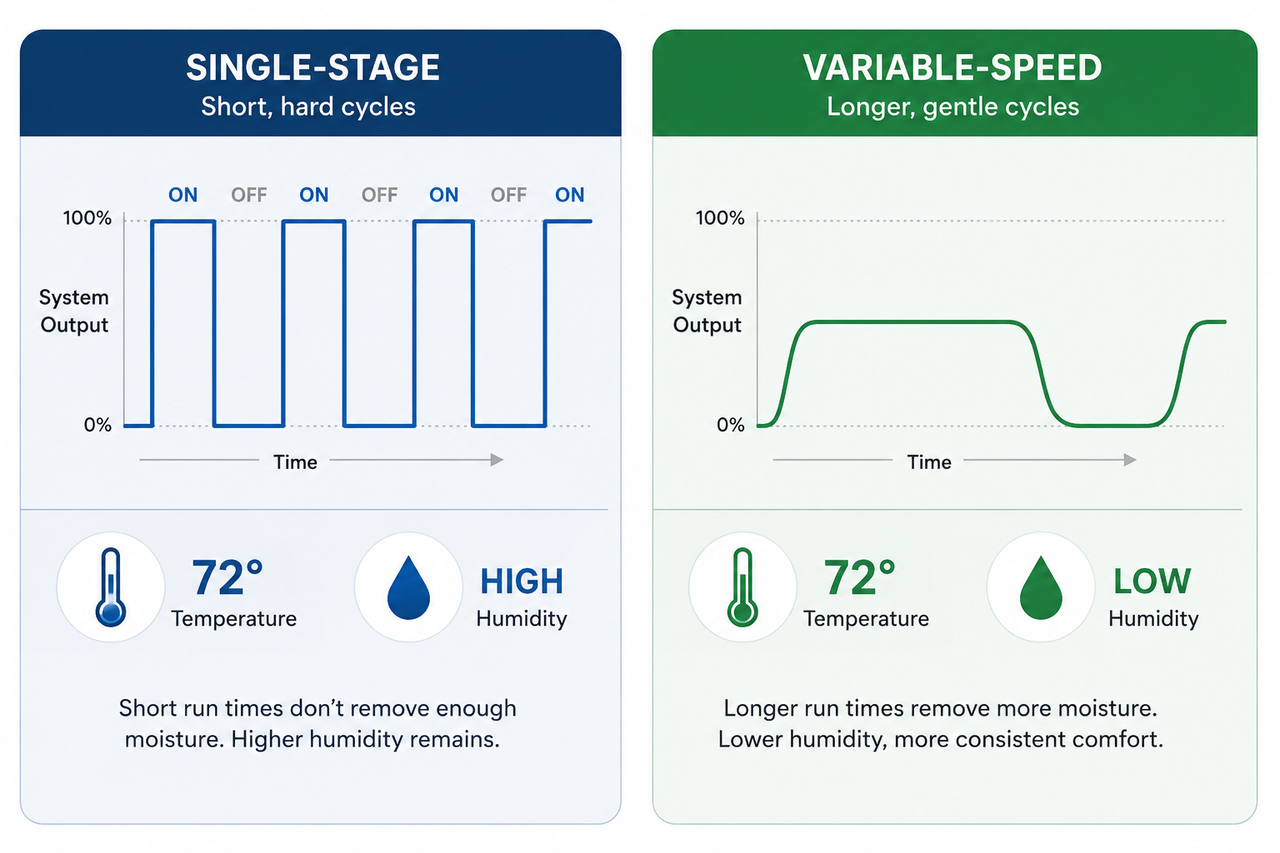
The thing that really changes how a system handles humidity is its staging and how well it's sized.
A single-stage system cools in one hard burst. It hits the thermostat setting fast, shuts off, and doesn't run long enough to pull much moisture out of the air. The house reaches 72 degrees and still feels sticky.
A variable-speed system runs longer at lower output. Those longer, gentler cycles remove far more moisture, which is what makes a home feel genuinely comfortable rather than just cool.
Both heat pumps and traditional air conditioners come in single-stage and variable-speed versions. So the humidity advantage comes from choosing correctly sized, variable-speed equipment, with either technology.
As I explain in Why Your House Feels Humid (and Why It Gets Worse During Allergy Season), temperature and humidity are two separate problems. A house can be 72 degrees and still feel uncomfortable, and a well-designed system has to address both. The equipment has to fit the home, the ductwork has to support it, the installation has to be done right, and sometimes additional dehumidification is needed.

Repairs, Reliability, and Power Outages
These all come down to one thing: what it's like to own the system over the years.
Repairs
Homeowners often ask which system is easier to repair, and it isn't a clear-cut answer. Modern equipment of every type is getting more sophisticated. Both traditional systems and heat pumps can include variable-speed compressors, inverter technology, advanced control boards, and smart thermostats.
As a rule, the more sophisticated the equipment, the more installation quality matters.
That's why I encourage you to spend as much time evaluating the contractor as the equipment.
A great system installed poorly rarely performs well, and a properly installed system often performs better than you'd expect. Our guide How to Choose the Right HVAC Company in Cypress and Katy walks through what to look for.
Power outages
This is one of the most practical questions Houston homeowners ask, especially after freezes, hurricanes, and summer storms. Because heat pumps are all-electric, some people worry they're more vulnerable in an outage. The reality is more even than that. Traditional air conditioners and gas furnaces both need electricity.
Even though the furnace burns gas, the blower motor, controls, igniter, safety systems, and thermostat all run on electrical power. Without electricity, a modern gas furnace won't run normally either.
So create your backup plan: a whole-home generator, portable generator compatibility, surge protection, and your electrical infrastructure.
Surge protection
This one applies no matter which system you choose. Modern HVAC systems carry increasingly sophisticated electronics: inverter boards, variable-speed motors, smart thermostats, communication boards, and compressor controls. All of them can be vulnerable to voltage spikes, surges, and lightning.
In the Houston area, where thunderstorms are common and power interruptions aren't unusual, surge protection has become a worthwhile part of HVAC ownership. I think of it the way many homeowners think of insurance. You hope you never need it, and you're glad it's there.
The right type depends on your electrical system and equipment, and it's a good thing to talk through during a replacement consultation.
Rebates and Refrigerants
Both of these are current industry changes worth understanding before you buy.
Current Houston Incentives
For several years, the federal government offered a tax credit of up to $2,000 for a qualifying heat pump.
That credit ended on December 31, 2025, so a heat pump installed in 2026 no longer qualifies for it.
Texas has no state income tax, so there's no state-level credit either.
There is, however, one real and current benefit in the Houston area, and it favors the more efficient choice. CenterPoint Energy, which delivers electricity across the Houston area, offers an energy-efficiency incentive on qualifying high-efficiency heating and cooling equipment.
The incentive pays more for a qualifying heat pump than for a comparable air conditioner.
Depending on the size and efficiency of the system, it can range from several hundred to well over a thousand dollars. The General participates in this program, so the incentive is applied directly to qualifying projects. You can see current details on our Rebates and Incentives page.
Refrigerant Changes
If you've researched systems recently, you've probably seen terms like R-410A, R-32, and A2L refrigerants. Beginning in 2025, new residential HVAC equipment started moving toward refrigerants with lower global warming potential as part of federal regulatory changes. One of the most common refrigerants going forward is R-32.
The takeaway: the refrigerant transition affects traditional air conditioners and heat pumps equally, so it's happening whichever technology you choose.
Which System Is Better for Your Home?
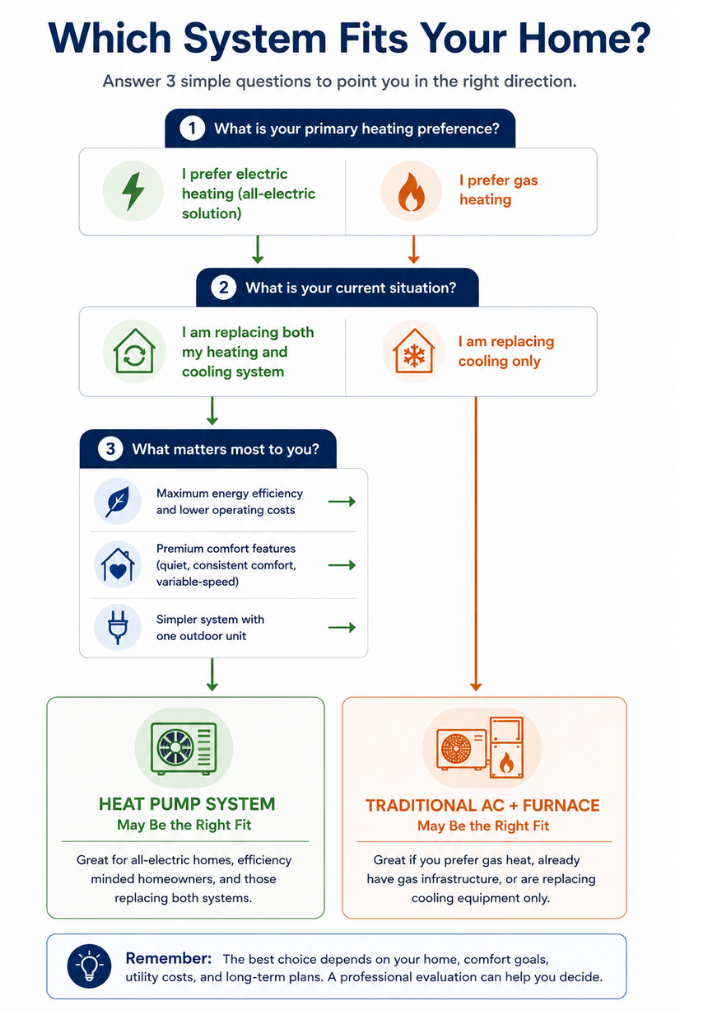
The honest answer is that neither is universally better. Houston's climate lets both perform well when they're properly designed and installed. The right choice depends on your home's construction, existing infrastructure, comfort goals, budget, ownership timeline, and preferences.
A Heat Pump May Be a Good Fit If...
- You want one system for both heating and cooling
- You're replacing your heating and cooling equipment at the same time
- You value energy efficiency
- You prefer an all-electric home
- You plan to stay in your home for many years
- You want premium comfort features like variable-capacity operation
- Your home has no natural gas service, since one outdoor unit handles both jobs
A Traditional AC and Furnace May Be a Good Fit If...
- Your home already has reliable natural gas infrastructure
- You prefer the feel of gas heat
- You want to keep an existing furnace
- Your project involves cooling equipment only
- Simplicity and familiarity are your priority
These are all good reasons. What matters most to you is rarely the technology itself. It's comfort, reliability, cost, indoor humidity, repair risk, and how the system holds up over the years. The equipment is just the tool for getting there.
My Recommendation
If you're considering a replacement, start with one question: what problem am I trying to solve?
For some homeowners, it's lower energy use. For others, it's humidity control, or replacing aging equipment before it fails, or finally making the upstairs comfortable enough for the kids to sleep. Once that's clear, the equipment recommendation becomes clear too. That's why I begin with a conversation and a complete evaluation of your home before making any recommendation.
The Bottom Line
Heat pumps and traditional air conditioners are more alike than they seem.
- Both cool your home
- Both can be reliable
- Both are affected by refrigerant changes
- Both require electricity
The biggest difference is how they heat your home. For some homeowners, that makes a heat pump the obvious choice. For others, a traditional air conditioner and furnace is the better fit. The goal isn't choosing the newest technology. It's choosing the right technology for your home.
If you're in Cypress, Katy, or West Houston and weighing your options, a conversation about your needs and a proper evaluation of your home will show you what your current system is actually doing and lay out clear options before you invest in equipment you'll own for the next 10 to 20 years.
Veteran-owned. Family-run. Dr. Mom approved.
Frequently Asked Questions
Are heat pumps a new technology?
No. The first home heat pump was built in the late 1940s. What's changed recently is efficiency, reliability, and how well modern equipment performs across a range of climates.
Do heat pumps work in Houston?
Yes. Houston's mild winters and long cooling season make heat pumps a strong option for many homeowners.
Does a heat pump remove humidity as well as a regular AC?
In cooling mode, a heat pump dehumidifies exactly like a traditional air conditioner. The bigger factor in how humid a home feels is whether the equipment is single-stage or variable-speed, and whether it's correctly sized. Both technologies are available with variable-speed operation.
Is there a heat pump tax credit in 2026?
No. The federal heat pump tax credit ended December 31, 2025, so a system installed in 2026 doesn't qualify, and Texas has no state income tax credit. There is still a CenterPoint Energy utility incentive on qualifying high-efficiency equipment, applied through a participating contractor. Incentives change regularly, so always verify which ones are current.
Does CenterPoint offer a rebate on a heat pump in Houston?
Yes. CenterPoint Energy offers an energy-efficiency incentive on qualifying high-efficiency systems, and it pays more for a qualifying heat pump than for a comparable air conditioner. The General participates in the program and applies it to qualifying projects.
Will a heat pump keep my house warm in winter?
Modern heat pumps provide reliable heating through Houston winters. You can also add backup heating with electric strips or a gas furnace in a dual fuel setup.
What happens if the power goes out?
Both heat pumps and modern gas furnaces rely on electricity. Without backup power, neither operates normally during an outage.
Can a heat pump work with a gas furnace?
Yes. A dual fuel system pairs a heat pump with a gas furnace. In milder weather, the heat pump provides heating; when temperatures drop, the system switches to the furnace. Dual fuel setups offer flexibility.
Are heat pumps more expensive to repair?
Not necessarily. Repair costs depend on the specific equipment, warranty status, installation quality, and the component involved.
Does the refrigerant transition affect heat pumps only?
No. It affects traditional air conditioners and heat pumps equally.